
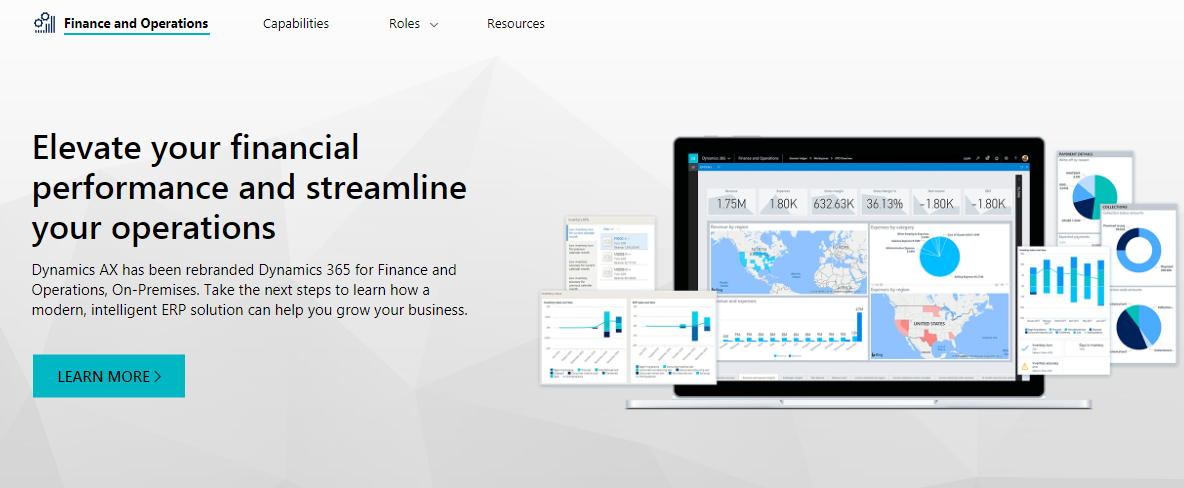
Microsoft Dynamics AX was a major enterprise ERP platform used by organizations for finance, supply chain, manufacturing, retail and operations. Today, AX is a legacy product family and its capabilities have evolved into the modern Dynamics 365 finance and operations applications.
What Was Microsoft Dynamics AX?
Dynamics AX, previously known as Axapta, was Microsoft’s enterprise resource planning platform. It supported complex organizations with capabilities spanning financial management, supply chain, manufacturing, human resources and other enterprise operations.
What Happened to Dynamics AX?
Microsoft transitioned the AX product line into Dynamics 365 cloud and finance and operations applications. Organizations evaluating modernization should therefore distinguish historical AX terminology from the current Dynamics 365 product architecture.
Dynamics AX vs. Modern Dynamics 365
| Area | Dynamics AX | Modern Dynamics 365 |
|---|---|---|
| Positioning | Legacy enterprise ERP | Modern cloud-oriented business applications |
| Customization | Legacy model and modifications | Modern extension and application architecture |
| Updates | Legacy version lifecycle | Regular Microsoft release waves |
| AI | Not designed around today’s Copilot/agent model | Increasing AI and agent capabilities |
| Cloud | Depends on AX version/deployment | Strong SaaS and cloud capabilities |
Where Did AX Functionality Move?
AX-related ERP capabilities are now represented primarily across Dynamics 365 Finance and Dynamics 365 Supply Chain Management, with other workloads covering areas such as commerce and human resources.
Microsoft’s 2026 Finance release plan highlights investments in global-scale finance, agent-driven automation, financial operations and Globalization Studio. citeturn0search0
Why Modernize an AX Environment?
- Move toward a current supported application platform
- Reduce legacy technical debt
- Improve cloud and integration capabilities
- Access modern analytics and AI capabilities
- Support changing regulatory and localization requirements
- Improve maintainability and upgradeability
AX to Dynamics 365 Migration Considerations
- Identify the exact AX version and deployment model.
- Inventory customizations, integrations and reports.
- Map current processes to standard Dynamics 365 functionality.
- Assess data quality and historical-data requirements.
- Determine which customizations should be redesigned or retired.
- Build and test a migration approach.
- Complete business-user acceptance testing.
- Plan cutover and post-go-live support.
Common AX Modernization Risks
- Assuming all AX customizations can move unchanged
- Ignoring data quality
- Underestimating integrations
- Recreating unnecessary legacy processes
- Insufficient testing
- Choosing a target application without process analysis
What Is New in Dynamics 365 Finance in 2026?
Microsoft’s 2026 release wave 1 focuses on business performance, core financials, global operations and agentic automation. It also includes investments in regulatory capabilities and Globalization Studio. citeturn0search0turn0search4
Frequently Asked Questions
Is Dynamics AX still a current Microsoft ERP?
No. AX is a legacy product generation. Organizations running AX should evaluate the appropriate current Dynamics 365 application based on their business requirements.
Is Dynamics 365 Finance the same as AX?
Dynamics 365 Finance is part of the modern evolution of Microsoft’s enterprise finance and operations applications, but it is not simply an unchanged AX product with a new name.
Can AX be migrated to Dynamics 365?
Migration options depend heavily on the AX version, customizations, data, integrations and target application. A technical assessment is required before choosing the migration path.
Final Takeaway
For organizations still using Dynamics AX, the important question in 2026 is how to modernize the existing ERP environment rather than how to continue extending a legacy platform. A structured assessment can determine the right Dynamics 365 target and migration strategy.
