
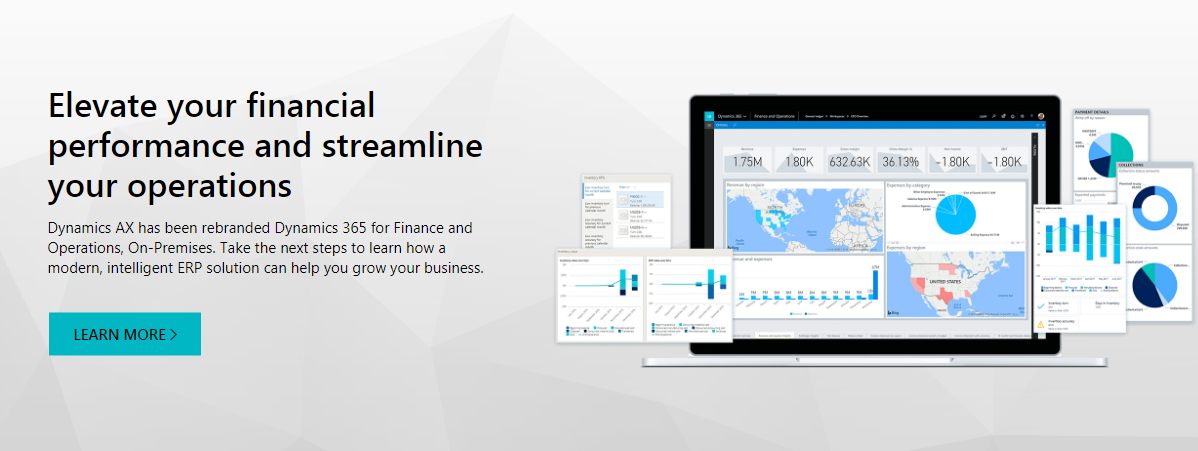
Microsoft Dynamics AX has a long history in enterprise resource planning. What began as Axapta evolved through several major releases before Microsoft moved the product family into the cloud-based Dynamics 365 finance and operations ecosystem.
For organizations still running Dynamics AX, this history matters because AX is now a legacy platform. Microsoft lists Dynamics AX 2012 as having reached the end of extended support in 2022, while AX 2012 R3 reached the end of extended support in January 2023. Current Microsoft migration guidance points customers toward Dynamics 365 finance and operations apps.
Microsoft Dynamics AX Evolution Timeline
| Era | Product | Why It Matters |
|---|---|---|
| 1998 | Axapta | Enterprise business application that established the product lineage |
| 2006 | Dynamics AX 4.0 | Expanded enterprise ERP capabilities and web services |
| 2008 | Dynamics AX 2009 | Broader global and industry capabilities |
| 2011 | Dynamics AX 2012 | Major ERP platform release for global organizations |
| 2016 | Dynamics AX 7 | Browser-based architecture and major platform modernization |
| 2017 onward | Dynamics 365 Finance and Operations | Cloud-oriented successor within the Dynamics 365 ecosystem |
From Axapta to Microsoft Dynamics AX
Axapta established the foundation for a business management platform covering finance, trade, logistics, manufacturing, and related enterprise processes. Microsoft later brought the product into the Dynamics family and continued expanding its capabilities for larger and more complex organizations.
Dynamics AX 4.0
Dynamics AX 4.0 expanded the platform’s enterprise capabilities and introduced improvements around integration and web services. It strengthened AX as a broader ERP platform rather than a collection of isolated business applications.
Dynamics AX 2009
Dynamics AX 2009 continued the product’s expansion into global business operations. Organizations could use the platform for financial management, supply chain, manufacturing, and other core processes while supporting international operations.
Dynamics AX 2012
Dynamics AX 2012 became a major release for medium and large enterprises, with stronger industry capabilities, global functionality, and support for complex organizational structures. It was widely adopted across manufacturing, distribution, retail, services, and other industries.
However, AX 2012 is no longer a current supported ERP platform. Microsoft lists the extended support end date for Dynamics AX 2012 as April 2022, and AX 2012 R3 reached the end of extended support in January 2023.
Dynamics AX 7 and the Move to the Cloud
Dynamics AX 7 represented a major architectural shift toward a browser-based experience. Microsoft subsequently moved the product into the Dynamics 365 family, with Dynamics 365 Finance and Supply Chain Management becoming the modern cloud-oriented path for many enterprise workloads.
What Replaced Dynamics AX?
There is not a single one-to-one replacement for every AX workload. Microsoft now provides finance and operations applications such as Dynamics 365 Finance and Dynamics 365 Supply Chain Management, along with other Dynamics 365 applications for specific business needs.
Microsoft’s current migration guidance states that organizations on Dynamics AX 2012 can use an upgrade path to finance and operations apps, with supported upgrade scenarios for AX 2012 R2 and R3. Microsoft also provides a data migration tool for AX 2009 scenarios. citeturn0search1
Why the AX to Dynamics 365 Transition Matters
- Support: Legacy AX versions have reached the end of their Microsoft support lifecycle.
- Cloud capabilities: Dynamics 365 provides cloud-based deployment options and a continuously updated platform.
- Integration: Modern Dynamics 365 applications connect with the wider Microsoft ecosystem.
- Automation and AI: Current finance and operations apps continue to add automation and AI capabilities.
- Business agility: Organizations can modernize processes instead of simply carrying forward legacy customizations.
What Should an AX Customer Do in 2026?
Organizations still operating Dynamics AX should treat modernization as a business and technology program rather than a simple software upgrade. Start by assessing the current AX version, customizations, integrations, reports, data quality, business processes, and compliance requirements.
Next, determine which workloads should move to Dynamics 365 Finance, Supply Chain Management, or another appropriate application. Microsoft recommends using its migration and code-upgrade guidance to assess the technical path. citeturn0search13
Frequently Asked Questions
Is Microsoft Dynamics AX still supported?
No. The major Dynamics AX releases have reached the end of their Microsoft support lifecycles. AX 2012 ended extended support in 2022 and AX 2012 R3 ended extended support in 2023.
What is Dynamics AX called today?
Dynamics AX is a legacy product family. Its modern enterprise finance and operations path is represented by Dynamics 365 applications such as Dynamics 365 Finance and Dynamics 365 Supply Chain Management.
Can AX 2012 be migrated to Dynamics 365?
Yes. Microsoft provides migration and upgrade guidance for supported AX scenarios, including AX 2012 R2 and R3. citeturn0search1
Conclusion
The Dynamics AX story is a progression from Axapta to a mature enterprise ERP platform and finally to the Dynamics 365 cloud ecosystem. For businesses still running AX, the important question in 2026 is no longer which AX version to adopt. It is how to plan a controlled move to the modern finance and operations platform while protecting data, integrations, business continuity, and the value of existing processes.
