

IT services companies need more from CRM than a contact database and opportunity board. Sales teams manage long buying cycles, multiple stakeholders, service portfolios, renewals, expansion opportunities and handoffs to delivery. A CRM that cannot connect commercial commitments with project and service operations can create gaps between what was sold and what the delivery team is expected to execute.
This guide explains the CRM capabilities to evaluate for IT services providers, MSPs, software development firms, systems integrators and consulting businesses. It focuses on the operating model rather than naming a universal “best” platform.
What makes IT services CRM different?
Many IT services deals are account-led and solution-based. One customer may have several opportunities across cloud migration, managed services, cybersecurity, ERP implementation, application development and support. The CRM needs to preserve account history, buying committees, partner relationships, proposals, contract terms and future renewal dates.
Sales qualification should also reflect delivery feasibility. A deal may be commercially attractive but unprofitable if it requires scarce skills, unrealistic timelines or unpriced scope. Connect opportunity qualification to delivery and resource planning before the proposal becomes a commitment.
Core CRM capabilities to evaluate
| Capability | Why it matters | Evaluation test |
|---|---|---|
| Account and stakeholder management | Tracks multiple contacts, roles, relationships and account plans | Can the team map buying committees and subsidiaries? |
| Pipeline and forecasting | Supports long cycles, stages, probability and recurring revenue | Can forecast services, projects, renewals and expansions separately? |
| Proposal and scope management | Connects discovery, estimates, assumptions and commercial approvals | Can delivery review scope before a proposal is approved? |
| Project handoff | Transfers commitments from sales to delivery | Can scope, milestones, risks and assumptions move into PSA/project tools? |
| Renewals and customer success | Reduces missed renewals and identifies expansion opportunities | Can the system surface contract dates, service health and renewal owners? |
| Partner and channel management | Tracks referrals, co-selling and subcontracting relationships | Can source, influence and commercial ownership be reported separately? |
CRM vs PSA: where each system belongs
CRM manages the customer relationship and commercial lifecycle: leads, accounts, opportunities, activities, proposals and renewals. Professional services automation (PSA) typically manages project delivery, resource scheduling, time and expenses, project financials, utilization and services billing. Some suites combine parts of these functions, while others integrate specialist applications.
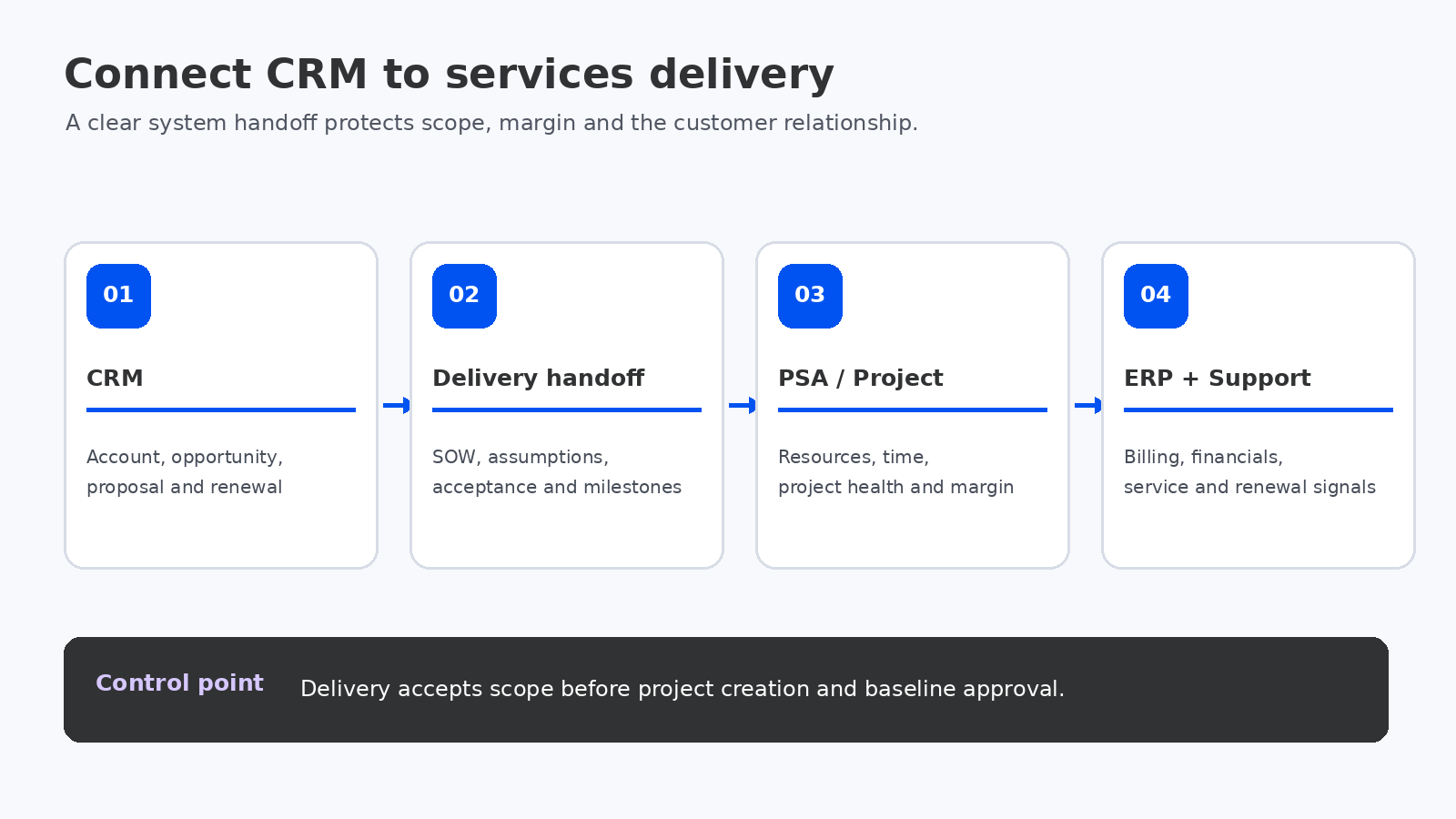
Do not force CRM to become a project accounting system if it lacks the required controls. Define the handoff point and the system of record for customer, contract, project, resource, time and billing data. For project-led firms, evaluate CRM and PSA as a connected architecture.
Integrations to plan
- PSA or project management for project creation, milestones, resource plans and delivery status.
- ERP or finance for contracts, invoicing, revenue, costs and profitability.
- Marketing automation for campaign attribution, lead nurture and consent.
- Support or ITSM for incidents, service health, customer satisfaction and renewal risk.
- Proposal, CPQ and e-signature tools for estimates, approvals and contract execution.
- Business intelligence for pipeline, bookings, utilization, gross margin and customer lifetime value.
Which CRM platforms should IT services firms evaluate?
Shortlist platforms based on the broader technology stack and operating requirements. Salesforce offers a broad CRM ecosystem and extensibility. Microsoft Dynamics 365 Sales is relevant where the organisation uses Microsoft 365, Teams, Power Platform or other Dynamics applications. HubSpot may suit firms that prioritize marketing-to-sales workflows and a comparatively accessible CRM operating model. Other CRM products may fit smaller or specialist teams.
Do not assume that any platform includes a full PSA capability. Verify integrations, marketplace applications, licensing dependencies and support responsibilities. Run a demonstration that covers the complete path from lead to signed statement of work, project setup, delivery health and renewal.
Implementation risks
- Disconnected sales and delivery: the proposal scope and assumptions are not passed to project managers.
- Unreliable forecasting: one-time services, recurring managed services and renewals are mixed together.
- Weak data ownership: account, contact, contract and project records are duplicated across systems.
- Over-customization: bespoke workflows create upgrade and administration burdens.
- Low adoption: consultants and account managers do not see useful value in updating CRM records.
Buyer checklist
- Map the sales lifecycle, service lines and renewal motions.
- Define CRM vs PSA vs ERP ownership for each data object.
- Identify required integrations and data synchronization rules.
- Build role-based requirements for sales, account management, delivery and leadership.
- Test a live scenario from first meeting to proposal, project handoff and renewal.
- Compare subscription, implementation, integration and administration costs over three years.
See our guides to B2B CRM platforms, CRM lead scoring and routing and ERP for professional services.
Design the handoff from opportunity to delivery
The most expensive CRM failure in a services firm often happens after the deal is marked closed-won. Sales may have promised a delivery date, named skills, response times, integrations or outcomes that were never translated into a delivery plan. The project manager then reconstructs the scope from email threads and proposal documents.
Define a mandatory handoff record containing the signed statement of work, scope boundaries, assumptions, exclusions, acceptance criteria, milestones, commercial model, named customer stakeholders, dependencies, risks and commitments made during sales. Decide which fields transfer automatically to the PSA or project system and which require a delivery review before project creation.
Do not treat the CRM as the source of truth for project cost or resource availability unless the selected platform and connected modules genuinely provide those controls. Establish ownership: CRM for customer and opportunity data, PSA for resource and project execution, ERP for financial posting and billing, and ITSM or support for service incidents—subject to the architecture selected.
Build a services-specific pipeline
A generic pipeline can hide meaningful differences between a fixed-price implementation, time-and-materials engagement, managed services contract, recurring subscription and staff augmentation assignment. Create opportunity types or product/service lines that support separate forecasting and margin assumptions.
At minimum, capture:
- Service line and delivery model, including one-time versus recurring revenue.
- Estimated delivery effort, required skills, subcontractor use and resource constraints.
- Expected start date, duration, dependencies and customer readiness.
- Commercial structure: fixed fee, milestone, time and materials, retainer or recurring subscription.
- Gross margin assumptions and approval threshold for discounting or delivery risk.
- Renewal, expansion and cross-sell dates for ongoing accounts.
This makes pipeline reviews more useful. Leadership can distinguish a large but low-margin opportunity from a smaller recurring contract with stronger retention potential.
Account growth and customer health
Services firms often grow through existing accounts: additional projects, cloud or security services, support retainers, new geographies and technology refreshes. CRM should show the relationship across business units and stakeholders, not just a list of individual deals.
Connect customer success signals where available: open escalations, SLA performance, project health, adoption, invoice disputes, renewal dates and executive engagement. Avoid creating a simplistic health score without defining the data and ownership behind it. A red status should trigger an accountable action, not merely appear on a dashboard.
Choose the right CRM architecture
Shortlist platforms against your current technology landscape, user scale and process complexity. Salesforce can be considered where a broad CRM ecosystem and specialist extensions are important. Dynamics 365 Sales is relevant where Microsoft 365, Teams, Power Platform and Dynamics applications are part of the operating environment. HubSpot may suit firms seeking connected marketing and sales workflows with a lighter administration model. These are shortlist hypotheses; verify the exact capabilities, editions and integration costs.
For project-led service firms, assess PSA integration as a first-class requirement. Test how opportunities create projects, how project status updates account teams, how time and expenses affect margin reporting, and how renewals or change requests return to the commercial pipeline. A connector that only synchronizes customer names is not an end-to-end integration.
Reporting that improves commercial decisions
| Metric | Why leadership needs it | Definition to agree |
|---|---|---|
| Qualified pipeline by service line | Shows demand and sales coverage | Stage criteria, probability and expected close date |
| Bookings versus revenue | Separates signed contract value from recognized revenue | Contract value, booking date and finance recognition rules |
| Win rate by source and service | Identifies effective channels and offers | Won opportunities divided by a consistent closed-opportunity cohort |
| Sales-to-start cycle | Highlights delays between signature and delivery | Signed date to approved project start date |
| Renewal and expansion rate | Measures account retention and growth | Renewed recurring value and expansion value, defined separately |
| Project margin at sale versus actual | Shows whether estimates translate into profitable delivery | Comparable scope, cost basis and margin calculation |
Do not combine bookings, revenue, backlog and pipeline into one “sales” number. They represent different stages and financial meanings. Align CRM dashboards with finance and PSA definitions so leaders can trust the figures.
Implementation roadmap for a services business
- Process discovery: map lead-to-opportunity, proposal approval, closed-won handoff, project execution, support and renewal.
- Data design: define account hierarchy, contacts, service catalogue, contract records, project links and data owners.
- Minimum viable configuration: implement pipeline stages, required fields, role security, approval rules and core dashboards before adding complex automation.
- Integrations: connect PSA, ERP, marketing, support and proposal tools using documented ownership and error handling.
- Migration and testing: cleanse accounts and contacts, map open opportunities, reconcile key records and run role-based UAT.
- Adoption and governance: train sellers and delivery leads, appoint data owners and review pipeline quality and user feedback after launch.
Questions to ask a CRM implementation partner
- Which IT services or professional services firms have you implemented CRM for, and can we speak with a reference?
- How will you connect CRM to our PSA and finance systems?
- How will the solution preserve proposal scope and assumptions at project handoff?
- How will recurring services, renewals and project-based revenue be forecast separately?
- What is standard configuration versus custom code, and who maintains it?
- What adoption and data-quality measures will be tracked after go-live?
Bottom line: the right CRM for an IT services company is the commercial front end of a connected operating model. It should help the firm qualify profitable work, transfer commitments cleanly, protect customer relationships and identify renewals and expansion opportunities. Select it with delivery and finance teams in the room—not sales leadership alone.
Conclusion
The right CRM for an IT services company connects pipeline, account growth and customer commitments with delivery operations. Evaluate the CRM and PSA architecture together, make handoffs explicit and test the full customer lifecycle. The goal is better forecast quality, fewer sales-to-delivery surprises and more predictable renewals—not simply more activity logged in the CRM.
