
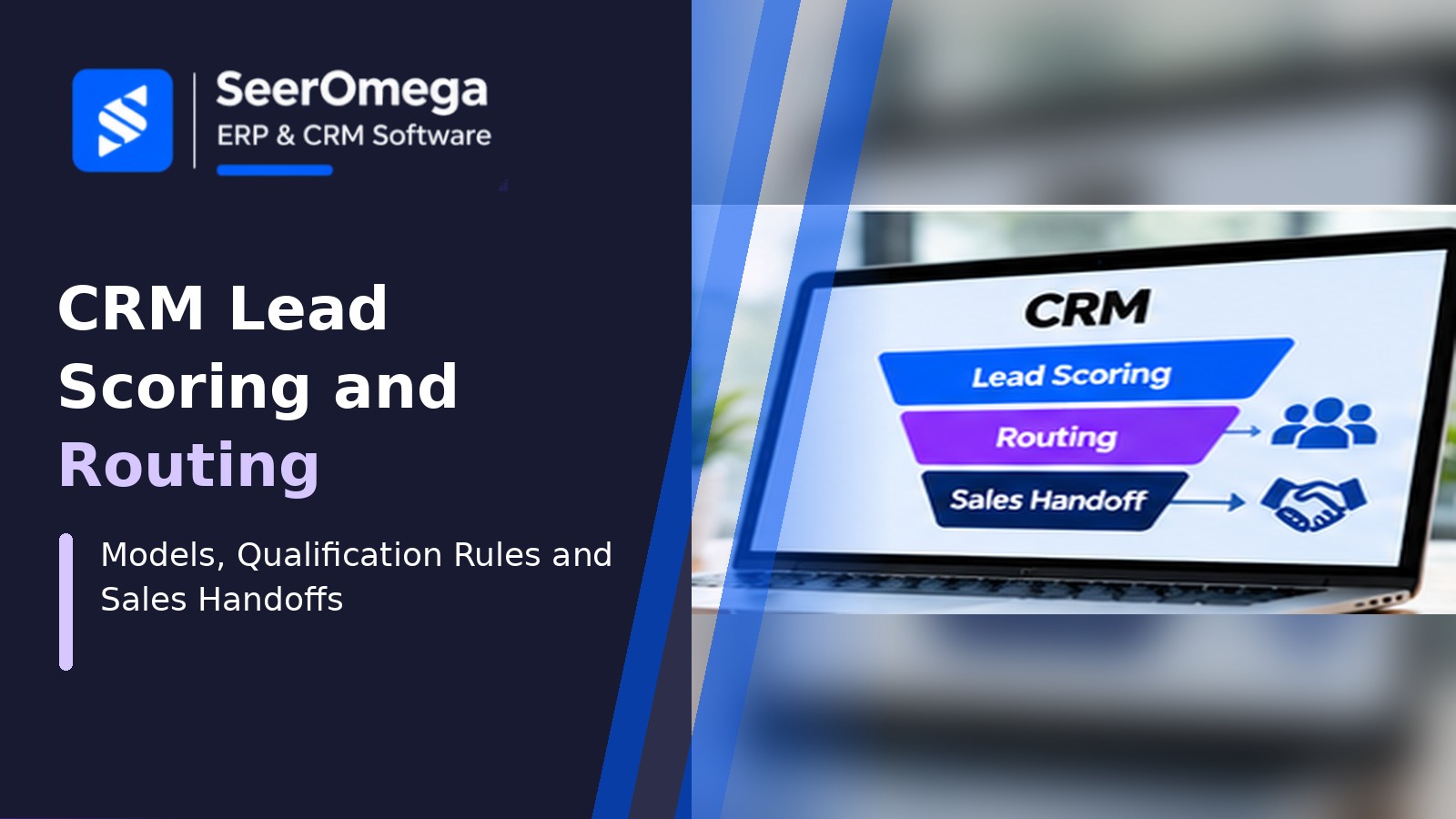
CRM lead scoring is useful only when it improves the next sales action. A high score that does not reflect buying fit, genuine intent or sales capacity creates noise; a routing rule that sends a qualified lead to the wrong owner wastes the opportunity. The objective is to prioritise accounts and contacts consistently, assign them to the right team and measure whether the process creates more qualified pipeline.
This guide explains how to design lead scoring and routing for B2B organisations, including fit and intent models, qualification thresholds, ownership rules, response-time agreements, CRM automation and ongoing model governance.
What lead scoring should decide
Separate three decisions that are often combined into one score:
- Fit: Does the organisation or contact match the target customer profile, including industry, size, geography, technology environment and use case?
- Intent: Is there evidence that the account is researching or actively evaluating a relevant solution?
- Readiness: Has the prospect taken an action that justifies a sales conversation now, and are the required qualification details available?
Engagement is not automatically intent. A person may open several emails because of curiosity or internal sharing, while an account with fewer interactions may have a clear project, budget and buying timeline. Keep the signals visible so representatives understand why a lead was prioritised.
Build the scoring model around fit, intent and engagement
1. Fit scoring
Fit scoring estimates whether a lead belongs in the organisation’s addressable market. Use attributes that have a demonstrated relationship with customer outcomes rather than fields that are simply easy to collect.
| Fit dimension | Possible signal | Scoring consideration |
|---|---|---|
| Industry | Target vertical or regulated sector | Weight based on proven conversion and delivery capability |
| Company size | Employee range, revenue band or operating scale | Use ranges aligned to product and service economics |
| Geography | Supported country or sales territory | Apply coverage and compliance constraints |
| Role | Economic buyer, process owner, technical evaluator or user | Distinguish decision influence from seniority alone |
| Technology environment | Existing ERP, CRM or cloud stack | Score only when it affects solution fit or implementation feasibility |
| Business need | Known process problem or relevant use case | Prioritise specific problems over generic interest |
2. Intent scoring
Intent signals indicate an active problem or evaluation. First-party actions such as a pricing enquiry, implementation consultation request, demo request or detailed product comparison are usually stronger than a single content view. Third-party intent data can add account-level context, but should be treated as a signal to investigate rather than proof that an individual is ready to buy.
3. Engagement scoring
Engagement measures interactions with the organisation: event attendance, webinar participation, email response, return visits, content consumption and sales conversations. Apply recency and frequency controls. Repeated low-value activity should not outweigh a direct request for a consultation.
Use negative scoring and decay rules
A reliable model also reduces scores when evidence suggests a poor fit or a lower likelihood of purchase. Examples include unsupported geography, student or job-seeker activity, invalid contact information, competitor domains, unsubscribed contacts or a prospect explicitly indicating that no project is planned.
Use time decay for signals that lose relevance. A pricing-page visit from yesterday may matter more than a webinar registration from six months ago. Do not let a historic burst of engagement keep a record permanently above the sales threshold.
Set qualification thresholds that trigger clear actions
Do not use arbitrary labels such as hot, warm and cold unless each label has an operational definition. A practical model can have separate thresholds for marketing nurture, sales review and immediate sales follow-up.
| Stage | Entry condition | Required action |
|---|---|---|
| Nurture | Relevant fit but limited intent or incomplete information | Continue education and collect qualification details |
| Marketing-qualified | Fit threshold met and meaningful engagement or intent observed | Validate data and route for sales acceptance review |
| Sales-accepted | Sales confirms ownership and agrees the lead merits follow-up | Start the agreed response SLA and record disposition |
| Sales-qualified opportunity | Problem, stakeholders, next step and commercial potential are sufficiently understood | Create or associate an opportunity and follow the sales process |
Scoring should recommend a workflow, not replace a conversation. Sales teams need a way to reject or recycle leads with a reason code so marketing operations can learn from the outcomes.
Design lead routing rules
Routing should follow the commercial operating model. Common assignment dimensions include:
- Territory: country, region, state or named account coverage.
- Account ownership: route contacts and new enquiries to the existing account owner where appropriate.
- Product or service: assign by solution expertise or specialist sales team.
- Company segment: enterprise, mid-market, SMB or strategic accounts.
- Partner channel: route partner-originated opportunities according to agreed channel rules.
- Capacity: use round-robin or queue assignment only after territory and account rules are applied.
Define precedence. For example, an existing strategic account owner should usually take priority over a generic round-robin rule. Include fallback queues for missing territory, unknown company size, unavailable owners and duplicate records.
Agree sales response SLAs and recycling rules
A lead-routing workflow is incomplete without ownership and response expectations. Define when the SLA clock starts, which business hours apply, how attempts are recorded and what happens if the owner does not respond.
Specify:
- Target response time by enquiry type and priority.
- Minimum number and type of contact attempts before recycling.
- Rules for reassignment when an owner is absent or leaves the business.
- Disposition reasons such as invalid, duplicate, no project, not a fit or future timing.
- Conditions for returning a lead to nurture and the events that can reactivate it.
- Escalation path for high-value enquiries that remain unassigned.
CRM automation and data requirements
Before automating, make sure the CRM has the fields and controls required to explain each decision. Store score components separately from the total, record the scoring-model version, preserve the reason for routing and log assignment changes. Integrations with marketing automation should use stable record identifiers and clear lifecycle definitions.
Test the full journey: form submission, duplicate detection, account matching, score calculation, territory resolution, assignment, notification, sales acceptance, opportunity creation and recycle. Include missing data, conflicting ownership, repeated form submissions and integration outages.
Measure whether scoring improves revenue outcomes
| KPI | What it tells you |
|---|---|
| Lead-to-sales acceptance rate | Whether marketing qualification matches sales expectations |
| Time to first meaningful response | Whether routing and ownership are fast enough |
| Accepted lead-to-opportunity rate | Whether prioritised leads become real pipeline |
| Opportunity win rate by score band | Whether higher scores correlate with commercial outcomes |
| False-positive and false-negative rates | Whether the model over-prioritises or misses good prospects |
| Unassigned and recycled lead ageing | Whether the operating process leaves demand unattended |
| Pipeline and revenue by source | Whether scoring contributes to outcomes, not just activity |
Review the model monthly during rollout and at least quarterly after it stabilises. Compare score bands with actual opportunity and revenue outcomes, check for bias across segments and adjust weights only when the data supports a change.
Implementation checklist
- Document the target customer profile and disqualifying conditions.
- Define fit, intent, engagement, negative signals and decay.
- Set lifecycle stages and thresholds with sales and marketing leaders.
- Agree routing precedence, territory ownership and fallback queues.
- Set response SLAs, recycle rules and disposition reasons.
- Configure score explanations, model versioning and audit history.
- Test duplicates, missing data, reassignment and integration failures.
- Monitor acceptance, opportunity conversion, speed and revenue outcomes.
Final guidance
Effective CRM lead scoring is a governed prioritisation process, not a points contest. Start with a small set of explainable signals, align thresholds with sales capacity, route using clear ownership rules and measure opportunity quality. Expand the model only when outcome data demonstrates that additional complexity improves decisions.
For the wider operating model, read SeerOmega’s guides to CRM integration with marketing automation, CRM pipeline reporting and sales forecasting and CRM data migration.
