

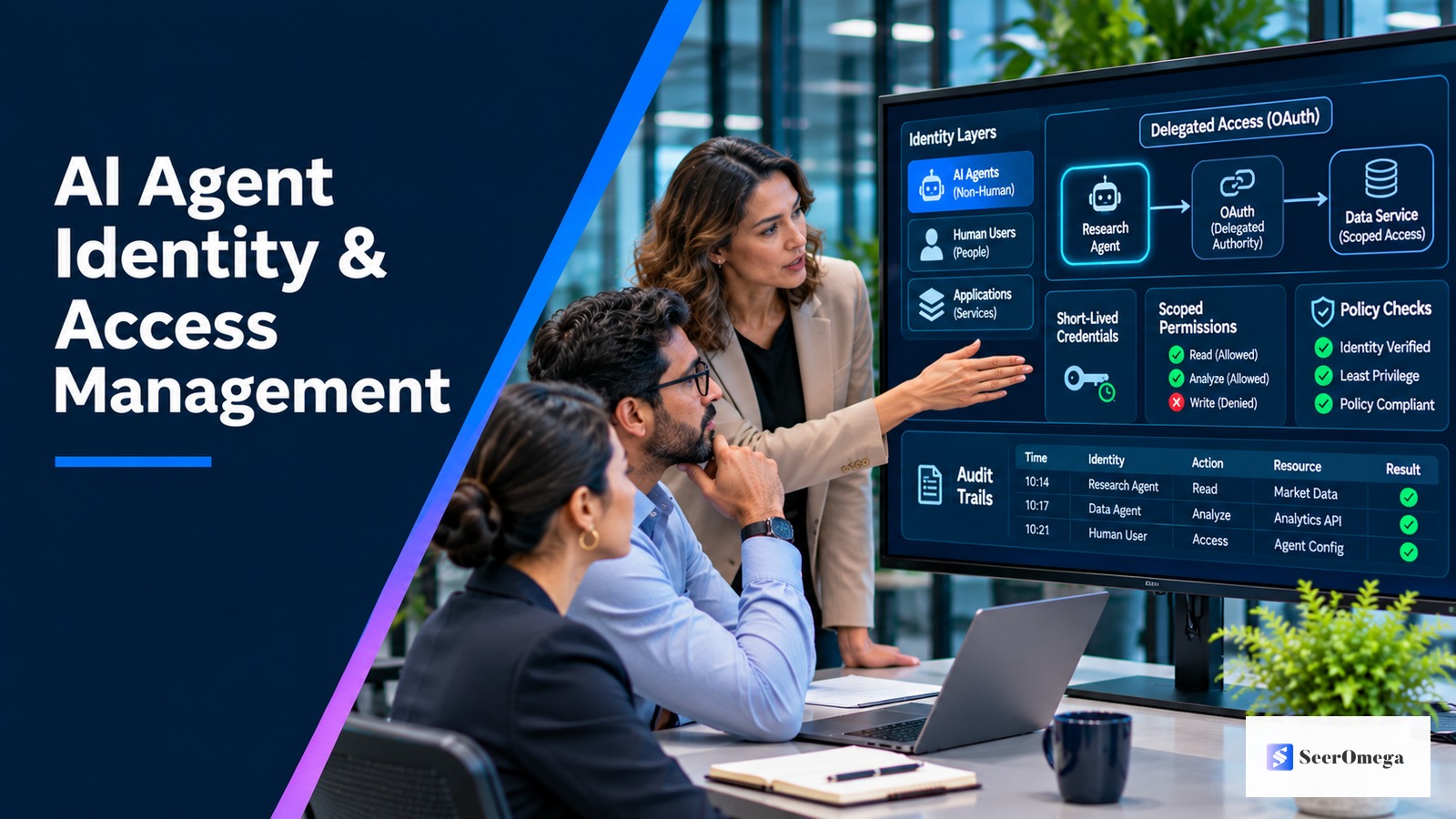
Enterprise AI agents need identities that systems can recognize, authorize and audit. A deployed agent may retrieve internal records, call APIs, create tickets, update business data or delegate work to another agent. If it uses a developer’s personal token or a shared service account, an organization can struggle to determine which agent acted, what authority it had and who approved the task.
AI agent identity and access management (IAM) extends established identity principles to software that can reason, invoke tools and act with varying degrees of autonomy. The objective is not to give every agent broad access. It is to give each workload a verifiable identity, issue credentials safely, grant only the authority required for a defined task, preserve the link to the initiating user or business owner and make access revocable and auditable.
This guide is for enterprise security, IAM, platform engineering and AI leaders designing those controls. It focuses on identity, authentication, delegation and authorization architecture. It is distinct from a broader agent security programme, agent governance framework or evaluation process. For related guidance, see AI agent readiness, the AI governance framework, SaaS management platforms and AI agent evaluation and testing.
Why AI agents need a distinct identity model
Traditional IAM systems distinguish people, applications, services and devices. Agents complicate the picture because one agent can act autonomously, operate for a user, call several services, spawn sub-agents or continue after the initiating user has left the session. The identity of the human who started a task does not, by itself, describe which software component made a particular API call.
Using a human’s credentials for an agent can blur accountability and give the agent more access than the task requires. Reusing a shared service account creates a similar attribution problem: logs may show which account acted, but not which agent instance or workflow initiated the action. Long-lived API keys can also remain valid after a test, deployment or employee relationship has ended.
NIST’s October 2026 design-tenets article recommends distinct, cryptographically verifiable agent identification, a separate identity and credential lifecycle, and linking agents to the entities that initiate their work. It also discusses delegation and attenuation, so downstream agents or services should not gain broader authority than the parent. These are proposed design tenets, not a universal compliance certification. See NIST’s design tenets for agent identity management systems.
Understand the three identity contexts
A practical architecture separates three related but different identity contexts. They can be represented by different credentials and policy checks, even when a platform manages them together.
| Identity context | What it represents | Key question |
|---|---|---|
| Human or initiating identity | The employee, customer, system owner or business process that requested or authorized the task | Who initiated this work, and were they allowed to request it? |
| Agent identity | The specific agent workload, deployment or agent instance performing the work | Which agent is making this request, and is it trusted? |
| Delegated authority | The limited permissions the agent receives to act on behalf of the initiating user or organization | What may this agent do for this task, against which resources and for how long? |
Google Cloud’s Agent Identity documentation describes a three-identity delegation model: the initiating user, the agent’s own SPIFFE-based identity and a delegated identity used when the agent acts for a consenting user through scoped OAuth credentials. It also describes dual attribution in audit logs. This is Google’s documented implementation model, not a requirement that every enterprise adopt the same product or exact architecture. See Google Cloud Agent Identity overview and identity delegation architecture.
Choose when an agent needs its own identity
Not every AI interaction needs a long-lived agent principal. A model that only drafts text inside an authenticated user’s session may not need the same identity architecture as a background agent that runs on a schedule and changes business records. Choose based on the agent’s lifecycle, autonomy, access and impact.
| Operating pattern | Identity approach to consider | Important boundary |
|---|---|---|
| Session-bound assistant | Authenticate the user and propagate a narrowly scoped user context where appropriate | The assistant must not exceed the user’s permissions or retain access after the session expires |
| Autonomous background agent | Assign a distinct workload or agent identity | Grant only the system permissions required for its approved tasks |
| Agent acting for a user | Combine the agent’s identity with explicit, scoped user delegation | Record both identities and preserve consent, expiry and revocation |
| Multi-agent workflow | Identify each agent or workload and use bounded delegation between them | Sub-agents must not inherit unrestricted parent credentials |
| Third-party or external agent | Use verifiable identity and explicit trust establishment at each organizational boundary | Do not treat a claimed agent name or metadata field as proof of identity |
The CNCF’s cloud-native agentic standards guidance makes a similar distinction: user identity may be sufficient for short-lived tasks tied to an active session, while agents that act autonomously, persist beyond the session or operate outside the user’s permission scope need a distinct identity. See CNCF cloud-native agentic standards.
Build an identity lifecycle for agents
Agents should be managed through a lifecycle, not treated as static API integrations. A complete lifecycle covers creation, registration, ownership, credential issuance, access review, rotation, suspension and retirement.
- Register: create a record for each production agent, including a stable identifier, owner, purpose, environment, model or runtime reference, approved tools and data classification.
- Provision: issue a distinct identity through an approved identity provider, workload identity system or agent identity service. Avoid embedding shared credentials in prompts, source code or configuration files.
- Bind to a workload: where supported, bind identity to an attested runtime, deployment or workload so that an identity cannot be freely copied to another environment.
- Authorize: attach resource-specific permissions and policy conditions that reflect the agent’s approved purpose.
- Monitor and review: record authentication, token issuance, delegation, access decisions and material changes. Review ownership and permissions on a defined schedule.
- Rotate and revoke: expire or rotate credentials, revoke delegated grants and disable access when the agent is paused, compromised, replaced or no longer needed.
- Retire: remove trust relationships, tokens, secrets, tool registrations and residual permissions. Preserve the audit record according to retention policy.
Include development, staging and production as separate identity environments. A test agent should not inherit production credentials, and a production identity should not be used for local experimentation. Record changes to the agent’s model, tools, runtime or purpose because those changes may affect its trust level.
Use workload identity and short-lived credentials
Workload identity provides a way for software to authenticate as a workload rather than relying on a developer’s personal credentials or a long-lived secret stored with the application. Depending on the infrastructure, this may use cloud-native workload identity, SPIFFE/SPIRE, federated identity or a platform-managed identity service.
SPIFFE defines a framework for identifying and securing workloads across heterogeneous environments. SPIFFE IDs can identify a workload within a trust domain, while SPIRE can provide workload attestation and issue SVID credentials. JWT-SVIDs can be used for token-based federation; X.509-SVIDs are commonly used for workload-to-workload authentication with mutual TLS. The exact credential type and trust configuration must match the receiving service’s supported protocol.
OpenAI’s workload identity federation documentation describes exchanging a SPIFFE JWT-SVID for a short-lived OpenAI access token, avoiding long-lived API keys for supported workloads. The documented configuration requires claims such as issuer, audience, expiration, issued-at and a key identifier, along with an appropriate JWKS validation setup. OpenAI’s guide specifically supports JWT-SVIDs for this flow and does not support SPIFFE X.509-SVIDs as the federation subject token. See OpenAI’s SPIFFE workload identity federation guide.
Apply these practices:
- Prefer workload-issued, short-lived credentials over static API keys wherever the target service supports them.
- Use distinct audiences and narrowly scoped token mappings for each destination.
- Validate issuer, audience, expiry, signature and subject before accepting a token.
- Keep private signing keys and refresh tokens out of model context and application logs.
- Use exact identity matching for privileged workloads. Avoid broad wildcard trust unless the full matching scope is intended.
- Define rotation, revocation and emergency disable procedures before deployment.
Design authorization around least privilege
Authentication answers which identity is presenting a credential. Authorization decides what that identity can do. An agent can authenticate successfully and still be denied access to a resource or operation.
Start with task-level permissions rather than broad application roles. For example, an agent that summarizes support tickets may need read access to a specific queue but no permission to close tickets, change account ownership or export customer data. A procurement agent may be allowed to draft a purchase request but not approve or submit a payment.
Translate business tasks into explicit permissions:
| Control dimension | Design question | Example constraint |
|---|---|---|
| Resource | Which records, systems or data sets can the agent reach? | Only tickets assigned to a defined queue |
| Action | Which operations are permitted? | Read and draft, but not submit or delete |
| Scope | Which tenant, user, project or business unit applies? | One tenant and approved project identifiers |
| Context | Under what conditions is access allowed? | Only from an approved runtime and workflow |
| Time | How long does the grant remain valid? | Short-lived token tied to a task or session |
| Approval | Which actions require a human decision? | External send, financial approval or permission change |
Use policy enforcement at the API, resource or tool gateway. A system prompt that tells an agent not to perform an action is not an access control. The receiving service must independently verify that the authenticated principal is authorized for the requested operation.
Implement safe delegation and sub-agent authority
Delegation occurs when an agent acts on behalf of a user, or when one agent passes a task to another agent or service. Delegation should be explicit, scoped and traceable. The downstream component should receive only the authority needed for its part of the workflow.
For user-delegated access, use an established authorization flow such as OAuth 2.0 or OpenID Connect where appropriate. Request only the scopes required for the task, preserve consent and expiration, and provide a way to revoke grants. Do not pass raw user passwords, refresh tokens or unrestricted bearer credentials through the model or agent prompt.
For agent-to-agent delegation, define:
- The parent agent and downstream agent identities.
- The task and resource scope being delegated.
- The maximum authority and duration of the delegation.
- Whether onward delegation is allowed, and under what restrictions.
- The correlation identifier linking parent, child and resulting tool calls.
- The conditions that terminate or revoke the delegated authority.
NIST’s design-tenets guidance calls for agent linking and delegation with attenuation: delegated scopes should narrow as authority passes to downstream agents or services. This helps prevent a child process from acquiring permissions beyond those granted to its parent. See NIST’s agent identity design tenets.
Make identity and authorization auditable
Audit records should answer who initiated a task, which agent performed it, which credential or delegated grant was used, what resource was accessed, what action was attempted and whether the policy allowed or denied it. For multi-agent workflows, records should preserve the parent-child relationship and a shared trace or correlation identifier.
Capture, where appropriate:
- Human initiator and agent principal identifiers.
- Authentication method, token issuer, audience and relevant expiry metadata.
- Delegated scopes, consent or approval reference and grant lifecycle events.
- Resource, operation, policy decision and enforcement point.
- Agent version, runtime or workload identity and environment.
- Parent agent, child agent and tool identity for delegated calls.
- Credential rotation, revocation, access review and administrative changes.
Do not log secret values, raw access tokens or unnecessary personal data. Store enough metadata to reconstruct the authorization decision while applying access controls and retention limits to the audit system itself. Test whether an investigator can distinguish an agent acting under its own authority from an agent acting under a user’s delegated authority.
Connect agent identity to MCP and external tools
Agents often call tools through APIs, connectors or the Model Context Protocol (MCP). Identity must remain meaningful across those boundaries. An MCP client or agent runtime should authenticate to the server using a supported mechanism, and the server should enforce authorization for the requested resource and operation. A tool description or agent instruction is not a substitute for server-side authorization.
For each MCP server or external tool, document its owner, endpoint, authentication method, accepted issuer and audience, scopes, data access, write capabilities and audit behavior. Use separate credentials per environment and tool where practical. Restrict outbound destinations and verify that the token presented to one service cannot be replayed at another. Reassess trust when a server, tool implementation or permission scope changes.
For a deeper treatment of protocol-specific controls, see the planned SeerOmega guide to MCP security for enterprise teams. Agent identity should be one layer in that design, alongside transport security, server authentication, tool authorization and runtime monitoring.
Common agent IAM anti-patterns
- Shared service accounts: multiple agents act under one identity, making attribution and revocation difficult.
- Personal API keys: an agent inherits an employee’s access and can remain usable after the employee’s role changes.
- Long-lived credentials: leaked or forgotten secrets remain valid longer than necessary.
- Overbroad OAuth scopes: an agent receives broad access when a task requires only a small subset.
- Prompt-only restrictions: the model is instructed not to perform an action, but the API does not enforce the rule.
- Unbounded delegation: child agents inherit parent permissions without task-specific narrowing.
- Missing dual attribution: logs identify the user or agent but fail to record both when the agent acts on the user’s behalf.
- Unmanaged lifecycle: agents, tokens and grants remain active after a workflow is retired.
An enterprise implementation checklist
| Workstream | Minimum implementation evidence |
|---|---|
| Inventory and ownership | Agent register with unique ID, business owner, technical owner, purpose, environment and approved tools |
| Authentication | Distinct agent identity and documented trust or workload attestation method |
| Credential management | Short-lived credentials where supported, secure storage, rotation and revocation procedures |
| Authorization | Resource and action scopes, least-privilege policies and server-side enforcement |
| User delegation | Consent, scope, expiry, revocation and dual attribution |
| Agent delegation | Parent-child linkage, bounded scope, duration and onward-delegation rules |
| Audit | Traceable identity, resource, action, policy decision and lifecycle events |
| Operations | Periodic access review, incident response, agent retirement and credential cleanup |
A 30-day starting plan
- Week 1: inventory production and pilot agents. Identify owners, access paths, shared credentials, tools, data classes and autonomous actions.
- Week 2: define the identity model for session-bound, autonomous and user-delegated agents. Select the appropriate identity provider and credential approach for each environment.
- Week 3: implement scoped authorization, server-side enforcement, token expiry, delegation boundaries and audit attribution for one representative workflow.
- Week 4: test access denial, credential expiry, revocation, cross-user isolation and sub-agent scope attenuation. Document operational ownership and rollout gates.
This is a starting sequence, not a fixed delivery estimate. Existing IAM maturity, legacy integrations, regulatory obligations and the number of agent runtimes will affect the implementation effort.
Frequently asked questions
Does every AI agent need its own identity?
Not every session-bound assistant requires a separate persistent principal. Agents that run autonomously, persist beyond a user session, access systems independently or delegate work generally need a distinct workload or agent identity so their actions can be authorized and audited.
Can an AI agent use a user’s permissions?
It can act on a user’s behalf through explicit, scoped delegation where the application and target service support it. The agent should not simply receive the user’s password or unrestricted session token. Preserve consent, scope, expiry, revocation and audit attribution.
What is the difference between agent identity and service account identity?
A service account typically identifies an application or workload. An agent identity model may additionally need to describe the specific agent, its runtime and lifecycle, its relationship to an initiating user, and the authority delegated to it for a particular task. Some platforms build on workload identity standards to provide these capabilities.
Are SPIFFE and OAuth alternatives?
They address different parts of the problem. SPIFFE provides workload identity and attestation concepts, while OAuth is commonly used to grant scoped access to protected resources. An architecture may use workload identity to authenticate an agent and OAuth delegation to authorize access on behalf of a user.
How should organizations secure agent API keys?
Prefer short-lived federated credentials or platform-managed identity where supported. If static secrets are unavoidable, store them in a secrets manager, scope them narrowly, rotate them, restrict which workload can retrieve them and keep them out of prompts, logs and source code.
Build agent access around identity, not assumptions
Enterprise agents need an identity model that can distinguish the human who initiated a task, the software agent performing it and the authority granted for that task. Establish distinct identities for autonomous workloads, use short-lived credentials where supported, enforce least privilege at the resource boundary and preserve traceable delegation across tools and sub-agents.
Start with an inventory of agents and credentials, then pilot the model on one workflow with meaningful access risk. Test not only successful authentication but also denied actions, expired grants, revocation, delegated scope and audit reconstruction. As the agent estate grows, make identity lifecycle and authorization part of the standard deployment process rather than a retrofit after adoption.
