
AI agents are becoming managed participants in business workflows. They can retrieve information, call tools, update records, coordinate other agents and take actions under delegated authority. That makes governance more operational than a conventional AI policy: organizations need to know which agents exist, who is accountable for each one, what each agent is allowed to do, and how those boundaries are reviewed while the agent is running.
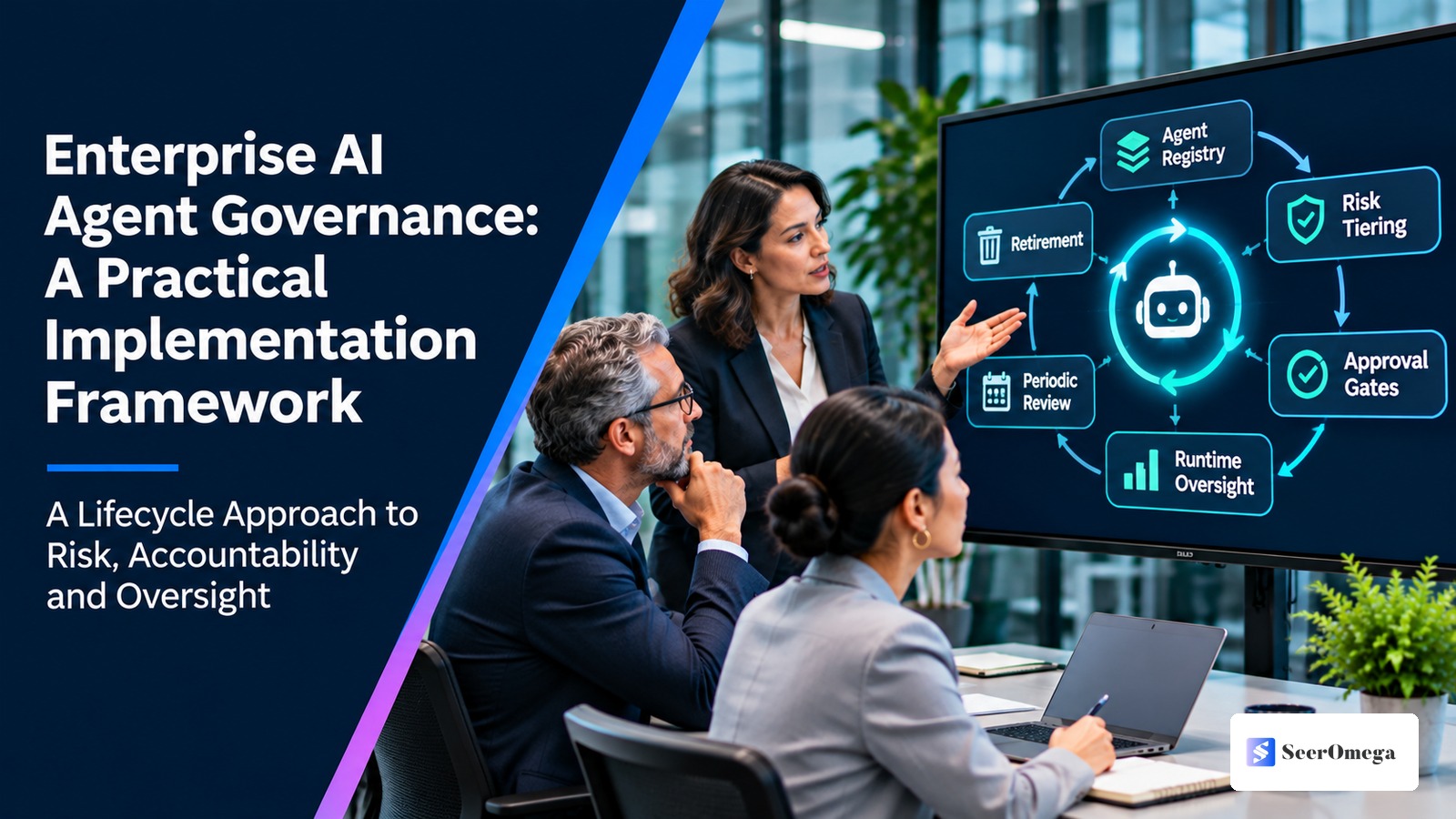
An enterprise AI agent governance framework turns those requirements into a repeatable lifecycle. It connects intake, registration, risk classification, approval, deployment, runtime oversight, change management and retirement. The goal is to let teams move low-risk use cases forward efficiently while applying stronger controls to agents with sensitive data access, broad permissions or consequential autonomy.
This guide focuses on the operating model for governing agents across an enterprise. It is distinct from a general AI governance policy: the emphasis here is on agent inventory, decision rights, autonomy tiers, release gates, runtime enforcement and lifecycle evidence. For the broader organization-wide AI governance foundation, see our AI governance framework for businesses. For assessing whether an individual workflow is suitable for an agent, see our AI agent readiness assessment.
What enterprise AI agent governance must control
Agent governance is the set of organizational rules, responsibilities and enforceable controls that determine how agents are proposed, built or acquired, approved, deployed, monitored, changed and retired. It needs to address more than model behavior. An agent’s risk also depends on its identity, tools, data access, runtime, autonomy, business context and downstream effects.
A practical framework should answer seven questions:
- Which agents are operating, including embedded, third-party, departmental and experimental agents?
- Who owns the business outcome, technical operation and risk acceptance?
- What data, tools, systems and actions are within the agent’s approved scope?
- What level of autonomy is permitted, and which actions require human approval?
- Which technical controls enforce the policy during execution?
- What evidence shows the agent remains within its approved purpose and boundaries?
- When must an agent be reassessed, restricted, suspended or retired?
These questions align with the lifecycle approach in NIST’s voluntary AI Risk Management Framework, which organizes risk management through Govern, Map, Measure and Manage. NIST describes governance as a cross-cutting function that informs the other three. Its AI RMF 1.0 is being revised, so organizations should check the current NIST publications when adopting the framework. See the NIST AI Risk Management Framework and NIST AI RMF Playbook.
1. Establish a federated governance operating model
Central governance should define mandatory enterprise boundaries. Business and platform teams should own the agents they operate within those boundaries. This avoids two common failures: every team inventing different controls, and a central committee becoming a bottleneck for routine low-risk work.
A workable model has three layers:
- Executive oversight: sets risk appetite, approves material exceptions and receives reporting on significant agent risks and incidents.
- Central AI governance function: maintains policy, minimum control standards, risk methodology, the enterprise registry and escalation routes. It coordinates security, privacy, legal, compliance and architecture review.
- Domain and platform owners: sponsor individual agents, validate business purpose, implement technical controls, monitor performance and maintain evidence.
Define decision rights in writing. For example, a business owner may approve the use case and expected outcome, while security approves the identity and access design. A platform owner may authorize deployment only after required approvals and test evidence are complete. High-impact exceptions should go to an explicitly authorized risk owner, not to an informal chat or an agent’s own decision.
Microsoft’s guidance on architecture and governance for AI agents recommends extending existing architecture and governance frameworks, with central functions setting mandatory boundaries and platform or workload teams managing agents within them. This federated model can build on existing cloud, identity, data and risk structures instead of creating a parallel bureaucracy.
2. Create one authoritative agent registry
An organization cannot govern agents it cannot see. The registry should include agents developed internally, acquired from vendors, embedded in SaaS applications, deployed by business units and running as sub-agents. Discovery tools can help identify activity, but discovery is not the same as approval.
Each registry entry should include:
- Unique agent identifier, name, description, version and lifecycle status.
- Business purpose, intended users, process owner and accountable sponsor.
- Technical owner, support team, vendor and hosting platform.
- Model and framework, runtime environment, connected tools and MCP servers.
- Data sources, data classifications, tenant boundaries and retention requirements.
- Identity type, delegated authority, permissions and credential lifecycle.
- Autonomy level, risk tier, permitted actions and required approvals.
- Assessment results, approvals, test evidence, known limitations and review dates.
- Monitoring location, incident contact, suspension method and retirement plan.
Use stable identifiers rather than display names alone. Maintain links between parent agents, sub-agents, tools, service identities and the business process they support. Record embedded agents even when the vendor does not expose every implementation detail. Where discovery reveals an unregistered agent, route it into triage rather than silently treating it as approved.
Microsoft’s enterprise guidance recommends a centralized agent inventory with ownership, purpose, platform and access scope. Its agent governance and security guidance also treats the control plane as a way to apply consistent identity, ownership, access and continuous monitoring across agents.
3. Classify agents by autonomy, access and impact
Risk should be based on what an agent can do and the consequences if it behaves incorrectly, not simply on the model provider or the department using it. Consider at least these dimensions:
- Autonomy: does the agent suggest, draft, execute with confirmation or execute independently?
- Action impact: can it change records, communicate externally, move money, alter access, deploy code or affect safety?
- Data sensitivity: does it access public, internal, confidential, personal, financial or regulated information?
- Reach: how many users, customers, records, systems or business units can it affect?
- Reversibility: can actions be undone reliably, and is there a time window for recovery?
- Dependency risk: does it rely on third-party tools, sub-agents, external data or unverified MCP servers?
- Exposure: is it internal, customer-facing, supplier-facing or accessible to the public?
The following three-tier model is a practical internal starting point. It is an example governance method, not a statutory classification and not a substitute for legal analysis under applicable regulation.
| Tier | Typical agent behavior | Minimum governance route |
|---|---|---|
| Tier 1: Assistive | Summarizes public or approved internal information, drafts content, or helps an individual without taking consequential action | Named owner, approved tools, basic data rules, standard testing and usage monitoring |
| Tier 2: Operational | Retrieves sensitive internal information, creates or updates routine records, or supports a business process with bounded authority | Formal use-case assessment, domain validation, scoped identity, documented permissions, release review and ongoing quality monitoring |
| Tier 3: High impact | Acts externally, changes financial or access records, influences consequential decisions, or operates autonomously across critical systems | Security and privacy review, explicit decision rights, independent approval, stronger testing, runtime policy enforcement, incident plan and periodic executive oversight |
Start an agent in the tier that matches its actual behavior. Move it to a higher tier when new tools, permissions, users, data or autonomy increase its potential impact. Do not let a pilot’s original low-risk classification persist after the agent becomes part of a production workflow.
Microsoft’s risk-based agent governance guidance similarly recommends matching oversight to the agent’s role and impact, rather than applying the same checklist to a meeting summarizer and an agent that can move money. Treat vendor frameworks as useful design references, then adapt the thresholds to your own risk appetite and obligations.
4. Define an autonomy and decision-rights matrix
Risk tiers become operational only when they translate into permitted actions. For each agent, define what it may read, prepare, change, approve or execute. Avoid vague permissions such as “manage customer operations” or “handle finance tasks.” Specify the target systems, record scope, action types, thresholds and exception paths.
| Action class | Example authority | Governance requirement |
|---|---|---|
| Observe | Read approved documents or retrieve permitted records | Source-system access checks, data minimization and audit events |
| Recommend | Suggest a decision or next step | Output validation and clear human accountability for the decision |
| Prepare | Draft a message, transaction or record update | Review before commit, with visible target and proposed changes |
| Execute bounded actions | Update a low-risk field or create a routine ticket | Tool-level policy, limited scope, validation and traceability |
| Execute consequential actions | Issue a refund, change access, send bulk communications or deploy code | Action-specific human approval, independent policy checks and rollback or containment plan |
| Administer or delegate | Grant permissions, create credentials or launch sub-agents | Default deny, separate authorization, short-lived credentials and heightened monitoring |
Human approval must be enforced by the application or orchestration layer, not by asking the model to remember to request permission. Bind approval to the exact tool, target, parameters, user and time window. If any material detail changes, require a new approval. The reviewer needs enough information to understand the action and the ability to reject it.
For high-impact actions, consider separation of duties. An agent may prepare a transaction, but it should not approve its own proposal. A human reviewer should not be pressured to approve an action without seeing the material context, data sources and expected consequence.
5. Turn governance policies into runtime controls
Policies that exist only in documents cannot reliably constrain an agent during execution. Translate the approved scope into controls at identity providers, tool gateways, orchestration layers, data platforms and target applications.
Core controls include:
- Unique agent identity: assign an attributable identity to each production agent and preserve the initiating human identity where delegation is used.
- Least privilege: grant only the tools, data and actions required for the approved task.
- Short-lived credentials: scope credentials to the target resource and operation, and revoke them when the task or agent is suspended.
- Tool allowlists: expose only reviewed tools and validate their schemas and downstream effects.
- Action policy: evaluate identity, operation, target, parameters, risk and approval immediately before execution.
- Data boundaries: enforce source permissions, tenant separation, retention and output controls.
- Runtime containment: restrict filesystem, network, code execution, memory, time, concurrency and resource use.
- Emergency intervention: provide a tested way to pause the agent, block tool access and revoke credentials.
Microsoft’s secure agentic systems guidance describes explicit action schemas, least-privilege access, deterministic human approval for high-risk actions and tool allowlists as application-layer controls. The Canadian Centre for Cyber Security also recommends continuous runtime authentication, monitoring of identity and privilege changes, and human approval for high-impact actions. See Microsoft’s secure agentic systems guidance and the Canadian Centre for Cyber Security guidance.
6. Establish lifecycle approval gates
Use explicit gates to make sure that the right evidence exists before an agent moves to the next lifecycle stage. The depth of review should depend on the risk tier.
- Intake and triage: record the business problem, sponsor, intended users, proposed platform and expected value. Check whether an existing approved agent or conventional automation already meets the need.
- Registration: create the registry entry and identify the business owner, technical owner, data sources, tools, model and runtime.
- Risk assessment: classify autonomy, data sensitivity, action impact, exposure, reversibility and regulatory context. Assign the tier and mandatory reviewers.
- Design review: approve identity, access, data boundaries, action policy, human checkpoints, observability, supplier dependencies and fallback design.
- Pre-production validation: test expected tasks, edge cases, unauthorized actions, prompt injection, data leakage, failure handling and performance. Document limitations and residual risk.
- Production authorization: obtain sign-off from the people authorized for the business, technical, security, privacy and compliance decisions required by the tier.
- Operational acceptance: confirm support ownership, alerts, service expectations, incident playbooks, rollback and review cadence.
- Periodic and event-driven review: reassess on a defined schedule and whenever a material change or incident occurs.
- Retirement: disable identities, revoke credentials, remove integrations, handle stored data and records, and update the registry.
Do not use a single approval date as permanent authorization. The approval should describe the agent version, purpose, tools, permissions, data scope and autonomy that were actually reviewed.
7. Monitor behavior and review evidence continuously
Governance continues after deployment. Agent behavior can change when a model, prompt, tool, retrieval source, policy, data set, vendor service or user population changes. Static approval is not evidence that the system remains within its approved scope.
Monitor signals that help answer whether the agent is behaving as authorized:
- Agent activity, tool calls, data access and downstream actions.
- Identity, permission, credential and configuration changes.
- Unexpected tools, destinations, data volumes or delegation chains.
- Policy denials, approval requests, overrides and exception rates.
- Task completion, output quality, latency, retries and cost.
- Incidents, near misses, complaints and user-reported problems.
- Differences between the approved purpose and observed behavior.
Keep audit evidence protected from modification by the agent itself. Record enough information to reconstruct consequential actions, but avoid indiscriminate prompt and payload retention that creates unnecessary privacy and security risk. Set alert thresholds according to the agent’s purpose and impact.
Define an event-driven reassessment policy. Triggers should include a change to the model or provider, new tools or MCP servers, expanded data access, new permissions, higher autonomy, new external users, material workflow changes, a significant incident or a change in applicable obligations. If the change moves the agent beyond its approved boundary, pause the relevant capability until review is complete.
8. Make incident response and retirement part of governance
Every production agent needs a named incident contact and a containment plan. The plan should not depend on the agent cooperating or accurately reporting its own behavior.
For a suspected compromise or harmful action, teams should be able to:
- Pause the agent or stop the affected workflow.
- Disable the agent identity and revoke active credentials.
- Block the relevant tools, server connections and network routes.
- Prevent queued or scheduled actions from continuing.
- Preserve audit evidence and identify affected systems and records.
- Review downstream changes and restore data or service where possible.
- Notify the appropriate business, security, privacy, legal and regulatory stakeholders.
- Require corrective action and re-approval before returning the agent to service.
Retirement needs the same rigor. Remove service identities, API keys, delegated credentials, scheduled jobs, tool registrations and data access. Confirm that stored memory and retained data follow the organization’s retention and deletion rules. Update the registry so that retired agents are not mistaken for active or approved systems.
9. Measure governance effectiveness
Measure whether the framework provides visibility, control and timely intervention. Avoid treating the number of registered agents or completed reviews as proof that risk is managed.
| Measure | What it reveals |
|---|---|
| Registry coverage | Whether known and discovered agents are accounted for |
| Ownership coverage | Whether active agents have accountable business and technical owners |
| Pre-production approval coverage | Whether required reviews occur before production use |
| Permission review completion | Whether access remains aligned with the agent’s approved purpose |
| Policy enforcement outcomes | Whether runtime controls allow, deny or escalate actions as intended |
| Change reassessment rate | Whether material changes trigger a fresh review |
| Incident containment time | How quickly teams can suspend agents and revoke authority |
| Retirement completion | Whether credentials, integrations and access are actually removed |
| Business outcome and quality | Whether the agent continues to deliver its approved purpose safely |
Set targets after establishing a baseline. A rising number of policy denials may indicate better enforcement, a poorly designed agent or an attempted misuse pattern. Interpret measures alongside incidents, task quality and operational context.
30-60-90 day implementation roadmap
| Period | Priority work | Deliverable |
|---|---|---|
| Days 1-30 | Appoint governance owners, agree minimum policy, discover current agents, establish registry fields and identify high-impact use cases | Governance charter, initial agent inventory and risk triage |
| Days 31-60 | Define risk tiers, decision rights, identity baseline, tool policy, release gates and incident process. Pilot the controls on a representative agent. | Approved control baseline, lifecycle workflow and pilot evidence |
| Days 61-90 | Extend registration and monitoring, implement event-driven reassessment, test suspension and credential revocation, and report control effectiveness | Operational governance dashboard, review schedule and improvement backlog |
This is a suggested sequence, not a universal implementation deadline. Organizations with regulated or high-impact systems may need deeper legal, security and operational work before any production expansion.
Frameworks and guidance to align with
Use established frameworks as reference points, while keeping their purpose distinct:
- NIST AI RMF: a voluntary risk-management framework organized around Govern, Map, Measure and Manage. It can structure the governance cycle and evidence review. NIST AI RMF 1.0 is under revision, so verify the current version and related profiles.
- ISO/IEC 42001:2023: an international standard specifying requirements for an AI management system. It can support organizational processes for establishing, maintaining and continually improving AI management. See the ISO standard overview.
- OWASP Top 10 for Agentic Applications: a security risk taxonomy for agentic applications. It can inform threat modeling, technical controls and security testing. OWASP’s guidance includes governance and logging, isolation, monitoring, containment and identity controls. See the OWASP Agentic Applications project.
- EU AI Act: binding requirements apply according to the organization’s role, system classification and intended use. The European Commission’s timeline currently identifies 2 December 2027 for rules covering certain high-risk systems in Annex III and 2 August 2028 for high-risk AI embedded in regulated products. Check the official implementation timeline and obtain jurisdiction-specific advice. An internal agent risk tier does not determine the legal classification.
These resources are complementary, not interchangeable. A voluntary risk framework, a management-system standard, a security taxonomy and a regulation have different scopes and legal effects.
Common implementation mistakes
- Registering agents without enforcing policy: an inventory improves visibility, but it does not prevent an agent from taking unauthorized actions.
- Using one risk tier for every agent: oversight should scale with autonomy, data access, action impact and reversibility.
- Approving a platform instead of a use case: the same platform can host low-risk assistants and high-impact agents with very different permissions.
- Leaving ownership unclear: shared responsibility without a named accountable owner makes incidents and reviews harder.
- Relying on model instructions for control: enforce access, approval and action boundaries in trusted application and infrastructure components.
- Reviewing only at launch: models, tools, data and permissions change, so governance must include ongoing and event-driven reassessment.
- Creating process without evidence: approval gates should produce test results, decisions, owners and review dates that can be checked later.
Frequently asked questions
What is an enterprise AI agent governance framework?
It is the operating model that defines how an organization inventories, classifies, approves, deploys, monitors, changes and retires AI agents. It assigns accountability and makes the agent’s permitted data, tools, autonomy and actions enforceable.
Who should own AI agent governance?
Executive leadership should set risk appetite and decision authority. A central governance function should maintain the baseline and coordinate reviews. Business and technical owners should remain accountable for individual agents and their operation.
How often should AI agents be reviewed?
Set a periodic review cadence based on risk, and trigger reassessment whenever there is a material change to purpose, model, provider, tools, data, permissions, autonomy, users or operating environment. High-impact agents need more frequent and evidence-based review.
Should every AI agent require human approval?
No. Routine, low-impact tasks may operate within approved boundaries without a human checkpoint for every action. High-impact, irreversible or externally consequential actions should have deterministic approval requirements defined by the organization, not left to the agent to decide.
What is the difference between AI agent governance and AI agent security?
Governance defines ownership, acceptable use, risk decisions, oversight and lifecycle accountability. Security provides technical protections such as identity, authorization, isolation, secrets management and detection. Security is a critical part of the wider governance framework.
Make governance a lifecycle capability
Enterprise AI agent governance works when ownership, risk classification, decision rights and technical enforcement remain connected throughout the agent lifecycle. A registry makes agents visible. Risk tiers make oversight proportionate. Approval gates make deployment accountable. Runtime controls and monitoring keep behavior within approved boundaries. Retirement closes the loop.
Start by inventorying the agents already in use, identifying those with sensitive access or consequential authority, and assigning owners. Then apply a consistent control baseline and test whether the organization can stop an agent and revoke its access when required. Scale adoption only as the governance process proves it can keep pace with change.
Related reading: Enterprise AI agent security, AI agent observability platforms and AI agent management platforms.
