

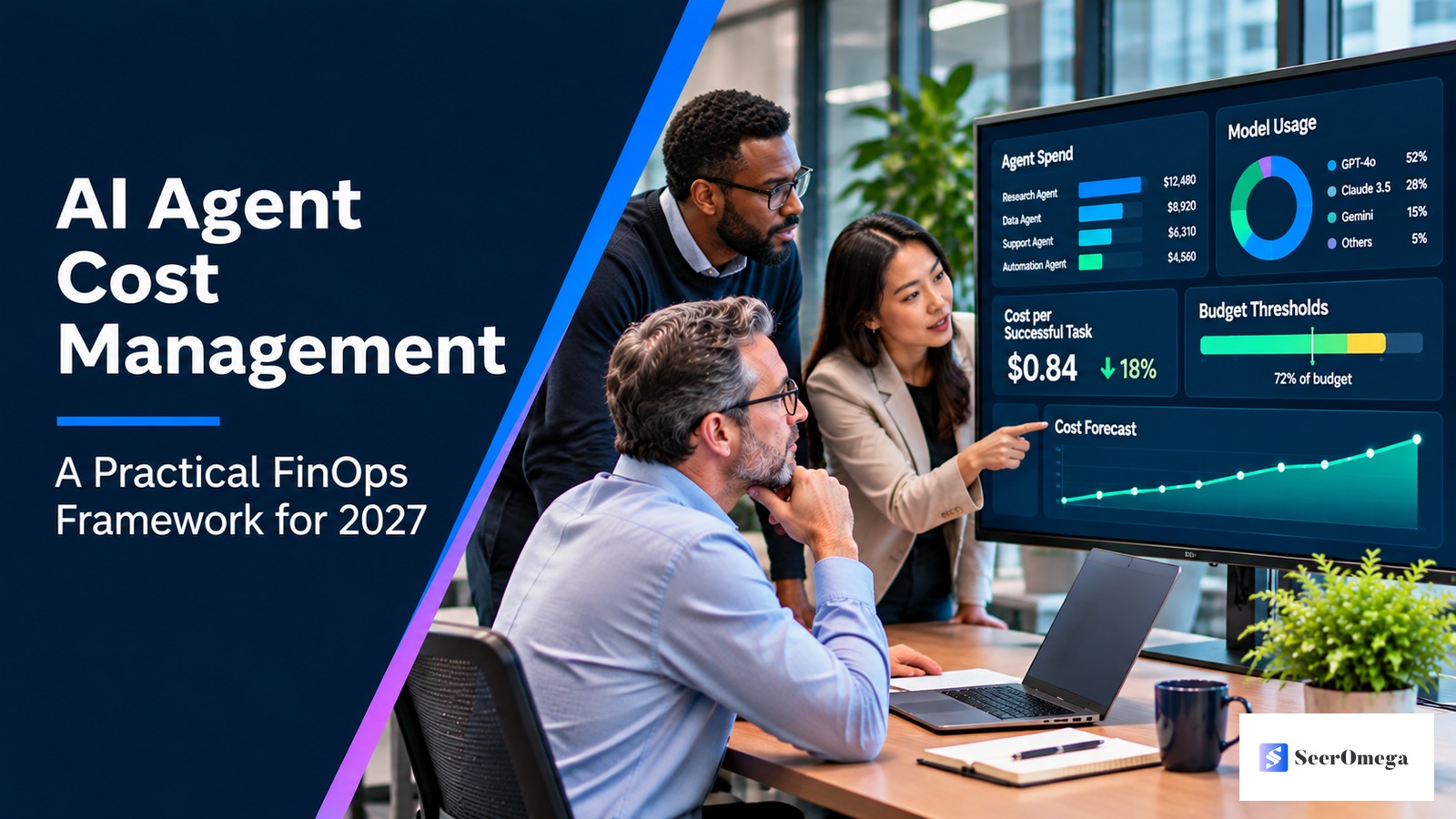
AI agent costs are harder to manage than a simple model API bill. A production agent may call a model several times, retrieve documents, invoke tools, delegate work to another agent, retry failed steps and run background tasks. The final invoice can combine model tokens, hosted runtime, search, storage, orchestration, observability and the engineering work required to keep the system reliable.
That makes cost per token an incomplete measure. Finance and engineering leaders need to understand what each agent costs to deliver a successful business outcome, which teams and workloads drive usage, and which controls can prevent unexpected consumption without disrupting valuable work.
This guide sets out a practical FinOps framework for AI agents in 2027. It covers cost attribution, workload economics, forecasting, budgets, runtime controls, optimization and business value. It is an operating framework, not a list of AI cost management products. Product-specific features and release states mentioned below were checked on 26 November 2026 and should be revalidated before implementation.
Why AI agent costs need a different management approach
A conventional application often has relatively predictable infrastructure consumption. Agent workloads can be more variable because the number of model calls, tool invocations and reasoning steps may depend on the task, the context and the agent’s decisions. Two requests that look similar to a user can consume very different resources.
Common cost drivers include:
- Model inference: input tokens, output tokens, cached tokens, reasoning tokens, model choice and processing tier.
- Agent execution: hosted runtime, session duration, memory, concurrency and background execution.
- Tool usage: web search, code execution, browser sessions, retrieval, external APIs and paid connectors.
- Multi-agent orchestration: delegation, repeated handoffs, duplicated context and parallel execution.
- Data services: vector search, databases, object storage, indexing, data transfer and retrieval pipelines.
- Operations: observability, evaluation, logging, guardrails, human review and support.
- Engineering and governance: build, integration, testing, maintenance, security reviews and platform operations.
The cost of an agent is therefore a property of the complete workload, not only the model selected. A lower-priced model can still produce a more expensive workflow if it needs more retries, longer prompts or human correction. Conversely, a higher-priced model may reduce total cost if it completes a task reliably in fewer steps. Measure both consumption and outcome quality.
What an AI agent FinOps framework should deliver
The FinOps Foundation’s framework includes AI as a technology spending scope and organizes practice around understanding usage and cost, quantifying business value, optimizing usage and cost, and managing the FinOps practice. Its FinOps Framework identifies allocation, reporting, anomaly management, forecasting, budgeting and unit economics as core capabilities.
For agent workloads, translate those capabilities into six operating outcomes:
- Visibility: know which agents, applications, teams and business processes generate consumption.
- Attribution: connect usage and billed costs to accountable owners and cost centers.
- Unit economics: understand cost per task, successful outcome, user or business transaction.
- Forecasting: estimate the cost of expected adoption, workload growth and model or architecture changes.
- Control: set budgets, alerts, quotas and request-level guardrails at useful boundaries.
- Value: compare fully loaded cost with measurable quality and business outcomes.
Cost governance should be shared across finance, engineering, product, platform operations, procurement and business owners. Finance cannot allocate costs accurately without workload metadata. Engineering cannot optimize responsibly without quality measures. Business teams cannot judge value from a token bill alone.
1. Establish a complete AI agent cost model
Start by defining what belongs in the cost of an agent. A useful model separates direct consumption from shared platform and delivery costs.
| Cost layer | Examples | Allocation approach |
|---|---|---|
| Model inference | Input and output tokens, cached tokens, model-specific charges, batch or priority processing | Request metadata, model usage records and provider billing exports |
| Agent runtime | Hosted sessions, compute, memory, browser or code execution | Agent, project, session or workload identifiers where supported |
| Tools and services | Search, retrieval, APIs, databases, vector stores, storage and data transfer | Resource tags, service logs, gateway metadata and service billing |
| Observability and evaluation | Trace ingestion, log retention, online evaluations, test runs and monitoring | Agent or project telemetry and platform usage reports |
| Shared platform | Gateway, orchestration, identity, network, reserved capacity and common infrastructure | Usage drivers such as requests, tokens, runtime hours or active agents |
| People and delivery | Development, integration, maintenance, review, support and governance labor | Time allocation or an agreed product-level cost model |
Do not assume every provider exposes every layer in one invoice or dashboard. Some costs are metered directly, others are shared, and some require internal telemetry or an allocation model. Document what is measured, estimated or allocated so that a calculated cost per task is not mistaken for an invoice line item.
2. Build cost attribution into the agent architecture
Attribution becomes difficult after requests pass through shared gateways, orchestration services and multiple agents. If all model calls use one service identity and no workload metadata, the bill may show the gateway’s spend without revealing which product, team or user caused it.
Define a consistent set of low-cardinality dimensions and attach them to requests wherever possible:
- Agent ID and agent version.
- Application or product name.
- Business unit, team and cost center.
- Environment, such as development, test or production.
- Workflow or feature identifier.
- Model provider and model deployment.
- Parent run, session or trace identifier for detailed diagnostics.
Use stable identifiers and avoid placing personal information, credentials or confidential business data in tags. Keep high-cardinality values such as individual request IDs in logs or traces rather than creating an unmanageable billing-tag taxonomy.
Amazon Bedrock documents several complementary attribution mechanisms. IAM principal attribution can associate billed dollars with identities; application inference profiles, Projects and Workspaces can allocate spend to workloads; and per-request metadata can add prompt-level token detail to invocation logs. AWS notes that native billing methods provide aggregated dollars rather than a separate invoice row for every prompt. Its guidance recommends combining billing attribution with request metadata when both financial reconciliation and detailed diagnostics are needed. See Track usage and costs in Amazon Bedrock and AWS cost attribution best practices.
For OpenAI API usage, the organization Usage and Spend views support analysis by API source, project, API key, model and other available dimensions, while API responses expose token usage fields. Access to some organization analytics depends on permissions. See Reviewing API usage and costs.
Build attribution into a shared SDK, gateway or agent runtime so teams do not need to remember to add tags manually. Test that metadata survives delegation, retries and model routing. Reconcile telemetry-derived costs with provider billing exports on a regular schedule.
3. Measure cost per successful outcome
Token consumption is a useful diagnostic measure, but it is not a business unit of value. An agent that uses fewer tokens but fails more often may cost more after retries, human correction and downstream errors.
Choose a unit that matches the agent’s purpose:
| Agent use case | Useful unit economics | Quality guardrail |
|---|---|---|
| Customer support | Cost per resolved case | Resolution accuracy, escalation and customer satisfaction |
| IT service desk | Cost per correctly resolved ticket | Reopen rate, policy compliance and time to resolution |
| Document processing | Cost per accepted document | Extraction accuracy and manual correction rate |
| Sales operations | Cost per qualified record or completed workflow | Data quality and downstream conversion |
| Software engineering | Cost per accepted change or verified task | Test pass rate, review effort and defect rate |
| Research and analysis | Cost per usable deliverable | Source quality, factual accuracy and reviewer acceptance |
A simple calculation is:
Cost per successful outcome = total attributable workload cost ÷ number of outcomes that meet the agreed quality threshold.
Define the success threshold before measuring. Include failed runs, retries and human review in the denominator and cost model as appropriate. If a workflow produces 1,000 attempts but only 820 meet the acceptance criteria, report both attempts and accepted outcomes. Do not divide cost by successful tasks alone while hiding failure volume.
The FinOps Foundation’s recent FinOps for AI guidance recommends establishing both a cost baseline and a functional baseline, then tracking unit economics such as cost per inference, per user and per successful outcome. Its work on Total Cost of AI also highlights the need to include delivery-path costs and labor, not only runtime consumption.
4. Forecast agent spend before scaling
Forecasting should start with workload behavior rather than a single monthly token estimate. Model expected traffic, task complexity, agent step count, tool usage, context size, model mix, retry rate, concurrency and retention. Build scenarios for low, expected and high adoption, and revise them as production evidence becomes available.
A practical forecast can be structured as:
- Volume: expected tasks, users, requests and peak concurrency.
- Consumption per task: input and output tokens, cached tokens, model calls, tool calls and runtime duration.
- Failure allowance: retries, timeouts, fallbacks, abandoned sessions and human escalation.
- Rate card: current model, tool, compute, storage and platform prices, including regional or service-tier differences.
- Shared costs: gateway, networking, observability, evaluation and committed capacity.
- Delivery costs: engineering, maintenance, security, support and change management.
Run a pilot with representative tasks and measure the distribution, not only the average. Long-tail requests, large documents and multi-agent workflows can dominate spend. Forecast at least one peak scenario and identify which variables create the largest uncertainty.
Reforecast when the model, prompt, retrieval strategy, agent topology, user volume, service tier or quality threshold changes. Compare forecast with actual usage and explain material variance instead of simply raising the budget.
5. Put budgets and runtime guardrails at the right level
A monthly cloud budget is useful for financial oversight, but it may not stop a runaway agent loop in real time. Use multiple layers because each protects against a different failure:
| Control | Purpose | Typical scope |
|---|---|---|
| Financial budget | Warn owners and finance when spend trends exceed plan | Subscription, account, business unit or cost center |
| Workload budget | Limit or alert on consumption for a product or agent | Project, application, agent or environment |
| Token or request quota | Control throughput or consumption before costs accumulate | Model deployment, API key, project or tenant |
| Per-run limits | Prevent excessive steps, retries, tool calls or session duration | Agent run or session |
| Policy guardrails | Restrict expensive or inappropriate model and tool choices | Model router, gateway or orchestration policy |
| Anomaly alerts | Identify unusual spikes, loops or changes in consumption | Agent, model, project or billing account |
Microsoft Foundry’s cost controls are documented as a public preview feature. They can track spending or token budgets for selected resources, projects, model deployments, agents or hosted sessions, and can send alerts or block new applicable requests at configured thresholds. Microsoft notes that the request crossing a threshold may still complete, that the preview’s running cost total is not reconciled with the bill, and that certain charges and models are not included. Do not treat this preview as a production guarantee or as a replacement for Azure Cost Management. See Microsoft Foundry cost controls overview and cost optimization guidance.
For OpenAI API workloads, use project and organization usage analytics, review request-level token usage and configure available usage notifications and rate limits. A rate limit controls throughput, not necessarily the total monthly financial exposure. Keep budget alerts, access controls and application-level limits in place. See OpenAI production best practices and API rate limits.
For Google Cloud, Cloud Billing documentation describes AI-related spend analysis, anomaly detection and forecasts. The AI Cost Summary Agent is labelled Preview, so verify its current availability and terms before relying on it for an operational control. See AI-powered cost monitoring and optimization features.
Use alert thresholds before hard limits. For example, notify the owner when a workload reaches an agreed warning level, then apply a stricter block only where the business process can safely pause. Define a fallback path for critical operations so cost protection does not create an uncontrolled service outage.
6. Optimize the workload without degrading quality
Optimization should target the largest verified cost drivers and preserve the outcome quality required by the business. Test one change at a time and compare cost, reliability and task acceptance before rolling it out.
Route tasks to the least costly adequate model
Use task complexity and quality requirements to select models. A lightweight model may handle classification or extraction, while a more capable model handles ambiguous or high-impact cases. Route to a stronger model when confidence or evaluation signals indicate that it is needed. Do not downgrade solely because a model has a lower token price.
Reduce repeated context
Review system prompts, conversation history, retrieved documents and tool outputs. Remove duplicated context, retrieve only relevant passages, cap unnecessary history and use prompt caching where the provider and request pattern support it. Check cache eligibility, retention and pricing before assuming a saving.
Control loops, retries and delegation
Set maximum steps, retry budgets, timeouts and tool-call limits. Detect repeated calls with the same arguments and stop unproductive loops. Require a clear reason for delegation and avoid sending the same large context to every sub-agent. Parallel execution may reduce latency but increase total consumption.
Improve retrieval and tool efficiency
Use retrieval filters, smaller result sets and appropriate indexing. Avoid calling external tools when cached or trusted application data is sufficient. Set pagination and response-size limits, and prevent agents from repeatedly fetching the same information.
Choose service tiers and capacity deliberately
Compare pay-as-you-go, batch, cached, provisioned or reserved options only where they fit the workload and provider’s current terms. Include idle capacity, minimum commitments, regional processing and peak utilization in the comparison. A lower unit rate does not guarantee lower total spend if capacity sits unused.
Right-size observability and evaluation
Keep the telemetry needed for debugging, security and audit, but define retention and sampling for high-volume diagnostic data. Do not disable critical traces simply to reduce cost. Schedule offline evaluations where appropriate and reserve online evaluation for checks that need production feedback.
7. Calculate total cost of ownership and business value
Runtime spend is only one part of the economics. A credible business case includes implementation, integration, security, governance, monitoring, maintenance, support and the cost of human review. It should also account for errors, rework and the cost of operating fallback processes.
Use a consistent total cost of ownership model:
- Model and tool consumption.
- Agent runtime and infrastructure.
- Shared platform and network costs.
- Observability, evaluation and data services.
- Build, integration and ongoing engineering labor.
- Security, privacy, governance and compliance work.
- Human review, escalation and exception handling.
- Incident, error correction and operational recovery costs.
Compare the total with a defined baseline process. If an agent reduces handling time, measure the actual time released and whether the organization can redeploy it productively. If it improves throughput, confirm that downstream capacity can absorb the additional work. Avoid presenting theoretical labor savings as cash savings unless staffing or capacity changes make that outcome real.
Use a small set of outcome measures such as cost per accepted task, time to completion, error rate, customer or employee experience, risk reduction and capacity released. Report the trade-off between cost and quality rather than a single ROI percentage that hides assumptions.
8. Create a monthly AI agent FinOps review
A repeatable review helps finance and engineering turn usage data into action. Keep the meeting focused on decisions and exceptions, not dashboard narration.
| Review area | Questions | Decision or action |
|---|---|---|
| Spend and forecast | Which agents and teams are above plan? What changed? | Update forecast, investigate variance or approve a revised budget |
| Attribution quality | Can material spend be assigned to a product, owner and cost center? | Fix missing tags, shared identities or unallocated resources |
| Unit economics | Is cost per successful outcome improving while quality holds? | Optimize workflow or revise the business case |
| Efficiency | Are retries, long contexts, tool calls or model selection driving waste? | Prioritize engineering changes and test their impact |
| Controls | Are alerts, budgets and run limits working as intended? | Adjust thresholds, owners and safe fallback behavior |
| Value | Does the agent deliver the expected business result? | Continue, expand, redesign or retire the use case |
Bring finance, platform engineering, product or process owners and procurement into the review. Invite security or governance when a change affects access, data, model choice or risk. Record decisions, accountable owners and review dates.
90-day implementation roadmap
| Period | Priority work | Deliverable |
|---|---|---|
| Days 1-30 | Inventory production and pilot agents, identify cost sources, define metadata standards and establish baseline workload and quality measures | Agent cost register, attribution standard and baseline report |
| Days 31-60 | Instrument shared gateways and runtimes, reconcile usage with invoices, define unit economics and implement alerts and per-run limits | Cost allocation model, workload dashboards and first control thresholds |
| Days 61-90 | Build forecasts, test optimization changes, review business value and establish monthly FinOps governance | Forecast model, optimization backlog and operating review |
Start with a small number of production workloads that have clear owners and measurable outcomes. Expand the framework as attribution and operational evidence become reliable.
Common AI agent cost management mistakes
- Tracking tokens but not tasks: consumption alone does not explain whether the agent completed useful work.
- Allocating all spend to a shared gateway: use workload metadata and identity-aware attribution to recover ownership.
- Confusing budgets with hard limits: some cloud budgets alert after delayed billing data and do not block requests.
- Ignoring non-model costs: runtime, tools, data, monitoring and labor can materially change total cost.
- Optimizing for the cheapest model: include retries, quality, escalation and correction in the comparison.
- Setting limits without a fallback: a budget block can interrupt a business-critical workflow unless safe degradation is designed.
- Using sensitive data in cost tags: metadata may be retained in logs and billing exports. Use stable non-sensitive identifiers.
- Claiming savings from theoretical productivity: measure actual process outcomes and the capacity that can be redeployed.
Frequently asked questions
What is AI agent FinOps?
AI agent FinOps applies financial management and engineering accountability to agent workloads. It covers cost visibility, attribution, forecasting, budgeting, optimization and measurement of business value across models, tools, runtime and supporting services.
How do you calculate the cost of an AI agent?
Include model inference, tools, hosted runtime, data services, orchestration, observability, evaluation and an appropriate share of shared infrastructure and delivery labor. Divide attributable cost by an agreed workload unit, such as a successful task, while reporting quality and failure rates.
What is the difference between token cost and cost per task?
Token cost measures model input and output consumption. Cost per task includes the full workflow, including retries, tool calls, runtime and other services. Cost per successful task also accounts for whether the result met the required quality threshold.
Can cloud budgets stop an agent from overspending?
Not always. Traditional billing budgets often send alerts based on delayed cost data and do not block requests. Some AI platforms provide request-time token or spending controls, but their scope, release status and limitations vary. Combine financial budgets with runtime limits and safe application-level controls.
How often should AI agent costs be reviewed?
Monitor usage and anomalies continuously where possible, reconcile provider bills regularly, and conduct a monthly cross-functional review. Reforecast after material changes to model, prompt, tools, traffic, architecture or quality requirements.
Manage AI agent economics as an operating discipline
AI agent cost management is not a one-time exercise in choosing a cheaper model. It requires consistent attribution, workload-level unit economics, realistic forecasting, layered controls and a clear connection between spend and business value.
Start by identifying which agents are running, who owns them and what they cost to complete an accepted task. Add request metadata and invoice reconciliation, then apply budgets and runtime guardrails where they can prevent waste without creating unsafe interruptions. Optimize only when quality remains within the agreed threshold, and retire agents that no longer justify their full operating cost.
Related reading: AI agent observability platforms, AI agent management platforms and enterprise AI agent governance.
