

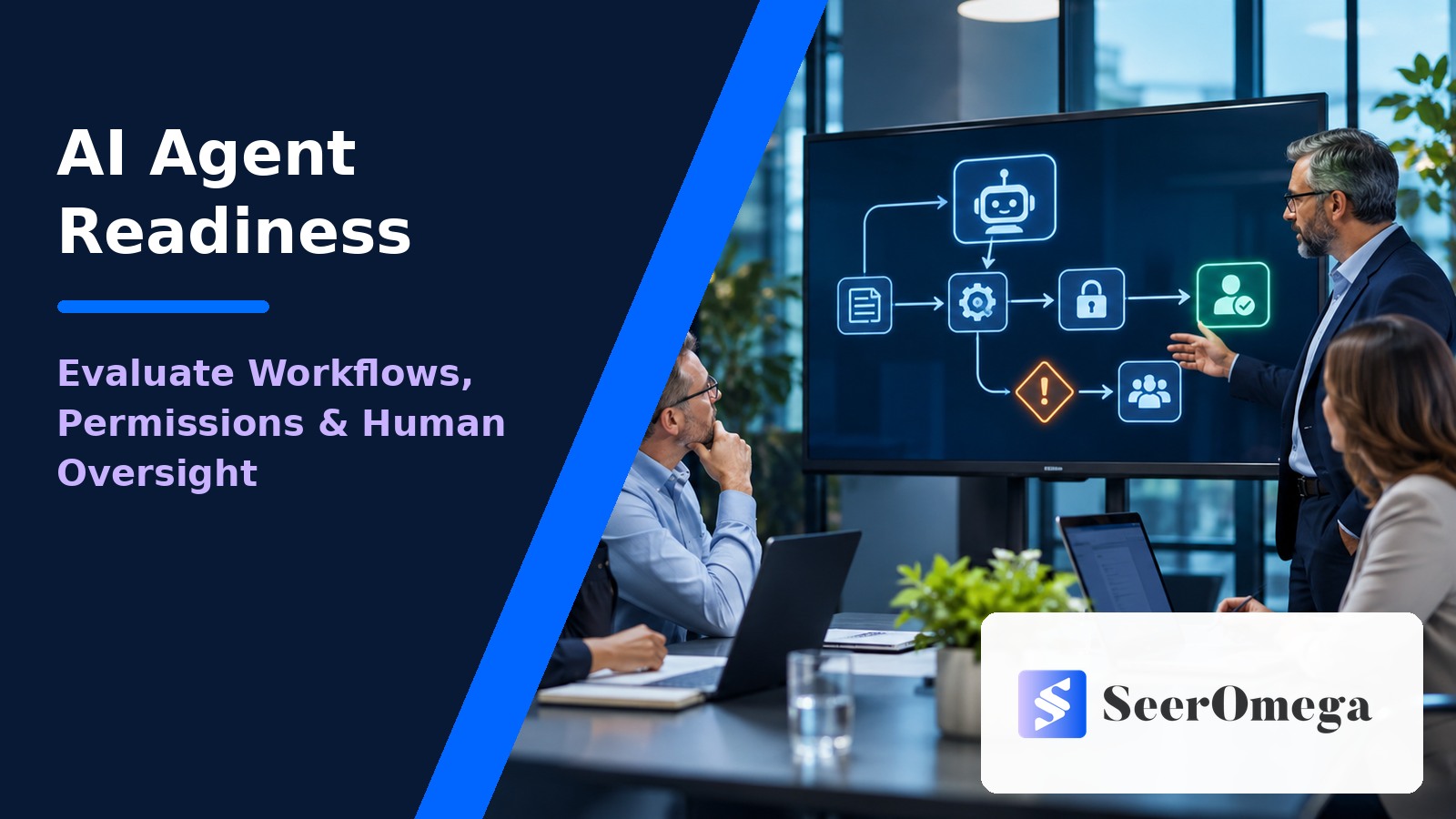
AI agents can do more than generate recommendations. When connected to business applications, they can retrieve records, call tools, update systems and coordinate multi-step work. That makes them potentially useful for operations, but it also means a workflow that is merely repetitive is not automatically ready for an agent.
An AI agent readiness assessment evaluates whether a specific business workflow can safely support bounded autonomous or semi-autonomous action. It examines process stability, data and system access, permissions, decision limits, human oversight, exception handling, auditability and the ability to stop or reverse actions. The right outcome may be a conventional workflow, an AI assistant with human approval, a tightly scoped agent pilot or a decision to defer automation.
This guide is for IT, operations and automation leaders who need to evaluate a workflow before selecting an agent platform or granting production access. It focuses on operational suitability, not on ranking agent products or repeating a general AI governance framework.
What makes a workflow suitable for an AI agent?
An AI agent is a software system that can interpret a goal, decide which permitted steps or tools to use, and act across one or more stages with some degree of autonomy. The precise capabilities vary by architecture and product. Some systems only recommend actions; others can call APIs, update records, send messages or trigger downstream processes.
A workflow is a stronger candidate when its objective is clear, the permitted actions can be bounded, the systems expose reliable interfaces, exceptions are understood and the consequences of mistakes can be contained. It is a weak candidate when the process is unstable, success criteria are subjective, permissions are broad, or a single incorrect action could create serious and difficult-to-reverse harm.
Agent readiness is therefore a property of a particular workflow in a particular operating context. A company should not label itself “agent-ready” based on a platform purchase or a successful demonstration.
Start with the workflow, not the agent
Choose a process with a defined start event and end outcome. Examples might include classifying incoming support requests, preparing a draft response from approved knowledge, collecting information for a purchase request, or checking a service ticket for missing fields. These examples are not blanket recommendations: actual suitability depends on data sensitivity, system permissions, error impact and exception volume.
Map the real process with the people who perform and supervise it. Record:
- The trigger that starts the work and the condition that marks it complete.
- Inputs, outputs, source systems and authoritative records.
- Tasks that require judgment, policy interpretation or human negotiation.
- Decision rules, approval thresholds and segregation-of-duty requirements.
- Normal paths, common exceptions, rare but serious failures and manual workarounds.
- Who owns each step and who is responsible when the workflow fails.
Separate the workflow into actions an agent may propose, actions it may execute within limits, and actions that must remain under human control. If the process cannot be described clearly enough to define those boundaries, improve the process before introducing autonomy.
Eight dimensions to assess before deployment
1. Process stability and task boundaries
Agents need a defined operating envelope. Assess whether the workflow has consistent inputs, recognizable states, documented rules and an observable completion condition. Determine how often policies, forms, system screens or downstream requirements change.
Unstructured work is not automatically unsuitable, but it requires stronger validation and more careful limits. If the agent is expected to invent its own objective, decide what “good” means, or expand the scope whenever it encounters an obstacle, the task is too open-ended for an initial deployment.
Define explicit boundaries: which records it may handle, which actions it may take, how many steps or retries it may perform, what counts as completion and when it must stop. Use a bounded task rather than a broad instruction such as “manage customer accounts.”
2. Data access and information quality
List every data source the workflow needs, including documents, knowledge bases, email, databases and application records. Check whether the information is current, relevant, permissioned and sufficiently complete for the intended task. Confirm which source is authoritative when systems disagree.
Review whether retrieved content can contain malicious or misleading instructions. An agent may encounter untrusted text in a webpage, email, attachment, ticket or document. Treat that content as data to evaluate, not as authority to change the agent’s instructions or permissions. Apply access controls at retrieval time; do not rely only on a prompt telling the agent to protect confidential information.
Decide what information may enter prompts, context, memory and logs. Define retention, redaction and deletion requirements, and test whether one user or business unit could retrieve another’s restricted information.
3. Identity, permissions and tool access
Every connected system expands the agent’s potential impact. Create a list of tools and actions, then classify each permission as read, create, update, delete, approve, send or administer. Avoid giving an agent a human user’s broad credentials or a general-purpose service account when narrower access is possible.
Use a distinct identity for the agent where the platform supports it. Grant only the permissions required for the approved task, restrict access to specific records or resources, and separate read-only tools from write-capable tools. Require an authorization check at the point an action is executed; the model’s own assessment that an action is appropriate is not an authorization control.
Set credential ownership, rotation, expiry and revocation procedures. Review permissions when the workflow changes and at a defined interval. Microsoft’s guidance on securing agents through identity, access and data protection emphasizes individual identities, least privilege and agent registration. These are design considerations, not a substitute for reviewing the specific platform and configuration.
4. Human oversight and decision authority
Human oversight should be designed around the consequences of an action, not added as a generic final checkbox. Decide which steps can run automatically, which require review before execution and which should never be delegated to the agent.
For example, an agent might gather information and prepare a supplier payment request, while an authorized employee verifies the details and approves payment in the financial system. The agent should not be able to approve its own work or bypass the organization’s segregation-of-duty rules.
Define who receives an approval request, what evidence they see, how long an approval remains valid, what happens if nobody responds and how a reviewer can reject or amend a proposed action. Reviewers need enough context and authority to challenge the agent; a nominal approval step that people routinely accept without inspection is not meaningful oversight.
The Canadian Centre for Cyber Security’s guidance on agentic AI recommends human control points, interruption during execution, approval for consequential actions and clear accountability. The appropriate checkpoints depend on the workflow’s risk.
5. Exception handling and recovery
List what can go wrong: missing or conflicting data, an unavailable API, a duplicate request, a permission denial, an unexpected response, a partial update, a timeout or a downstream system outage. For each condition, define whether the agent should retry, pause, ask a person, route the case to an exception queue or stop.
Retries need limits. Repeating a non-idempotent action, one that creates a new effect each time, can produce duplicate orders, messages or records. Use transaction identifiers, duplicate checks, idempotency controls where supported and clear confirmation of the final system state before continuing.
Define recovery before production. Can an operator stop the run, revoke credentials, isolate the agent, restore a prior record or complete the task manually? Not every action can be rolled back. Where reversal is impossible, add stronger pre-execution validation and human authorization.
6. Audit trails and operational visibility
Logs should allow an authorized reviewer to reconstruct what happened without exposing unnecessary sensitive information. At minimum, retain the agent and workflow version, task identifier, initiating event, tools invoked, records accessed, proposed and executed actions, authorization result, human approvals or overrides, exceptions and final outcome.
Monitor more than the final answer. A plausible response can conceal an unsafe tool call or an unintended change. Track unusual access patterns, repeated failures, unexpected tool selection, excessive retries, long-running tasks, changes in permission scope and actions outside the approved objective.
OWASP’s AI Agent Security Cheat Sheet identifies excessive permissions, untrusted inputs, high-impact actions, unbounded loops and insufficient oversight as risks to address through least privilege, validation, monitoring and structured testing.
7. Security testing and adversarial scenarios
Test the workflow with realistic and deliberately difficult cases before granting production access. Include malicious instructions embedded in retrieved content, requests to access unauthorized records, attempts to use tools outside the task, ambiguous user instructions, conflicting source data, unexpected API responses and repeated failures.
Test whether the agent can be induced to reveal sensitive data, exceed its permissions, skip an approval, change its objective or continue after a stop condition. Check whether the system rejects unauthorized actions even if the model proposes them. Evaluate the complete chain, model, prompts, retrieval, tools, identity, orchestrator and connected applications, not just the language model’s answer quality.
Record the tested configuration, test cases, expected behavior, observed results, unresolved issues and accepted residual risks. Repeat relevant tests after material changes to the model, prompts, tools, data sources, permissions or workflow.
8. Business value and operating ownership
Define the reason for using an agent and compare it with simpler alternatives. Could a form, rules engine, native application feature, API integration or conventional workflow automation solve the problem more reliably? Agentic autonomy adds value only when flexible interpretation or multi-step action is genuinely needed.
Establish a baseline before the pilot. Depending on the process, measure cycle time, first-pass completion, exception rate, rework, cost per completed case, service quality, user effort and control failures. Include the cost of model usage, platform licensing, integration, security review, monitoring, human approvals, maintenance and incident response.
Name a business process owner and a technical owner. The business owner is accountable for the outcome and operating rules; the technical owner manages the deployed system, access, reliability and changes. Security, privacy, legal, compliance and audit functions should participate according to the data and potential impact.
A practical AI agent readiness scorecard
Use the scorecard below to structure a review. It is an internal screening aid, not a certification, legal risk classification or guarantee of safety. Score each dimension from 0 to 2: 0 means absent or unknown; 1 means partially defined or inconsistently implemented; 2 means documented, tested and owned.
| Dimension | Evidence for a score of 2 |
|---|---|
| Process boundaries | Clear trigger, scope, completion condition, allowed actions and stop conditions |
| Data readiness | Approved sources, access checks, ownership, quality and retention rules |
| Identity and permissions | Distinct identity where supported, least privilege and tested authorization |
| Human oversight | Named approvers, meaningful review context and enforced approval gates |
| Exception recovery | Defined retry limits, escalation, manual fallback, interruption and recovery |
| Auditability | Traceable tool calls, actions, approvals, changes and outcomes |
| Security testing | Representative and adversarial tests with documented results |
| Business ownership | Named owners, baseline measures, operating budget and review cadence |
A total score can show where preparation is incomplete, but do not let a high average conceal a critical weakness. Missing authorization controls, an inability to stop consequential actions, unbounded write access or the absence of a responsible owner should be treated as blockers for autonomous production use regardless of the total.
Use the findings to choose an operating mode:
- Not ready: process scope, data access or ownership is unclear. Redesign the workflow or improve foundational controls first.
- Assistant-supported: the system may summarize, classify or prepare recommendations, but a person performs and verifies consequential actions.
- Bounded pilot: the agent operates in a restricted environment with limited users, narrow permissions, monitored actions and explicit stop conditions.
- Controlled production: evidence supports the defined operating scope, approvals, recovery, monitoring and ongoing ownership. Expansion still requires reassessment.
How to run a controlled readiness assessment
- Select one workflow. Choose a bounded process with a measurable problem and a business owner. Avoid starting with an enterprise-wide “agent transformation” objective.
- Map actions and systems. Document the steps, decisions, data sources, tools, identities, permissions, human roles and exception paths.
- Set the autonomy boundary. Specify what the agent may read, prepare, change or execute; what requires approval; and what is prohibited.
- Design controls before the pilot. Configure access restrictions, approval gates, logging, rate and retry limits, alerts, interruption and manual fallback.
- Test normal and hostile cases. Verify task quality and the system’s response to invalid data, malicious instructions, unauthorized requests, outages and high-impact actions.
- Run in a restricted environment. Start with limited records, users and tools. Compare results with the baseline and review every exception.
- Decide whether to expand. Expand only when the evidence supports the next level of access and autonomy. Record unresolved risks and the person authorized to accept them.
Questions to ask an AI agent platform provider
- Can each agent have its own identity and narrowly scoped permissions?
- Can administrators restrict individual tools, actions, records and data sources?
- Are approvals enforced outside the model, at the point of execution?
- Can the agent be interrupted immediately and can credentials be revoked?
- What logs are available for prompts, retrieval, tool calls, state changes, approvals and outcomes?
- How are untrusted documents, webpages, emails and tool responses handled?
- Can administrators set limits for steps, retries, runtime, tokens and cost?
- What happens when a workflow partially completes or a downstream system is unavailable?
- How are model, prompt, tool and permission changes tested and versioned?
- Which controls are provided by the vendor, and which remain the customer’s responsibility?
Ask for a demonstration using a representative workflow and failure scenario, not only a successful scripted task. Verify capabilities in the product documentation and the plan or deployment model you would actually use.
Common mistakes in agent readiness decisions
- Confusing a successful demo with operational readiness: demonstrations rarely represent permission failures, messy records, outages or adversarial inputs.
- Giving the agent a user’s full access: broad inherited permissions increase the impact of mistakes and compromise.
- Using human approval as decoration: approvals must be enforced, informed and assigned to someone with authority to reject.
- Ignoring partial completion: multi-step tasks can fail after some actions have already changed business records.
- Skipping the manual fallback: critical workflows need a safe way to continue when the agent is unavailable or disabled.
- Expanding scope without reassessment: a workflow that begins with read-only access can become materially riskier when write actions or new data sources are added.
- Measuring only speed: faster processing is not a success if errors, rework, security exposure or customer harm increase.
Frequently asked questions
What is an AI agent readiness assessment?
It is a structured review of whether a specific workflow can safely support an AI agent. It examines process boundaries, data, permissions, human oversight, exceptions, auditability, testing and business ownership before deployment.
What workflows are best suited to AI agents?
Potential candidates have clear objectives, bounded actions, accessible and permissioned data, observable outcomes and manageable exceptions. Suitability depends on the actual systems and consequences; a workflow should not be selected simply because it contains repetitive tasks.
Should AI agents have write access to business systems?
Only when write access is necessary for the approved task and can be restricted to specific actions and resources. Begin with read-only or draft-only access where possible. Enforce authorization outside the model and require human approval for consequential or difficult-to-reverse actions.
When should a human approve an agent’s actions?
Require approval when an action has material financial, legal, privacy, security, customer, employee or operational impact, or when it is difficult to reverse. Define the thresholds and approvers before deployment rather than allowing the agent to decide when oversight is necessary.
How is agent readiness different from AI governance?
AI governance defines the organization’s overall authority, policies, responsibilities and oversight for AI. Agent readiness applies those controls to a particular workflow and determines whether its process, permissions, safeguards and recovery mechanisms are sufficient for a proposed level of autonomy. See our AI governance framework for businesses for the wider operating model.
Make autonomy a decision, not a default
AI agents should receive authority only when a workflow has clear boundaries, suitable data, enforceable permissions, meaningful human control and tested recovery. If those conditions are missing, the right next step may be process redesign, conventional automation or an assistant that prepares work for a person to complete.
Start with one workflow, document the evidence and expand autonomy only when the controls work under realistic conditions. This keeps the decision grounded in operational readiness rather than the capabilities shown in a product demonstration.
Related reading: Enterprise AI use cases by industry, business process workflow optimization and robotic process automation.
