
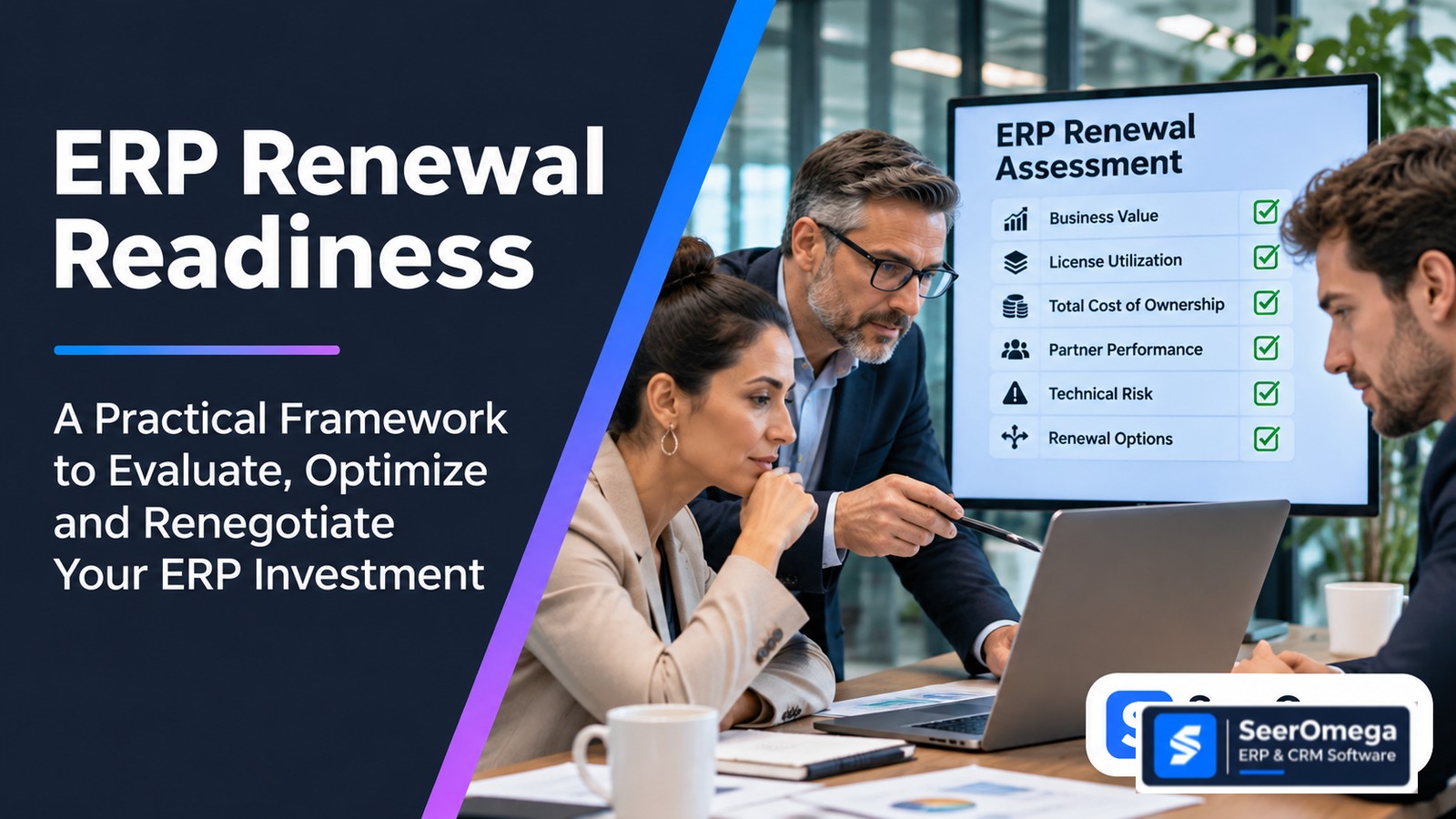
An ERP renewal is often treated as a procurement event: confirm the renewal date, validate the invoice, negotiate the price and secure approval. That process can protect the commercial terms while leaving a more important question unanswered: does the current ERP arrangement still serve the business well enough to justify another commitment?
ERP renewal readiness is the ability to make an evidence-based decision to renew, renegotiate, optimize, reimplement, modernize or replace the current ERP arrangement before contractual deadlines reduce the available options. It goes beyond licence utilization. The assessment should consider business value, process fit, adoption, total cost, service performance, technical condition, partner dependency, roadmap and exit feasibility.
This guide introduces the SeerOmega ERP Renewal Decision Framework. It is designed for enterprise buyers reviewing an incumbent ERP platform and its supporting services. The scorecard is a practical decision aid, not a validated industry benchmark or a substitute for legal, licensing or financial advice.
Why renewal should be a business decision, not an administrative default
An ERP may remain operational while its value deteriorates. Workarounds may multiply, business units may rely on spreadsheets, customizations may become expensive to maintain, service quality may decline, or the partner may no longer have the skills required for the next phase. Conversely, a system that looks dated may still be the most sensible option if it supports critical processes, has a viable product lifecycle and can be improved at lower risk than a replacement.
IBM’s 2026 framework for enterprise SaaS and COTS optimization identifies underused licences, duplicated platforms, unsupported applications, customization lock-in and operational risk as reasons to reassess software before renewal. Flexera’s renewal-readiness guidance focuses on aligning usage, entitlements, contracts and future demand ahead of negotiations. Those are important inputs, but an ERP decision also needs to assess process outcomes, implementation-partner performance, technical debt and the feasibility of changing the operating model.
SeerOmega’s distinction is therefore deliberate: licence optimization is one workstream within ERP renewal readiness, not the entire decision.
When should an organization start an ERP renewal assessment?
Begin early enough to gather evidence and act on it. Flexera recommends starting major software renewal preparation six to twelve months before the renewal date; the right lead time for an ERP depends on contract notice periods, negotiation complexity, procurement governance, implementation alternatives and the scale of any transition. For a large ERP estate or a decision that could lead to replacement, start earlier than the minimum contractual notice period.
Common triggers include:
- A material increase in subscription, maintenance, hosting or support charges.
- Low or unclear adoption of modules, licences or paid capabilities.
- Repeated process workarounds, spreadsheet dependence or poor user experience.
- Declining service quality, unresolved incidents or unclear support accountability.
- New business requirements, acquisitions, geographic expansion or regulatory changes.
- Approaching product or version lifecycle milestones.
- Partner changes, staff turnover, undocumented customizations or knowledge concentration.
- Unclear data portability, termination assistance or transition costs.
The SeerOmega ERP Renewal Readiness Scorecard
Assess seven dimensions. The suggested weights below are an editorial starting point for a broad enterprise ERP review. Adjust them to the business context and document the rationale. Do not compare scores across companies as if they were an industry benchmark.
| Dimension | Suggested weight | Evidence to collect |
|---|---|---|
| 1. Business value realization | 20% | Original business case, agreed benefits, outcome KPIs, process owner feedback and evidence that benefits are sustained |
| 2. Process fit and adoption | 15% | Critical process coverage, workarounds, manual effort, usage by role, user feedback and exception patterns |
| 3. Licence and usage fit | 10% | Entitlements, active users, role assignment, module use, indirect access and expected future demand |
| 4. Total cost and commercial terms | 15% | Subscription or maintenance, hosting, support, partner services, integrations, customizations, price protections and exit cost |
| 5. Service and delivery performance | 15% | Incident trends, service levels, backlog, release quality, partner staffing, escalation and knowledge transfer |
| 6. Technical health and dependencies | 15% | Custom code, integrations, data quality, security, infrastructure, support status, technical debt and dependency concentration |
| 7. Strategic fit and exit readiness | 10% | Roadmap fit, business change needs, data portability, alternative providers, contract flexibility and transition feasibility |
Score each dimension from 1 to 5 against documented evidence: 1 = materially inadequate; 2 = weak; 3 = acceptable with known gaps; 4 = strong; 5 = strong and independently evidenced. If evidence is missing, mark the score as provisional rather than awarding a neutral 3. A weighted total can help organize the discussion, but it should never override a critical failure in security, support, legal compliance or business continuity.
1. Test whether the ERP is still delivering business value
Return to the business case and identify the outcomes that justified the original investment. Examples may include faster financial close, better inventory accuracy, improved order fulfilment, more reliable production planning, stronger audit trails or reduced manual processing. Establish the baseline, current performance, measurement owner and any conditions that must remain true.
Separate value that has been achieved from value that was expected but never realized. Also distinguish a platform limitation from a process, configuration, training or governance problem. Replacing software will not automatically resolve unclear ownership, poor master data or a broken approval process.
For measurement design, see ERP Benefits Realization: How to Track Value After Go-Live and How to Measure ERP ROI.
2. Reconcile licences, entitlements and actual usage
Do not rely on login counts alone. Understand the licence metric, permitted use rights, role requirements, indirect access rules and the difference between assigned, active and genuinely required users. Review module usage, premium features, seasonal roles, duplicate accounts and business-unit differences. Validate the analysis against the actual contract and the vendor’s licensing terms; licensing rules can be product-, edition- and contract-specific.
Usage data is not the same as entitlement compliance. A low-usage licence may still be required for a critical seasonal process, while high activity does not prove the current licence tier is correct. Ask procurement, IT and finance to reconcile contract entitlements with actual assignments and forecast demand before changing quantities.
3. Calculate the cost of keeping the current arrangement
Build a three-to-five-year view where practical. Include recurring licences or maintenance, hosting, infrastructure, managed services, implementation-partner retainers, upgrades, integrations, custom development, testing, training, internal administration and business disruption. Include costs that sit outside the ERP invoice but are necessary to operate the platform.
Compare the cost of the current arrangement with credible alternatives: optimize and renew, renegotiate scope or terms, change support partner, reimplement the same product, modernize selected components or replace the platform. Use comparable scope and assumptions. A replacement proposal that excludes data migration, process redesign, integration remediation or dual-running is not a fair comparison.
4. Assess the product and partner separately
ERP product capability and partner delivery performance are related but not interchangeable. A capable product can be poorly configured or supported. A strong partner cannot remove a fundamental platform limitation. Assess both.
| Product / platform | Implementation and support partner |
|---|---|
| Functional fit, version support, release direction, security, integration capability, scalability and customization model | Named delivery team, response quality, resolution times, continuity, documentation, release management, commercial transparency and knowledge transfer |
Ask for incident and service evidence, not just a relationship review. Review unresolved defects, recurring root causes, service-level exclusions, partner staff changes, subcontracting, escalation paths and the quality of technical documentation. Where the partner has unique knowledge of custom code or integrations, include that dependency in the renewal decision.
5. Evaluate technical condition and operational dependency
Inventory customizations, extensions, reports, interfaces, integrations, databases, identity services, hosting and third-party components. Record ownership, support status, change history and the effort required to maintain or replace each critical component. Identify single points of failure and knowledge held by one individual or supplier.
For a structured way to connect business processes with applications, providers, people and exit dependencies, use the SeerOmega ERP Vendor Dependency Mapping framework. For the choice between upgrade and replacement, see ERP Upgrade vs Replacement.
6. Review contract terms and practical exit readiness
Confirm renewal dates, notice windows, auto-renewal clauses, price escalation, licence metrics, support scope, service levels, data rights, audit rights, termination triggers, transition assistance and deletion obligations. Legal counsel should review the agreement and applicable jurisdiction-specific terms.
Then test operational feasibility. Can the organization export the required records in usable formats? Are customizations and integration specifications documented? Does it control credentials and deployment assets? Can a new provider access the information needed to take over? What would it cost to run the old and new environments in parallel? A theoretical right to leave is not the same as a workable exit plan.
For detailed commercial review, see ERP Contract Negotiation: Terms Buyers Should Review.
Turn the assessment into a decision—not just a score
Use the evidence to select a response for the incumbent ERP. The options are not limited to renew or replace.
| Decision path | When it may fit | Conditions before approval |
|---|---|---|
| Renew as-is | Business value, process fit, support and technical condition are strong; commercial terms are acceptable | Document residual risks, confirm forecast demand and retain performance review measures |
| Renew and optimize | The platform remains suitable but usage, process or cost inefficiencies exist | Agree measurable optimization actions, owners, dates and post-renewal checkpoints |
| Renegotiate or rescope | Commercial terms, licence quantities, service scope or commitments no longer match actual need | Validate entitlements, benchmark alternatives where possible and protect critical service levels |
| Change support or implementation partner | The product remains viable but service quality, capacity or knowledge continuity is weak | Plan transition, access, documentation, knowledge transfer and service continuity |
| Reimplement or modernize | The product is suitable but the current configuration, customizations or architecture are not | Define scope, process redesign, migration, integration and change impact |
| Replace | Material business or technical fit gaps cannot be resolved economically within the incumbent platform | Build a defensible business case, options analysis, migration plan and exit strategy |
Renewal decision pack: what leadership should receive
A useful decision pack should be short enough to read but traceable to the underlying evidence. Include:
- Executive recommendation and decision deadline.
- Scorecard with evidence confidence and unresolved gaps.
- Benefits realization and process-fit summary.
- Licence and usage reconciliation.
- Three-to-five-year TCO comparison with assumptions.
- Product, partner and dependency risk assessment.
- Contractual notice, renewal and exit obligations.
- Options considered, trade-offs, implementation implications and decision owners.
- Conditions to approve the chosen path and the date of the next review.
Frequently asked questions
How early should ERP renewal planning begin?
Start with the contract notice period and the time needed to gather evidence. Six to twelve months is a useful starting point for many major software renewals, but a potential ERP replacement or complex multi-entity agreement may require substantially more time.
Is ERP renewal readiness the same as software licence optimization?
No. Licence optimization reviews entitlements, assignments and usage. ERP renewal readiness also assesses business outcomes, process fit, support, partner performance, technical condition, dependencies, total cost and the ability to change or exit.
Should an organization replace an ERP if users are dissatisfied?
Not automatically. Identify whether dissatisfaction comes from product limitations, configuration, process design, training, data quality, support or change management. Replace only when the evidence shows that the underlying fit problem cannot be resolved economically through other options.
What if the ERP score is high but one critical risk remains?
Do not let a weighted average hide a critical issue. Treat security, regulatory, continuity, data integrity and unsupported-platform risks as decision gates that may require remediation or formal risk acceptance regardless of the total score.
Who should participate in the renewal assessment?
Include the business process owners, CIO or IT leadership, enterprise architecture, finance, procurement, legal, security, vendor management and the implementation or support partner where appropriate. The vendor should provide evidence, but should not own the buyer’s assessment.
Conclusion: earn the next commitment with evidence
A sound ERP renewal decision weighs the value the business receives against the full cost, operational exposure and future flexibility of the arrangement. Licence savings matter, but they are only one part of the picture. Assess the product, partner, process, technical dependencies and exit path together; then choose to renew, optimize, renegotiate, modernize or replace based on evidence.
Explore SeerOmega’s ERP software and implementation partner directory to support a structured market review when the assessment indicates that alternatives should be considered.
