
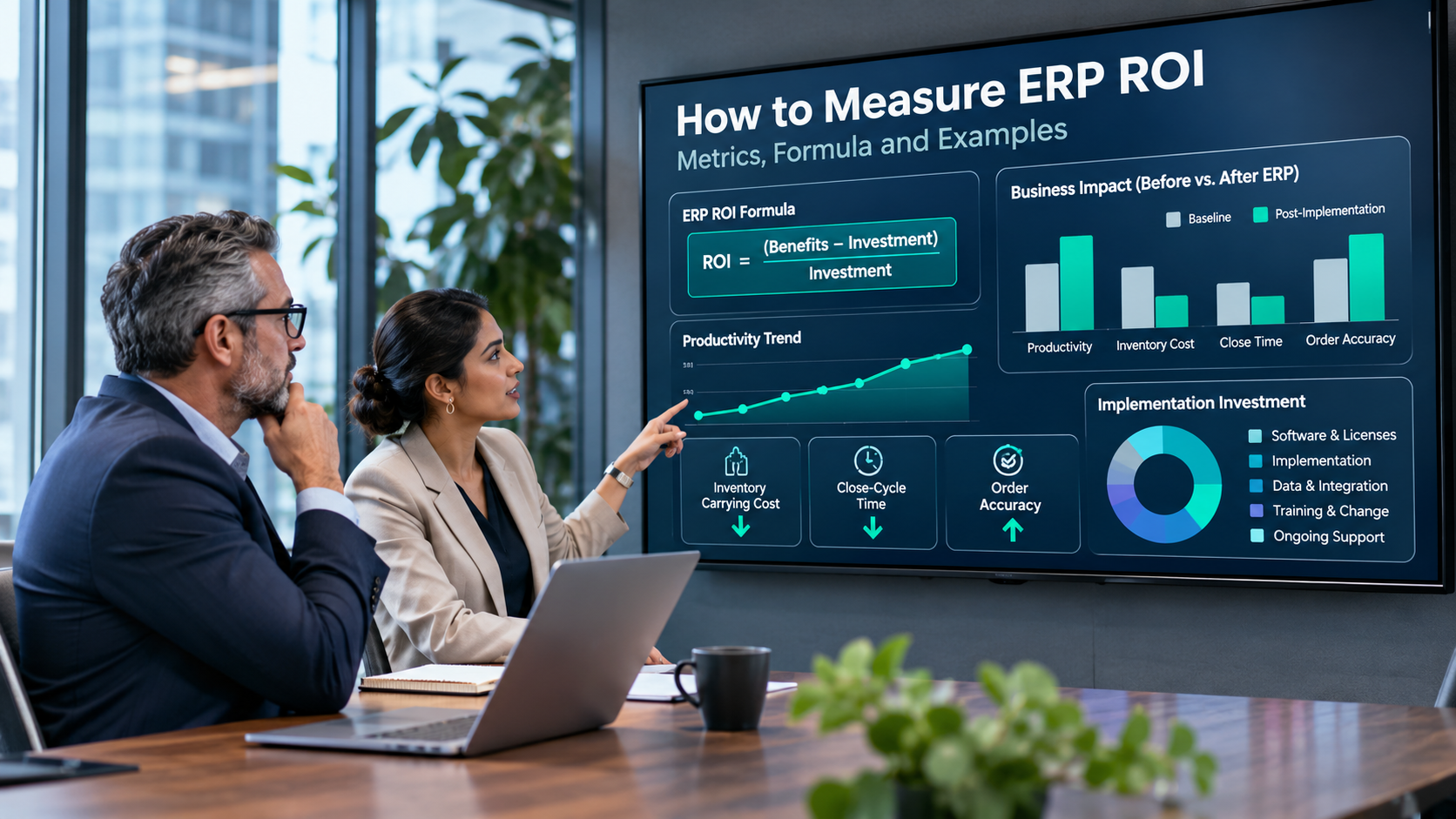
An ERP business case is weak when it relies on statements such as “better visibility,” “greater efficiency” or “one source of truth” without connecting them to measurable financial or operational outcomes. Those may be valid reasons to change systems, but they do not tell a CFO whether the investment is worth making.
To measure ERP return on investment (ROI), establish a baseline before implementation, identify benefits that can be measured after go-live, and include the full cost of ownership. The objective is not to produce the highest possible percentage. It is to create a business case that can survive scrutiny and be reviewed after the system is in use.
ERP ROI formula
A common simple formula is:
ERP ROI (%) = [(Total quantified benefits − Total investment) ÷ Total investment] × 100
For a multi-year business case, define the period clearly—often three or five years—and compare benefits and costs over the same period. Where timing matters, use discounted cash flow or net present value (NPV) rather than treating a benefit received in year five as equal to cash saved today.
Do not count the same benefit twice. For example, if reduced manual order entry is already reflected in labour savings, do not add the same hours again as a separate productivity benefit.
Start with a measurable baseline
Before selecting the ERP or beginning implementation, record how the business currently performs. Choose metrics that relate to the problems the programme is intended to solve.
| Business area | Baseline metric | Possible post-ERP measure |
|---|---|---|
| Finance | Days to close the month | Reduction in close cycle and manual reconciliations |
| Inventory | Inventory value, turns and write-offs | Lower carrying cost, fewer write-offs and better availability |
| Procurement | Purchase-order processing time and maverick spend | Less manual processing and stronger contract compliance |
| Order management | Order entry time, error rate and on-time fulfilment | Fewer corrections, faster processing and improved fulfilment |
| Manufacturing | Schedule adherence, scrap and production variance | Reduced waste and improved production planning |
| Services | Billable utilisation and time-to-invoice | More accurate resource use and faster billing |
| Reporting | Hours spent assembling management reports | Less spreadsheet consolidation and faster decision cycles |
Record the data source, owner, measurement frequency and calculation method for every KPI. A baseline that cannot be reproduced is not a reliable benchmark.
Which ERP benefits can be quantified?
1. Labour capacity and transaction productivity
Estimate the hours currently spent on repetitive tasks such as rekeying orders, matching invoices, reconciling accounts or compiling reports. Multiply the hours genuinely eliminated by a defensible loaded labour cost. Be careful: time released is not automatically cash saved. If employees remain on payroll, describe the benefit as capacity redeployed unless the business can show reduced overtime, avoided hiring or a real reduction in cost.
2. Inventory and working capital
Potential benefits include lower excess stock, fewer obsolete items, reduced emergency purchases and better stock availability. Separate a one-time release of working capital from recurring annual savings. A reduction in average inventory can release cash, but it is not equivalent to an annual profit improvement. Recurring benefits may include lower carrying costs, fewer write-offs and reduced expedite costs.
3. Procurement and supplier performance
Measure spend under contract, purchase price variance, approval compliance, supplier lead-time reliability and invoice exceptions. Attribute savings only where the ERP process contributed to a measurable change. Commodity price movements or supplier renegotiations should not be credited to the ERP without evidence.
4. Faster and more accurate order fulfilment
Track order-entry errors, credit holds, picking accuracy, on-time-in-full delivery, returns and time from order to invoice. Improved fulfilment may reduce rework and support retention, but revenue growth should be included only when a credible link to the ERP-enabled change can be demonstrated.
5. Finance close and reporting
Measure close duration, manual journal volume, reconciliation exceptions, audit adjustments and time spent producing management reports. Faster reporting can improve decision-making, but do not assign a financial value to “better decisions” unless the business can identify a specific outcome and a reasonable attribution method.
Calculate the full ERP investment
Include costs across the same time horizon as the benefits:
- Software subscriptions, user licences, modules and support plans.
- Implementation partner fees, internal project team time and programme management.
- Data cleansing, migration, integrations, customisation and reporting.
- Infrastructure, environments, security and compliance work where applicable.
- Testing, training, change management, temporary productivity loss and backfill.
- Ongoing administration, upgrades, support and third-party applications.
For a fuller cost breakdown, see ERP implementation cost, TCO and hidden expenses.
Worked example: keep assumptions visible
Consider a hypothetical company that estimates $600,000 in quantified benefits over three years and $450,000 in total three-year investment. Its simple three-year ROI would be:
[(600,000 − 450,000) ÷ 450,000] × 100 = 33.3%
This is an illustrative calculation, not a typical ERP return or a forecast. The result is only as credible as the assumptions behind the $600,000 benefit estimate. The business should show which benefits are recurring, which are one-time, when they are expected to start and who is accountable for delivering them.
Build a credible ERP business case
- Define the scope: identify entities, locations, processes and modules included in the programme.
- Document current performance: agree baseline values with finance and operational owners.
- Link each benefit to a process change: describe what will change, who will use it and why the KPI should improve.
- Assign a benefit owner: name the person responsible for measuring and realising each outcome.
- Model timing and adoption: phase benefits by rollout, training, process adoption and stabilisation.
- Include downside scenarios: test lower adoption, delayed go-live, higher integration costs and slower benefit realisation.
- Review after go-live: compare actual results with the original baseline at 3, 6 and 12 months, then adjust the improvement plan.
Common mistakes that inflate ERP ROI
- Counting theoretical time savings as immediate payroll reductions.
- Counting working-capital release as recurring annual profit.
- Attributing revenue growth to ERP without evidence of causation.
- Ignoring internal staff time, data work, training and change management.
- Assuming benefits begin on the go-live date rather than after adoption.
- Using different time horizons for costs and benefits.
- Leaving benefit ownership with the IT project team instead of business process owners.
ERP ROI is a governance measure, not just a selection metric
Use the business case to compare options before purchase, but keep it alive after implementation. A steering committee should review actual costs, adoption, process performance and benefit delivery against the approved assumptions. If a benefit is not materialising, identify whether the cause is system capability, process design, data quality, training or a lack of operational ownership.
For related buyer guidance, read ERP implementation risks and compare cloud ERP systems for growing businesses.
Conclusion
A defensible ERP ROI calculation starts with a reliable baseline and a clear link between system-enabled process changes and measurable outcomes. Include the complete investment, distinguish cash savings from capacity gains, avoid double counting and assign benefit owners. That produces a business case that is useful both when choosing an ERP and when deciding whether the implementation is delivering the value originally promised.
