
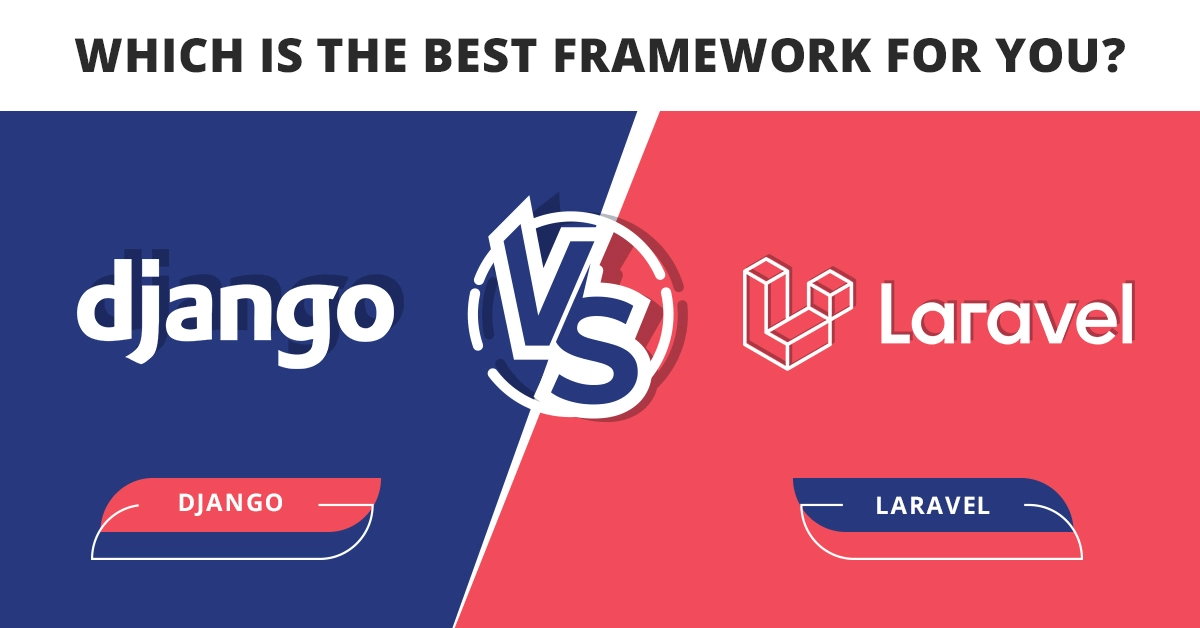
Django and Laravel are mature web frameworks built around different programming languages and ecosystems. Django is a Python framework, while Laravel is a PHP framework. Neither is universally better. The right choice depends on the application’s requirements, the team’s skills, the surrounding ecosystem and the way the system will be operated.
This guide compares the two frameworks across architecture, performance, security, scalability, testing, ecosystem and project fit.
At a Glance
| Factor | Django | Laravel |
|---|---|---|
| Language | Python | PHP |
| Architecture | MVT-oriented framework with strong conventions | MVC-oriented framework with expressive tooling |
| Strengths | Data-heavy applications, APIs, security-focused development, Python ecosystem | Web applications, SaaS products, rapid PHP development, rich first-party tooling |
| Learning | Good fit for teams already using Python | Good fit for teams already using PHP |
| Scaling | Supports horizontal scaling and distributed architectures | Supports horizontal scaling and distributed architectures |
Performance
Framework performance should be evaluated at the application level rather than by language stereotypes. Database design, caching, network calls, serialization, background jobs, hosting, code quality and traffic patterns can have a larger impact than the framework name.
Django works well for applications where Python’s ecosystem and development model are valuable. Laravel provides a productive PHP environment with a broad set of tools for common web application needs.
Architecture
Django uses a model-template-view approach with strong conventions and a large set of built-in components. Laravel follows MVC conventions and provides an expressive ecosystem around routing, queues, authentication, database access, testing and application tooling.
The better architecture is the one the team can operate consistently. A framework that fits the team’s experience can reduce defects and maintenance cost even if another framework looks stronger on paper.
Scalability
Both frameworks can support large applications when the surrounding architecture is designed correctly. Use caching, database optimization, asynchronous processing, queues, load balancing, observability and horizontal scaling where the workload requires them.
Django can be especially attractive when the application needs to integrate closely with Python-based data, analytics or machine-learning workflows. Laravel can be attractive when the organization already has strong PHP expertise and a Laravel-oriented engineering ecosystem.
Security
Neither framework should be called inherently secure simply because of its language. Both provide security features, but developers still need to configure authentication, authorization, input validation, session management, dependency updates, secrets and deployment controls correctly.
Testing and Maintainability
Both ecosystems provide strong testing options. Django projects can use Django’s testing tools plus the broader Python testing ecosystem. Laravel provides an integrated testing experience and supports unit and feature testing.
For long-lived systems, the quality of the team’s tests, documentation, code review, dependency management and deployment process matters more than the framework comparison itself.
Current Framework Support
Django’s current supported releases include Django 5.2 LTS, Django 6.0 and Django 6.1. Django 6.1 was released in August 2026, and the project recommends supported Python versions rather than end-of-life Python releases. citeturn0search5turn0search9
Laravel’s current release line is Laravel 13, with the framework’s published support policy providing 18 months of bug fixes and two years of security fixes for releases. citeturn0search18
When Django Is a Strong Fit
- Python is already a core language in the organization.
- The application needs Python data or machine-learning libraries.
- The project benefits from Django’s conventions and built-in components.
- Security-conscious development and structured application design are priorities.
- The team needs a mature framework for data-heavy applications and APIs.
When Laravel Is a Strong Fit
- The organization already has strong PHP expertise.
- Rapid development of web applications is important.
- The project benefits from Laravel’s integrated ecosystem and tooling.
- The team wants a framework aligned with an established PHP hosting and deployment environment.
What Should You Choose?
Choose based on the team, product requirements, existing infrastructure and long-term operating model. If both frameworks meet the functional requirements, the framework your team can develop, secure, test and maintain most effectively is usually the better business decision.
Final Takeaway
Django and Laravel are both capable frameworks. Instead of asking which framework is universally best, ask which one gives your project the strongest combination of engineering capability, ecosystem fit, security, delivery speed, maintainability and total cost of ownership.
Framework versions and support policies change. Verify current releases and security guidance before starting a new production project.
