
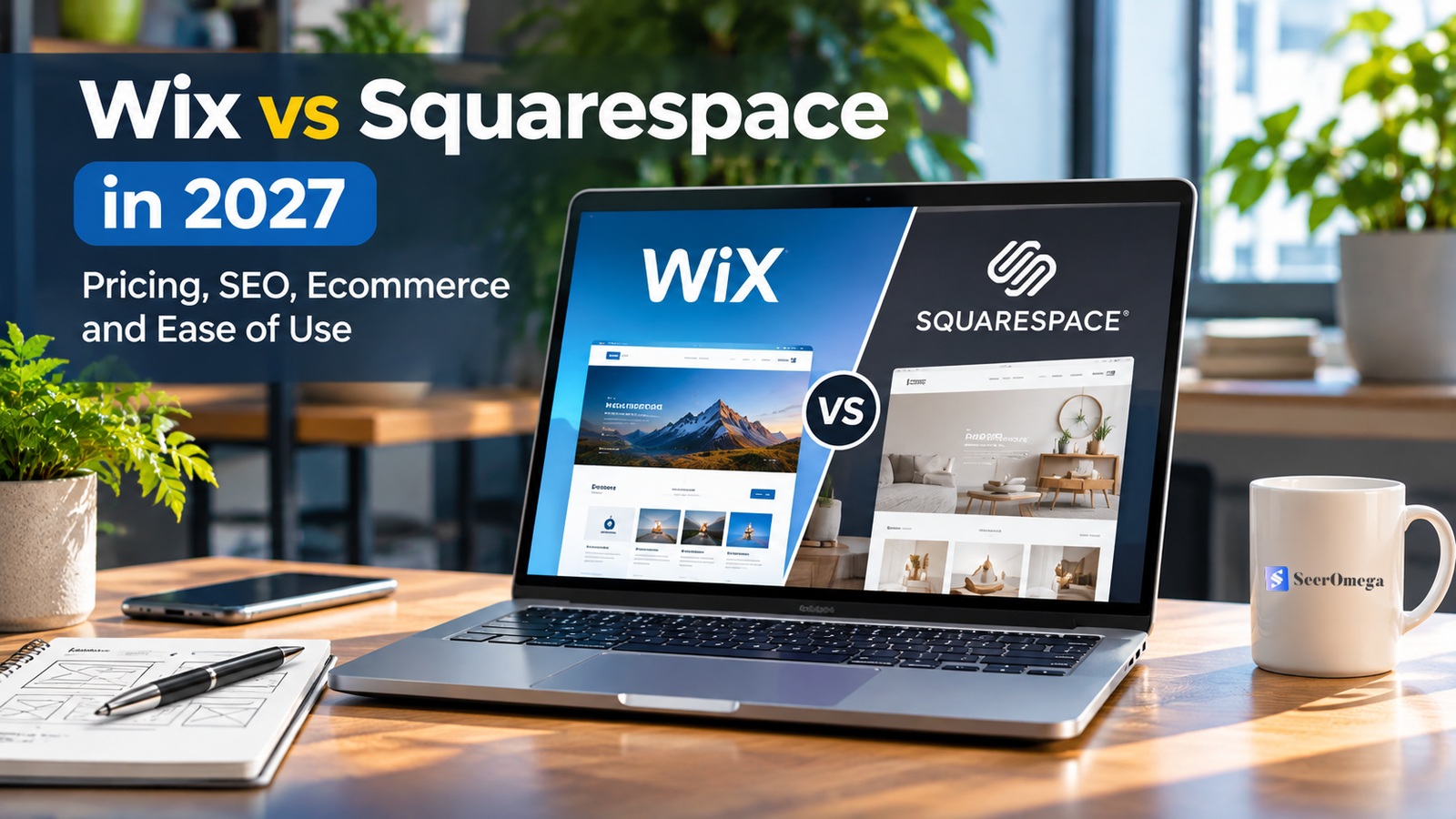
Choosing between Wix and Squarespace is not simply a design decision. Both platforms can launch a professional website without a traditional hosting stack, but they give owners different levels of control over layout, business operations, search settings and future changes. The better choice depends on what the website must do after launch, not only how quickly the first homepage comes together.
This comparison is for small-business owners, consultants, independent professionals and growing service businesses planning a website for 2027. It focuses on the operating trade-offs that are easy to miss during a free trial: how each editor behaves, when selling features become available, what the SEO controls let you change, how plan fees affect transactions and what happens if you later move platforms.
Research checked: 24 November 2026. Plan names, prices, payment availability and feature access can vary by country, billing term and account. Use the live pricing page and checkout for the final amount in your region. This guide does not treat vendor uptime or performance statements as independently tested results.
Wix vs Squarespace at a glance
| Decision area | Wix | Squarespace |
|---|---|---|
| Starting point | Free plan available, with platform branding and limits | Time-limited trial rather than a permanent free website plan |
| Editor approach | Flexible drag-and-drop editing with broad placement freedom | Structured visual editing, with Fluid Engine layouts on version 7.1 |
| Design direction | Large template selection and extensive customization | Curated templates and a more guided design system |
| Business tools | Broad app and business feature ecosystem, with plan-dependent commerce and services | Integrated commerce, scheduling and service tools, with plan and product fees to check |
| SEO controls | Page-level and template-level settings, structured data options and robots.txt editing | Core SEO fields, URL controls, redirects and a guided SEO checklist |
| Mobile design | More layout freedom means more responsibility to review the mobile result | Responsive layouts, with separate mobile arrangement options in Fluid Engine sections |
| Moving away | Plan for a rebuild or content migration rather than assuming a portable site package | Some content can export, but many site features and design elements do not |
The short version: Wix is usually the stronger starting point when you want flexibility, a free entry point and a wider set of business tools. Squarespace is often the better fit when you value a controlled design workflow and want a polished presentation without configuring as many moving parts. Neither is automatically better for every business.
1. Website editor and design flexibility
Wix: more freedom, more decisions
Wix gives site owners a flexible visual editor and a large template catalogue. You can position and customize many page elements with relatively few layout constraints, then extend the site with business features and apps. Its AI website builder can produce a starting structure from a prompt, while the editor lets you refine the result.
That freedom is useful when a business has unusual page layouts, different service lines, custom landing pages or a need to experiment with page structure. It also creates more decisions. A site can become inconsistent when different pages are assembled without shared layout rules. Teams should define reusable sections, typography, spacing and mobile checks before several people start editing.
Squarespace: stronger guardrails for visual consistency
Squarespace takes a more structured approach. Its templates and section-based editing make it easier to start with a coherent visual direction. On version 7.1, Fluid Engine allows blocks to be arranged within sections, and supported sections can have a separately arranged mobile layout. This gives designers control without requiring every site owner to manage a completely open canvas.
The trade-off is that the editor’s structure may feel restrictive if you need highly unusual page compositions or want to control every element independently. Squarespace is not a no-customization system, but it encourages owners to work within a more consistent design framework.
Practical choice: choose Wix if layout freedom is part of the requirement and someone will own design consistency. Choose Squarespace if the team prefers a guided system that makes it easier to keep pages visually aligned.
Official product references: Wix’s comparison of Wix and Squarespace and Squarespace Fluid Engine editing guidance.
2. Pricing, free access and the real cost of ownership
Wix offers a free plan for building and testing a site. It is useful for learning the editor, but a business that needs its own domain and a more complete professional presence will generally need a paid plan. Wix’s plan structure separates basic website needs from payment acceptance, ecommerce and higher-level business capabilities. Check the plan comparison for the exact features included in your region.
Squarespace offers a trial rather than a permanent free website plan. Its paid plans are organized around website needs, contributors, commerce and advanced selling. The current plan guidance lists a commerce transaction fee on Basic and no Squarespace commerce transaction fee on Core and higher plans. Payment processing charges and digital product fees are separate, so a zero commerce transaction fee does not mean every sale is fee-free.
Do not compare only the monthly headline price. Calculate the cost for the site you intend to operate:
- Website access: the plan needed for a custom domain, storage, contributors and the features you actually use.
- Payments: card processing, platform transaction fees, currency conversion and payment-provider availability in your country.
- Commerce: digital product fees, subscriptions, booking tools, shipping, tax and point-of-sale requirements.
- Extensions: paid apps, email marketing, scheduling, integrations and any external service that fills a product gap.
- Operations: design or developer time, content updates, migration work and the cost of maintaining a more complex setup.
For a small brochure site, the lowest suitable plan may be enough. For a store, compare the fee on each order and the plan required to remove or reduce that fee. For a service business, check whether booking, invoicing, client management and payment collection are included or depend on an additional product. Use the vendor’s local checkout price, not a third-party comparison table, as the final quote.
Official plan references: Wix plans and included features, Squarespace plan comparison and Squarespace transaction and processing fees.
3. Ecommerce and service-business operations
Wix is worth a close look when the website needs to do more than display products. Depending on the selected plan and enabled apps, its ecosystem covers online payments, product catalogues, bookings, services, marketing and additional business workflows. That breadth can reduce the need to assemble separate tools, but it also means you should check which features are native, which require an app and which require a higher plan.
Squarespace combines website design with store and service features. It can suit a focused catalogue, a creative business, a portfolio that sells products, or a professional service site that needs scheduling and payments. The plan details matter: contributor limits, commerce fees, digital product fees and the availability of specific selling tools can change the economics.
Use your real operating workflow as the test. Write down how a customer discovers an offer, chooses a product or service, pays, receives confirmation, books a time, gets support and receives follow-up communication. Then map each step to the platform. A feature list is less useful than knowing whether the complete customer journey works without awkward workarounds.
Choose Wix when you need a broader mix of business features, integrations or a more configurable store and service workflow. Choose Squarespace when the catalogue or service journey is relatively focused and presentation is a major part of the buying experience. If ecommerce is the primary business rather than one part of a wider website, include a dedicated commerce platform in the shortlist before committing.
4. SEO, content management and control
Both platforms provide the foundations for a search-friendly website. Neither platform can guarantee rankings. Search visibility still depends on the usefulness and originality of the content, site architecture, crawlability, page experience, competition, links and how well the site satisfies the searcher’s task.
Wix SEO controls
Wix provides SEO settings that can be applied by page type as well as edited for individual pages. Its documentation covers title tags, meta descriptions, indexability, URL structures, redirects and structured data markup. Wix also documents a robots.txt editor. These controls are useful when a site has multiple page types or needs a repeatable SEO configuration.
The extra control is not a reason to change advanced settings without a plan. Incorrect robots directives, canonical tags or structured data can create indexing problems. A site owner should document important URL rules and test changes before applying them across a page group.
Squarespace SEO controls
Squarespace’s SEO checklist covers site titles and descriptions, page-specific descriptions, title formats, URL slugs, image alt text, custom domains, SSL, redirects and connections to Google Search Console, Bing Webmaster Tools and Google Analytics. It is a practical checklist for owners who want a clear sequence of launch and maintenance tasks.
Squarespace’s more guided approach can be enough for many service sites, portfolios and small stores. If your SEO requirements depend on unusual technical controls or a custom content architecture, test the exact settings you need during the trial rather than assuming every control is available in the same way as a more configurable CMS.
For either platform, prepare a page map before launch. Define the purpose of each page, use descriptive URLs, write unique page titles and descriptions, add useful image alt text, connect analytics and webmaster tools, and test redirects if URLs change. For a blog, check category structure, author information, internal linking, structured data and how easily editors can maintain older content.
Official SEO references: Wix SEO settings, Wix robots.txt guidance and Squarespace SEO checklist.
5. Mobile experience and page quality
A website can look excellent in the desktop editor and still create friction on a phone. Review the actual customer journey on a small screen: navigation, tap targets, form fields, calls to action, image crops, page length, checkout and booking steps. Test important pages on more than one screen size and with real content, not only the template’s sample text.
Wix’s flexible layouts give owners room to adjust the design, but that flexibility makes a deliberate mobile review important. Squarespace sites are responsive, and Fluid Engine sections on version 7.1 support mobile-specific block arrangements. Even then, Squarespace recommends reviewing mobile layouts because content, media and section choices can affect how a page appears.
Do not choose either platform based on vendor uptime claims or a single speed score from a template demo. A fair performance comparison requires the same content, images, scripts, location, device and measurement conditions. Before launch, compress images, avoid unnecessary third-party scripts, limit heavy animations and test key pages with real mobile devices and field data once the site has visitors.
Official mobile references: Squarespace mobile layout editing and Squarespace mobile-friendly guidance.
6. Integrations, extensibility and day-to-day ownership
Wix’s app ecosystem can help a business add features without commissioning a custom build. Before installing an app, check its developer, update history, permissions, pricing, data handling, support and whether it can export the information you collect. More apps can mean more capability, but they can also add recurring costs and dependencies.
Squarespace takes a more curated approach to integrations and built-in features. This can make a compact site easier to manage, especially when its standard tools cover the required workflow. If the business depends on a specialist CRM, inventory system, marketing automation platform or custom API workflow, verify the integration path and the exact data that can move between systems.
For either platform, create an ownership checklist before launch. Record the domain registrar, billing owner, administrator accounts, payment provider, connected analytics properties, email marketing account, app subscriptions, data export process and renewal dates. The website should not become inaccessible if one employee or agency leaves.
7. Migration and platform lock-in
Migration is one of the most important differences to understand before you build. Hosted website builders manage the infrastructure for you, but the site design and some features are tied to their platform. Moving later can involve rebuilding templates, replacing integrations and checking every URL.
Squarespace documents an export to a WordPress-compatible XML file, but it does not export every content type or design feature. Its help centre lists exclusions such as store pages, product blocks, video blocks, custom CSS, style settings and some other page types. A content export is therefore not the same as a complete, ready-to-run copy of the website.
With Wix, plan for a migration project rather than assuming the full site can be exported as a portable package. Keep independent copies of original images, documents, product data, customer records where legally permitted, page copy and URL mappings. Confirm what can be exported from each Wix app or business feature before you rely on it for long-term records.
Before choosing either platform, ask how difficult it would be to leave. If the site will become a major content asset, has hundreds of landing pages or depends on custom integrations, portability deserves more weight. If it is a relatively small brochure site, the convenience of managed hosting may outweigh the future migration cost.
Official migration reference: Squarespace content export limitations.
Which platform should you choose for your business?
| Your situation | Better starting point | Why |
|---|---|---|
| You want to test a site before paying | Wix | Its free plan lets you explore the builder, with branding and feature limits to consider. |
| You want a guided design system | Squarespace | Curated templates and structured editing can reduce design decisions. |
| You need many custom page layouts | Wix | Its flexible editor is better suited to owners who want more direct layout control. |
| You run a portfolio or design-led service brand | Squarespace | Its visual system is a strong fit when presentation and consistency are central. |
| You need a wider set of business apps and workflows | Wix | Its app ecosystem and business tools offer more room to extend the site. |
| You need a focused store or service website | Either | Compare the exact plan, transaction fees, payment methods and booking workflow in your region. |
| You expect a complex future migration | Neither by default | Test content export, URL control and data portability before selecting a hosted builder. |
A practical evaluation before you commit
Do not spend the entire trial comparing templates. Build the same small test site in both platforms. Use one homepage, one service or product page, one article, one contact form and one conversion path. Then score each platform against the work your team will actually do.
- Recreate your most important page. Check how quickly you can match the layout, update sections and keep the design consistent.
- Test one real business workflow. Try a product purchase, appointment booking, enquiry form or lead handoff, depending on the business model.
- Complete the SEO setup. Edit a page title, meta description, URL, canonical or structured data setting where relevant, and check indexability.
- Review mobile pages. Test navigation, forms, images and the main conversion action on an actual phone.
- Check integrations and permissions. Confirm that the tools you already use can connect and that the right team members can manage them.
- Calculate the annual cost. Include plan fees, transaction charges, payment processing, extensions, email, domain renewal and support.
- Test the exit route. Find the export options for pages, posts, products, images and customer data before the site becomes business-critical.
If your team is also considering a broader content-management change, SeerOmega’s guide to WordPress alternatives for blogging and content publishing covers publishing-first platforms and other CMS choices. That is a wider CMS decision, while this comparison focuses on Wix and Squarespace as hosted website builders.
Final verdict
Wix is the more flexible choice for businesses that want a free starting point, broad visual control and a larger set of extendable business tools. Squarespace is a compelling option for businesses that value curated design, structured editing and a more guided website-building experience. The best choice is the one that fits the complete operating model, including the site owner, customer journey, payment setup, content workflow and likely future changes.
Before buying a plan, test the same pages and workflows in both platforms, compare the fees shown for your region and confirm the data you can take with you. A website builder is not just a way to publish a homepage. It becomes part of how your business attracts customers, delivers services and manages its online presence.
