
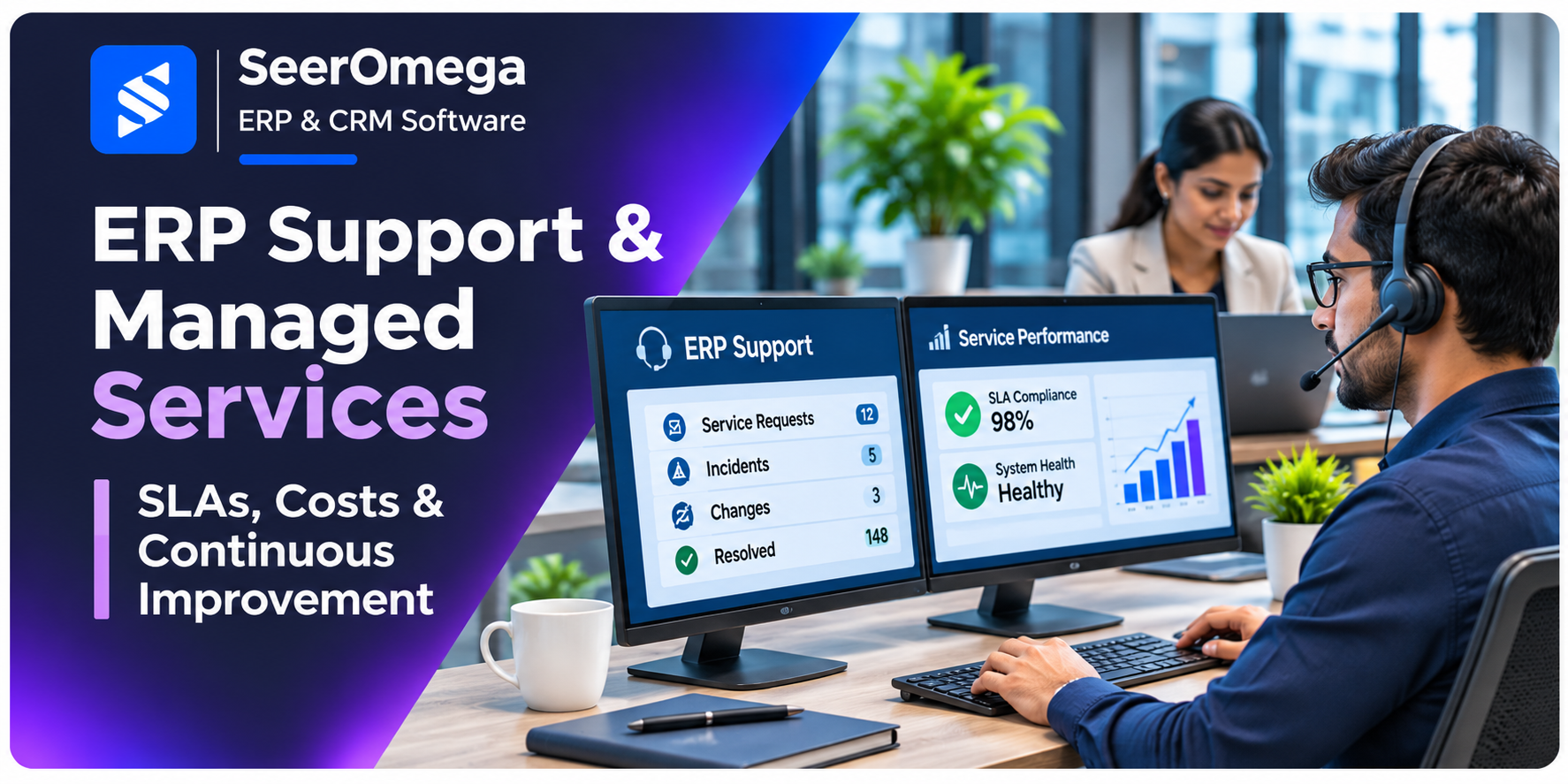
ERP go-live is the start of the system’s operating life, not the end of the implementation project. After launch, the organisation still needs incident resolution, user support, access administration, integration monitoring, release testing, configuration changes and process improvements. If these responsibilities are not assigned clearly, small issues can accumulate into operational disruption and an expensive backlog.
ERP managed services provide an ongoing support arrangement in which an internal team, implementation partner or specialist provider takes defined responsibility for keeping the ERP environment reliable and improving it over time. The right model depends on business criticality, internal capability, system complexity, change volume and the level of coverage required.
What ERP post-go-live support includes
ERP support is broader than answering user questions. A mature service may include several workstreams:
- Service desk and user support: Ticket intake, triage, access requests, how-to guidance and escalation.
- Application support: Investigation of configuration, workflow, reporting, transaction and application defects.
- Technical operations: Environment administration, monitoring, performance investigation, backup coordination and release support within the provider’s responsibility.
- Integration support: Monitoring interfaces, managing failed messages, retrying safely and reconciling data between systems.
- Security and access administration: Role changes, periodic access reviews, audit support and segregation-of-duties controls.
- Enhancements and optimisation: Approved configuration changes, reports, workflow improvements and small development items.
- Release and upgrade management: Impact assessment, sandbox testing, regression testing, deployment planning and user communication.
Not every support contract includes all these services. The scope should identify the applications, environments, integrations, business hours, user groups and activities that the provider will own.
ERP support models compared
| Model | How it works | Best suited to | Main trade-off |
|---|---|---|---|
| Internal support team | Employees own user support, administration and coordination with vendors. | Organisations with sufficient ERP skills and a need for close operational control. | Hiring, retention, coverage and specialist skills can be difficult to sustain. |
| Partner support retainer | The implementation partner provides a defined pool of support hours or services. | Businesses that need continuity from the implementation team without outsourcing every function. | Unused hours, exclusions and out-of-scope rates need clear treatment. |
| Managed application services | A provider takes ongoing responsibility for agreed application, technical and service-management activities. | Organisations seeking predictable support ownership and proactive service governance. | Requires careful transition, knowledge transfer, access controls and performance oversight. |
| Hybrid support | Internal process owners retain business decisions while a partner handles specialist support and operations. | Businesses with internal ERP ownership but limited specialist capacity. | Responsibilities and escalation paths must be explicit to avoid hand-off delays. |
There is no universally best model. A smaller business with a stable system may only need a modest support retainer, while a multi-site operation with integrations and extended operating hours may need a more formal managed service.
Define severity levels and service-level agreements
An SLA should explain how incidents are classified, when the service clock runs, who can raise a priority incident, and what the provider commits to do. Response time and resolution time are different measures: acknowledgement does not mean the business service has been restored.
| Priority | Example impact | Typical handling expectation to agree |
|---|---|---|
| P1 – Critical | ERP unavailable or a critical process stopped with no workable alternative. | Immediate escalation, continuous coordination during the agreed coverage window and frequent status updates. |
| P2 – High | Major business function impaired or a significant user group blocked. | Urgent investigation, named owner and regular progress updates. |
| P3 – Medium | Limited process impact with a reasonable workaround. | Scheduled investigation and resolution within an agreed service target. |
| P4 – Low / Request | How-to question, minor issue, access request or planned change. | Handled through the normal service queue and agreed request fulfilment process. |
Set targets that reflect the business’s operating hours and impact tolerance. A 24/7 response commitment costs more than weekday business-hours coverage and is only useful if the business has people available to act on escalations. Define separately the target for initial response, workaround or restoration, and final resolution where appropriate.
What should an ERP support SLA cover?
- Service hours: Business hours, extended coverage, weekends, holidays and time zones.
- Priority definitions: Objective impact criteria and who can approve a severity change.
- Response and restoration targets: Separate acknowledgement, workaround and resolution commitments.
- Escalation: Named operational, technical and management escalation contacts.
- Ticket ownership: Required details, status updates, evidence and closure approval.
- Availability and maintenance: Applicable service availability commitments and planned maintenance windows.
- Dependencies and exclusions: Cloud provider outages, third-party applications, customer-owned networks and delayed customer actions.
- Reporting: Ticket volumes, age, reopen rates, SLA attainment, root causes and recurring incidents.
- Security: Access approvals, privileged accounts, audit logs, data handling and offboarding.
- Continuous improvement: Problem management, automation opportunities and a prioritised enhancement backlog.
How much do ERP managed services cost?
There is no reliable universal monthly price for ERP managed services. Cost depends on the number of applications and integrations, user and transaction volumes, support hours, ticket demand, system complexity, service levels, provider location, skill mix and the amount of proactive work included.
Request a cost model that separates:
- Monthly service management and agreed support capacity.
- Incident and service-request handling, including volume assumptions.
- Extended-hours or 24/7 coverage and on-call arrangements.
- Technical administration, monitoring and integration support.
- Release testing, upgrade support and regression testing.
- Enhancements, report changes and project work outside the retainer.
- Transition, knowledge transfer, documentation and onboarding.
- Travel, third-party tools, licences and pass-through costs where applicable.
Compare proposals over at least three years and test what happens if ticket volumes rise, a new site is added or support coverage expands. A low monthly retainer can become expensive if routine requests are excluded or every small change is charged separately.
Transition from implementation to steady-state support
Support handover should begin before go-live. Waiting until the project team leaves creates knowledge gaps and forces the support provider to learn the system during live incidents.
- Confirm the service scope: List systems, environments, integrations, business processes, coverage windows and exclusions.
- Collect operational documentation: Capture architecture, configuration decisions, known issues, runbooks, data flows, access procedures and vendor contacts.
- Build the knowledge base: Document common user issues, workarounds, escalation paths and repeatable administration tasks.
- Transfer access securely: Provision named accounts, least-privilege roles, approval controls and audit logging. Avoid shared administrator credentials.
- Run shadow support: The incoming team observes the current team handling real tickets and operational routines.
- Run reverse shadowing: The incoming team handles work while the outgoing team reviews and corrects gaps.
- Start controlled service: Monitor ticket quality, backlog, SLA performance and unresolved risks closely during the transition period.
Agree exit assistance and knowledge-transfer obligations in the contract as well. The organisation should retain access to its documentation, configuration records, data and operational knowledge if it changes providers.
Measure support performance beyond ticket closure
A provider can meet response targets while the same incidents keep returning. Review a balanced scorecard that includes:
- First-response and restoration performance by priority.
- Ticket backlog, ageing and reopen rate.
- Mean time to restore service for critical incidents.
- Recurring incidents and root-cause actions completed.
- Integration failures, reconciliation exceptions and monitoring coverage.
- Release defects and regression-test outcomes.
- User satisfaction and the volume of avoidable support requests.
- Enhancement backlog age and business value delivered.
Use monthly service reviews for operational performance and quarterly reviews for capacity, risk, roadmap and improvement priorities. Assign an internal service owner who can resolve priority conflicts and approve changes.
Questions to ask an ERP managed services provider
- Which applications, integrations, environments and business processes are included?
- Which support activities are excluded or billed separately?
- Who will be on the named support team, and what is the escalation structure?
- How are P1 to P4 incidents defined and how are response, restoration and resolution measured?
- What coverage is provided outside normal business hours?
- How will knowledge transfer and transition be completed?
- How are releases, upgrades, security changes and regression tests managed?
- What operational reports and service reviews are included?
- How are enhancements prioritised and priced?
- What happens to documentation, access and knowledge if the contract ends?
Conclusion
ERP support should protect business continuity while keeping the platform useful as processes and requirements change. Choose an internal, partner, managed or hybrid model based on the skills and coverage the business actually needs. Define service scope, severity, response and restoration commitments, transition obligations and improvement measures in writing. Then compare the full operating cost—not just the monthly support fee—and retain clear internal ownership of the ERP roadmap.
