

Choosing an Acumatica partner is not simply a matter of finding a firm with a Gold badge or a long list of ERP projects. The delivery model matters just as much: who will lead the implementation, which industry workflows the team understands, what it will migrate, how it will test the result, and who will support the system after go-live.
Acumatica’s ecosystem includes different partner roles, including value-added resellers (VARs), services providers and independent software vendors (ISVs). Those roles are not interchangeable. A company that sells and implements Acumatica may have a different commercial and delivery relationship from a services-only firm that supports implementations for other partners. Buyers should establish exactly which organization will contract for, deliver and support each part of the project.
This guide profiles eight firms relevant to US buyers evaluating Acumatica implementation services. Most are US-based; Acutrive states that it serves clients in the US and Canada, so it is included for its services-led delivery model rather than being described as a US-headquartered firm. It is not a ranked list, and inclusion is not an endorsement or a claim that any firm is the right fit for every project. The selection uses publicly available Acumatica partner recognition and each company’s published Acumatica services information. Buyers should independently verify current partner status, team availability, references and scope before making a decision.
How we selected these Acumatica partners
We used a transparent, evidence-led approach rather than assigning an unsupported “best partner” ranking:
- Official ecosystem evidence: Acumatica’s published 2026 award results and partner programme information.
- Public implementation evidence: Each firm’s own published Acumatica implementation, consulting, support or industry information.
- Distinctive evaluation angle: Where the public evidence identifies a particular award, service model or industry focus, we explain it without treating that signal as proof of delivery quality for every buyer.
- Buyer due diligence: We identify what still needs to be verified directly with the proposed delivery team.
Acumatica’s 2026 award announcement recognizes partners across different categories, including Partner of the Year, Strategic Partner, Cloud Adoption, Implementation Excellence and industry-specific awards. These categories measure different things; they should not be collapsed into one overall ranking.
Eight Acumatica implementation firms to evaluate
1. Acutrive — services-led implementation support
Why it is worth evaluating: Acutrive describes itself as a certified Acumatica Gold Services Partner serving clients in the US and Canada (its implementation services overview). Its published service model includes discovery, solution design, configuration, testing, training, go-live and ongoing optimization. It also states that it works as a services-only partner supporting Acumatica VARs, which is an important distinction for buyers to understand.
Acumatica named Acutrive the 2026 Implementation Excellence award winner. The award category is specifically associated with implementation delivery, including timely go-live, customer satisfaction and partner feedback. That is useful ecosystem evidence, but buyers should still check the relevance of the firm’s experience to their own industry, scope and project size.
Ask before shortlisting: Will Acutrive contract directly with your organization or work under a VAR? Who owns solution design, commercial accountability, escalation and post-go-live support?
2. Anton Systems — real estate and property operations
Why it is worth evaluating: Anton Systems focuses on real estate developers and property managers, with a published professional services offering for Acumatica. Its published materials describe workflows for multi-entity accounting, property management, lease and tenant processes, project costing and real estate development. It also publishes an implementation approach covering onboarding, data migration, testing, training and support.
Acumatica listed Anton Systems as its 2026 Growth award winner. Anton’s own website also identifies its Acumatica Gold Certified status and real estate focus. This makes it a relevant candidate for buyers whose ERP requirements are shaped by property portfolios, development projects or property-management accounting—not necessarily for a manufacturer or general distributor.
Ask before shortlisting: Which real estate workflows are handled in Acumatica itself, which rely on Anton’s specialist applications or configuration, and how are property-level and entity-level financial controls tested?
3. Blytheco — broad ERP implementation and advisory services
Why it is worth evaluating: Blytheco publishes implementation and advisory services across multiple business software platforms, including Acumatica. Its stated process covers discovery, documentation, solution recommendation, budgetary estimates, demonstrations, scoping, implementation, training and go-live. That end-to-end process is useful for buyers who want software evaluation and implementation planning connected rather than treated as separate exercises.
Acumatica named Blytheco its 2026 Partner of the Year. Acumatica describes this award as reflecting a combination of new customer additions, customer satisfaction, renewals, growth and revenue contribution. The award is a meaningful recognition signal, but it does not replace checking the actual team proposed for your project.
Ask before shortlisting: Which named consultants will deliver your project, how much of their workload is dedicated to Acumatica, and what comparable projects can you reference?
4. CBIZ Technology — finance transformation and Acumatica
Why it is worth evaluating: CBIZ Technology publishes Acumatica implementation and optimization services within a broader finance and technology offering. Its stated approach includes discovery and configuration, data migration and integration, user training, go-live support and post-implementation optimization. This may be relevant to organizations where ERP selection is closely connected to finance transformation, reporting and control requirements.
Acumatica named CBIZ the 2026 Strategic Partner of the Year. The award description refers to a growing Acumatica practice and measures such as customer satisfaction, close ratio, average selling price, retention and growth. Buyers should not interpret the award as a substitute for project-specific evidence.
Ask before shortlisting: Who will own the finance-process design, how will the project handle integrations and data reconciliation, and what is the team’s experience with your reporting and control environment?
5. Net at Work — implementation, migration and optimization
Why it is worth evaluating: Net at Work describes Acumatica services spanning ERP selection, deployment, legacy migration, implementation rescue and optimization, training and ongoing support (Acumatica services overview). That breadth may be relevant to organizations implementing Acumatica for the first time as well as businesses that need to stabilize or improve an existing environment.
Acumatica’s 2026 industry-specific awards list Net at Work as the Distribution VAR and Retail VAR winner. These are category-specific recognitions, not a universal measure of implementation fit. They are most relevant when distribution or retail workflows are central to the project.
Ask before shortlisting: Which distribution or retail processes has the proposed team delivered, how are warehouse and order workflows tested end to end, and what does its post-go-live service model include?
6. NexTec Group — dedicated Acumatica consulting practice
Why it is worth evaluating: NexTec publishes a dedicated Acumatica implementation service and describes a consulting practice with in-house application, technical and development resources. Its implementation information covers planning, requirements, migration, configuration, testing, training and go-live. It also publishes Acumatica-specific customer and implementation resources.
Acumatica’s 2026 awards recognize NexTec in the Customer Success category. Its own Acumatica page also publishes practice-specific details, including consultant capacity and experience claims. Those figures are company-reported; ask how many of the named resources would be assigned to your project and request references that match your scope.
Ask before shortlisting: Which consultants will be assigned, how much capacity is available during your planned project window, and how does the firm measure customer success after go-live?
7. Protelo — Acumatica and NetSuite advisory
Why it is worth evaluating: Protelo works with both Acumatica and NetSuite and publishes services covering ERP evaluation, implementation, customization, integration, training, support and optimization. That dual-platform experience may be useful to buyers comparing ERP options before committing to a product, provided the advisory process and commercial incentives are made clear.
Acumatica named Protelo its 2026 Rookie of the Year. The award category is based on customer acquisitions during a partner’s first eighteen months. It is a growth-stage recognition, not a direct measurement of long-term implementation performance. Buyers should therefore place particular emphasis on the proposed team’s experience and references for projects of comparable complexity.
Ask before shortlisting: How does Protelo keep software selection advice independent when it can implement more than one ERP platform, and who will lead the project after the sales process?
8. SVA Consulting — cloud adoption and phased change
Why it is worth evaluating: SVA publishes an Acumatica consulting approach built around planning and alignment, training and pilot activity, go-live and support. Its published material emphasizes aligning the system with business workflows, people and goals, rather than treating implementation as a technical deployment alone.
Acumatica named SVA Consulting the 2026 Cloud Adoption award winner. This recognition is specifically associated with transitioning customers from legacy systems to Acumatica. It may be particularly relevant to buyers planning a move from an older ERP, although the right migration approach still depends on the source system, data quality, customizations and business requirements.
Ask before shortlisting: What legacy platforms has the proposed team migrated, how does it plan data validation and cutover, and what evidence will show that users have adopted the new processes?
How to compare these firms for your project
Award recognition and published service descriptions help create an initial shortlist. They do not tell you whether a specific project team can deliver your requirements. Use the same evaluation method for every firm and score evidence—not presentation quality.
| Evaluation area | Evidence to request | Suggested weight |
|---|---|---|
| Industry and process fit | Comparable workflows, references and examples from your industry | 20% |
| Proposed delivery team | Named project manager, functional leads, technical resources and availability | 20% |
| Acumatica product capability | Relevant modules, editions, integrations and current product experience | 15% |
| Implementation method | Discovery, design, data migration, testing, cutover and governance deliverables | 15% |
| Commercial transparency | Scope, assumptions, exclusions, change rates, client effort and contingency | 15% |
| Adoption and post-go-live | Training, hypercare, support ownership, SLAs and knowledge transfer | 10% |
| References and risk handling | Relevant customer references and examples of how delivery problems were handled | 5% |
These weights are a suggested starting point for a buyer’s evaluation, not an industry benchmark. Adjust them to reflect project risk, operational complexity and internal capability.
Related buyer guides: Use SeerOmega’s ERP implementation cost and TCO guide to build your budget, the ERP implementation statement of work guide to define delivery obligations, and the ERP RFP checklist to standardize vendor responses. If you are comparing providers more broadly, see our ERP implementation companies in the USA overview.
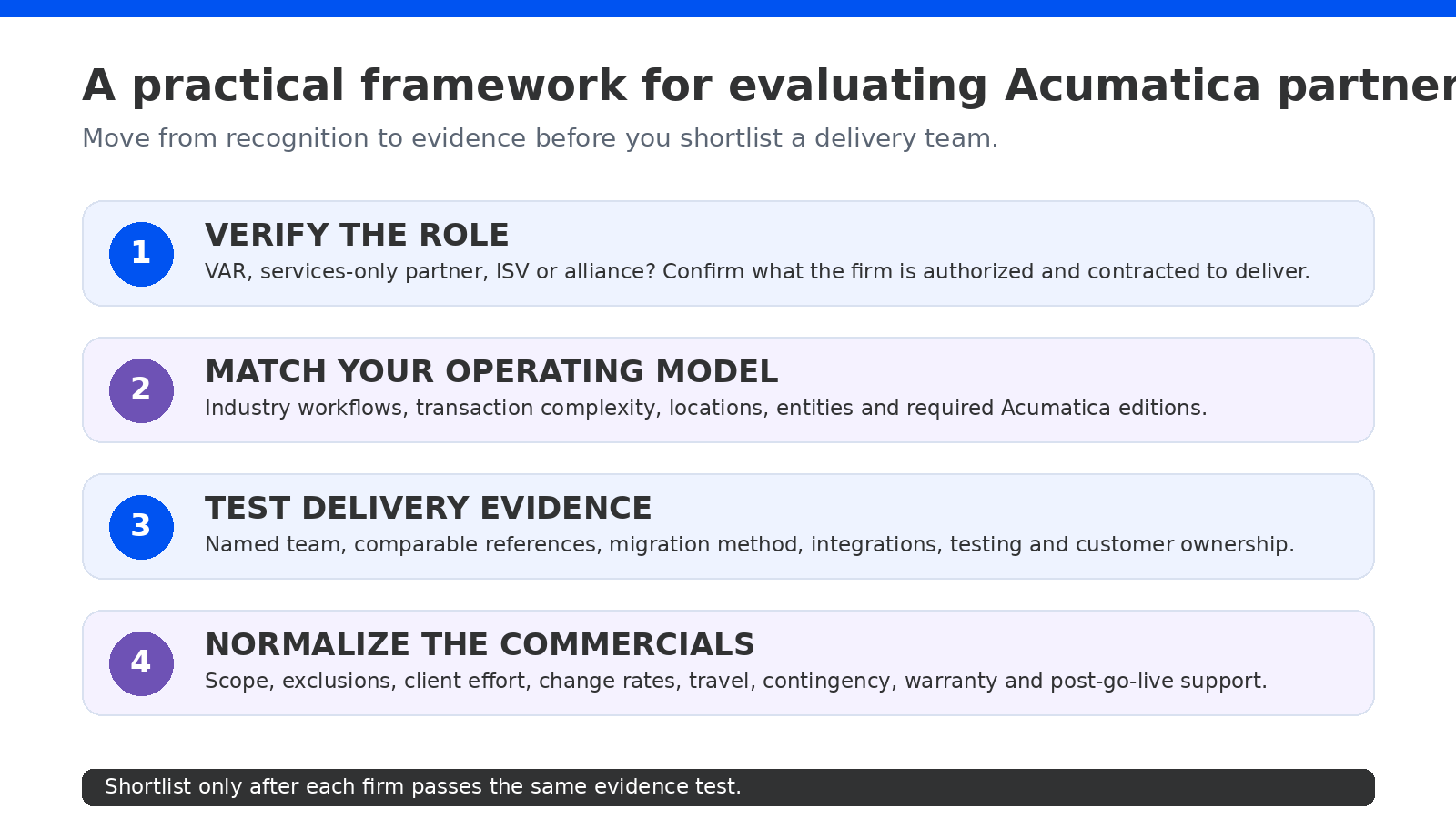
Five questions to ask before signing
- Who will actually deliver the project? Ask to meet the project manager and lead functional and technical consultants. Put key roles and substitution rules in the agreement.
- What is included in the implementation scope? Require explicit deliverables for configuration, data migration, integrations, reports, testing, training, documentation and cutover.
- What work must our team complete? Customer data cleansing, process decisions, user acceptance testing and subject-matter expert availability can materially affect timeline and cost.
- How will completion be accepted? Define business scenarios, reconciliation tolerances, defect severity, sign-off authority and what happens when acceptance criteria are not met.
- Who owns the system after go-live? Clarify hypercare duration, support hours, escalation, enhancement pricing, documentation and knowledge transfer.
What this shortlist does—and does not—tell you
This list reflects publicly available information reviewed on 7 November 2026. It is a starting point for research, not a certification audit or independent performance ranking. Acumatica’s award categories recognize different achievements, and company websites describe services and capabilities from the provider’s own perspective. Neither source establishes that a firm has current capacity for your project or that its proposed team is the right match.
Before making a decision, verify current partner status with Acumatica, confirm the precise partner role, review the named delivery team, speak with customers who had similar scope and complexity, and compare written proposals on the same assumptions. If a provider is a services-only partner, clarify how contracting, accountability and support will work with the VAR or other prime contractor.
Find an Acumatica partner that fits your requirements
The right partner is the one whose delivery team, industry understanding, implementation approach and commercial model match your operating requirements—not necessarily the firm with the most visible award or the largest practice.
Use SeerOmega’s ERP and CRM directory to continue your research, compare relevant providers and build a shortlist. Before contacting any firm, document your industry, locations, current systems, required modules, integrations, data scope, timeline and internal project ownership. That brief will make the first discovery conversation more useful.
Frequently asked questions
Are all Acumatica partners implementation partners?
No. Acumatica’s ecosystem includes VARs, services providers, ISVs and other partner types. A VAR may sell, implement and support the ERP. A services provider may deliver configuration or technical services, sometimes working with a VAR. An ISV develops software that extends the platform. Confirm the specific role and contractual responsibility before engaging a firm.
Does an Acumatica award guarantee implementation quality?
No. Awards provide a useful signal about a particular category and evaluation period. They do not guarantee that the team proposed for your project has the right skills, availability or industry experience. Ask for project-specific references and evidence.
Should we choose a partner based on industry specialization?
Industry experience is important when your workflows involve specialized processes such as property accounting, manufacturing, distribution or construction. But validate the actual processes delivered, not just the industry logos on a website. Ask for references with similar transaction volumes, locations, integrations and reporting needs.
Can we use a services-only partner?
Potentially, but first establish who owns the prime contract, solution architecture, licensing relationship, project governance, escalation and ongoing support. A multi-party delivery model can work when responsibilities are explicit; it can create gaps when accountability is unclear.
What should we compare in Acumatica implementation proposals?
Compare scope, deliverables, assumptions, exclusions, named resources, customer responsibilities, migration, integrations, testing, training, cutover, acceptance criteria, change control, warranty and post-go-live support. Compare the total cost of the same scope rather than headline fees.
