

ERP implementation change requests are not automatically a sign that a project was poorly scoped. As teams validate requirements, test real workflows and discover data or integration dependencies, new information will emerge. The risk begins when those requests are accepted informally—through meetings, chat messages or verbal instructions—without assessing what they do to the approved scope, budget, timeline and operational risk.
A workable change-control process should not block useful improvements. It should make the trade-off visible, route the decision to the right owner and preserve a reliable record of what the project agreed to deliver. This guide explains how to set up that process, assess requests and avoid turning every new idea into a costly project delay.
What counts as an ERP implementation change request?
A change request is a documented proposal to alter an approved project baseline. The baseline may include business requirements, process design, configuration, integrations, data migration, security, reports, testing scope, deployment approach, milestones or budget.
Not every clarification needs a formal change request. Correcting a typo in a requirement or resolving a defect against an already-approved design is normally delivery work. Adding a new approval layer, changing a financial posting rule, introducing another integration or expanding the rollout to another business unit may change the baseline and should be assessed through the agreed process.
| Request type | Example | Typical treatment |
|---|---|---|
| Defect or correction | Configured tax logic does not match the signed-off requirement | Manage through issue and defect resolution; do not disguise a missed requirement as new scope |
| Clarification | A field label or report definition needs explanation without changing the agreed outcome | Resolve within the existing design authority and document the clarification |
| Scope change | Add a new approval workflow, legal entity, integration or report not in the baseline | Log, assess impact and obtain approval before work starts |
| Risk or compliance response | A newly identified control gap requires additional access restrictions or audit evidence | Escalate promptly; assess mandatory action and delivery impact with the accountable owners |
| Future-phase enhancement | A useful capability is requested but is not essential for the agreed go-live | Record in a prioritized backlog for a later release |
Why ERP projects experience scope changes
Requirements become clearer during fit-gap and testing
Stakeholders may describe a requirement at a high level during discovery. Once they see the configured process, they identify missing exceptions, approval paths or reporting needs. Some of these findings expose a genuine requirement gap; others are preferences for reproducing a familiar legacy process. The team must distinguish business necessity from habit.
Data and integration dependencies surface late
A new field may appear simple in the ERP screen but affect CRM synchronization, reporting, tax calculations, warehouse processes or downstream analytics. A request to change customer ownership, product attributes or order status can have a much wider impact than the requester expects. Assess the full process and data flow before estimating the change.
New stakeholders join or decisions are delayed
When finance, operations, procurement, sales or regional leaders enter the project late, they may raise needs that were not represented in earlier workshops. This is one reason decision owners and process representatives should be named early. Late stakeholder input is not always avoidable, but its impact should be managed explicitly.
Teams confuse a defect with an enhancement
Implementation partners and customers can disagree about whether an item is included. A requirement may have been discussed but never approved; a standard feature may have been assumed but not included in the signed scope; or a delivered configuration may not meet the acceptance criteria. Keep the signed requirements, design decisions and acceptance evidence accessible so that the team can classify the request based on facts rather than who raised it.
Set the change-control rules before configuration begins
Do not wait until the first contentious request to decide who can approve it. Include the change process in the project governance plan and align it with the statement of work, delivery plan and requirements baseline. The process should define:
- What triggers formal review: changes to requirements, deliverables, integrations, data scope, controls, budget, critical milestones or deployment scope.
- Who can submit a request: named business owners, workstream leads, project managers and the implementation partner’s delivery lead.
- Who assesses impact: the relevant functional, technical, data, security, testing and change-management owners.
- Who decides: project manager for delegated low-impact items; sponsor or change-control board for material scope, cost or schedule decisions.
- How decisions are recorded: approval, rejection or deferral, rationale, owner, date and linked baseline updates.
- How urgent risks are handled: a fast escalation route for legal, security, safety, financial-control or business-continuity issues.
Thresholds should fit the project. A small implementation may use a sponsor and project manager rather than a large formal board. A multi-entity programme may need separate technical and business review paths. The principle is consistent: authority must be clear, and the people affected by a decision must be informed.
The five-step ERP change-request workflow
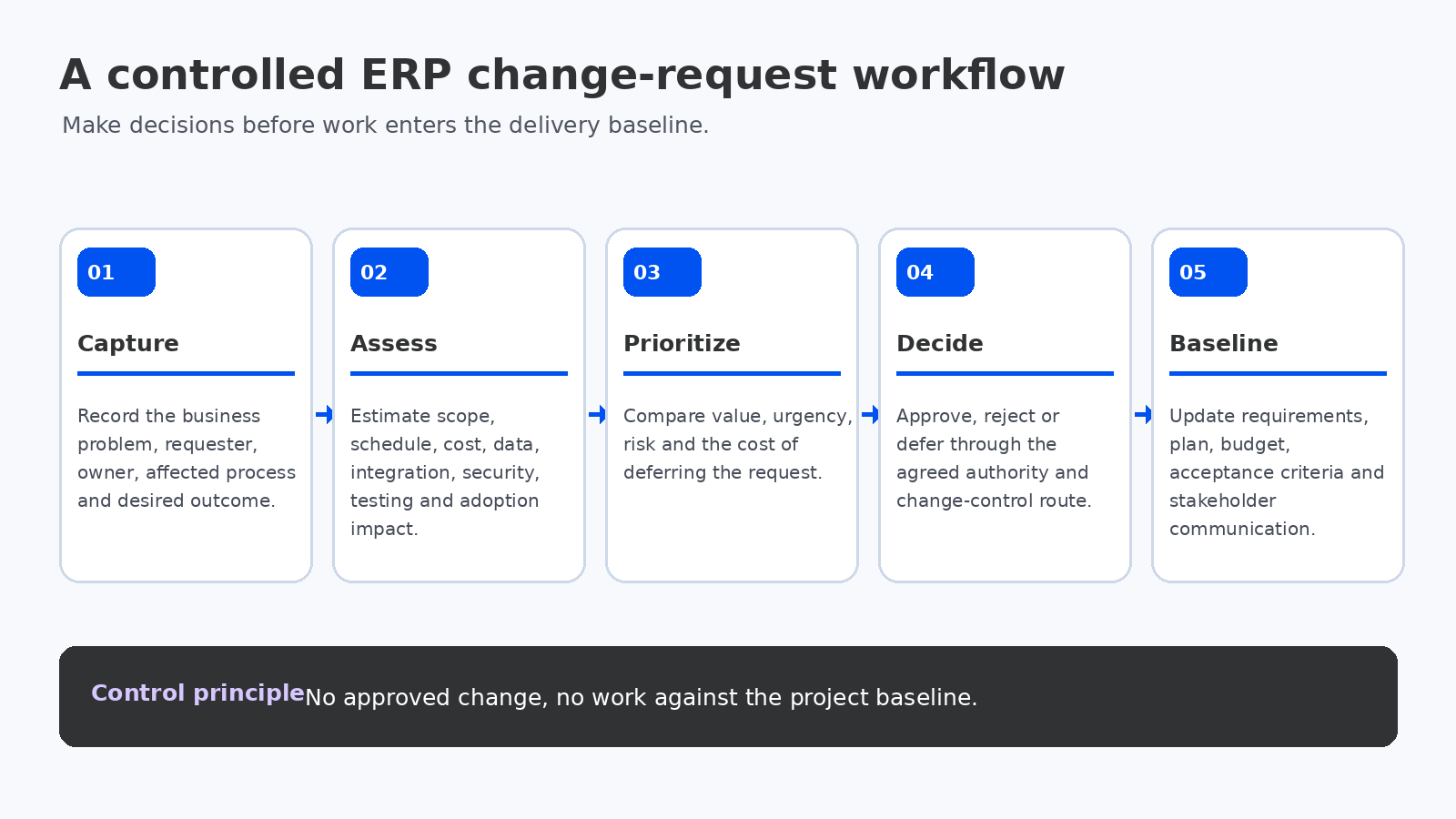
1. Capture the request and the business reason
Use one change log or request form. Capture the requester, date, affected process, requirement or deliverable, problem being solved, desired outcome, urgency and business owner. Ask what happens if the request is not implemented now. This prevents a solution idea—“add another field”—from being mistaken for the business problem it is meant to solve.
2. Assess the end-to-end impact
The relevant workstream leads should estimate more than development effort. Review effects on:
- Business process, roles, approvals and segregation of duties.
- ERP configuration, extensions, reports and user experience.
- Integrations, APIs, middleware, data ownership and error handling.
- Data migration, master data, historical records and reconciliation.
- Security, privacy, auditability and regulatory controls.
- Testing, regression coverage, training and operating procedures.
- Cost, resource capacity, critical path, cutover and support.
Record dependencies and uncertainty. If the impact cannot yet be estimated, approve a time-boxed analysis task—not the implementation itself. The analysis should have an owner, effort limit and decision date.
3. Prioritize against business value and delivery risk
Compare the expected benefit with the cost and risk of making the change now. Consider whether it is legally or operationally mandatory, whether it prevents material financial or control exposure, whether it improves a critical business outcome, and whether it can safely wait for a later release.
A useful prioritization test is to compare three choices: implement now, defer to a defined later phase, or do not proceed. Deferral is a real decision only when the backlog has an owner, priority, target review point and enough context to revisit the request.
4. Approve, reject or defer through the right authority
Do not let the person who requests a change approve its cost and schedule impact alone. The project manager can approve items within delegated thresholds. Changes that affect scope, funding, critical milestones, controls or go-live readiness should go to the sponsor or designated board. The implementation partner should provide an impact assessment but should not make the customer’s business-priority decision.
Record the decision and rationale. If approved, specify the revised deliverable, cost, schedule, resources, assumptions and acceptance criteria. If rejected, explain why. If deferred, record when and by whom it will be reconsidered.
5. Update the baseline before work starts
Approval is not complete until the project artefacts reflect it. Update the requirements traceability matrix, solution design, project plan, budget forecast, test scenarios, training materials, risk register and relevant contract or statement-of-work change order. Notify affected workstreams and business owners. The team should be able to trace each approved change from request to delivery and acceptance.
Change request impact assessment: what to estimate
| Impact area | Questions to answer | Evidence to retain |
|---|---|---|
| Scope and process | Which requirement, role or process changes? What is removed or added? | Updated requirement, process map and decision record |
| Cost and resources | What partner effort, licences, infrastructure or internal capacity is required? | Effort estimate, rate basis and revised forecast |
| Schedule | Does the change affect a dependency, test cycle, milestone or critical path? | Updated plan and milestone impact |
| Technology and data | Which integrations, extensions, data objects or environments are affected? | Solution design, interface impact and data mapping updates |
| Controls and risk | Does it change access, approvals, audit trail, privacy or regulatory exposure? | Risk assessment and control-owner approval |
| Adoption and support | Who needs retraining, revised procedures or additional support? | Training impact, communications and support plan |
Use decision thresholds to avoid bureaucracy
Formal control should be proportionate. If every minor wording adjustment requires a steering committee meeting, teams will bypass the process. If major changes can be approved in a chat message, the project has no reliable baseline.
Set project-specific thresholds for cost, schedule and risk. For example, the project manager might be allowed to approve a small change that uses contingency, does not move a milestone and does not alter a control or signed requirement. A change that adds a business unit, creates a new interface, changes a critical financial process or moves go-live should require sponsor-level review. Do not copy generic monetary thresholds from another programme; use the approved budget, delegated authority and risk profile of this project.
What belongs in a change request form?
A practical request record should include:
- Unique request ID, title, requester, date and business owner.
- Business problem, expected outcome and reason for urgency.
- Current baseline and exact proposed change.
- Options considered, including defer or reject.
- Impact assessment across scope, cost, schedule, resources, data, integrations, controls, testing and adoption.
- Dependencies, assumptions, risks and unresolved questions.
- Decision, approver, rationale and approval date.
- Revised deliverables, estimate, milestones and acceptance criteria.
- Implementation owner, target release and validation evidence.
- Closure status and confirmation that project records were updated.
Common change-control mistakes
- Starting work before approval: creates cost disputes and makes the baseline unreliable.
- Estimating only developer hours: ignores testing, data, security, training, documentation and support.
- Approving changes individually without cumulative review: many small requests can collectively consume contingency and delay milestones.
- Rejecting every new idea: prevents the project from responding to genuine legal, operational or customer needs.
- Using vague deferrals: “phase two” without an owner or review date often means the requirement disappears.
- Failing to update the SOW and plan: creates a gap between the commercial agreement and what the team is delivering.
- Allowing the partner to decide business priority: the partner can advise on effort and risk, but the customer owns the trade-off.
Questions for the project sponsor and implementation partner
- What is the approved baseline, and where is the latest version stored?
- Which changes can the project manager approve without sponsor review?
- How are defects separated from new requirements and enhancements?
- Does every estimate include testing, documentation, training and support impact?
- How are cumulative changes and contingency consumption reported?
- Who owns deferred requests and decides whether they enter a later release?
- How are approved changes reflected in the SOW, budget, plan and acceptance criteria?
Final recommendation
ERP change control should protect delivery commitments without freezing business improvement. Agree the baseline, decision rights and thresholds early. Require each request to state the business outcome, assess its full end-to-end impact, and receive approval from the right owner before work begins. Track approved, rejected and deferred requests together so the sponsor can see the cumulative effect on cost, schedule and expected value.
The objective is not to minimize the number of changes. It is to ensure that every material change is intentional, affordable, traceable and aligned with the business case.
Frequently asked questions
What is the difference between an ERP defect and a change request?
A defect is a failure to meet an approved requirement or acceptance criterion. A change request proposes altering the approved requirement, scope or baseline. The project should compare the delivered result with signed-off requirements before classifying disputed items.
Who should approve ERP implementation change requests?
Approval authority should be defined in project governance. Project managers can handle low-impact changes within delegated limits, while sponsors or a change-control board should approve material changes to scope, budget, critical milestones, controls or go-live readiness.
Should every change request increase the project budget?
No. Some changes can be absorbed within agreed contingency or offset by removing lower-priority work. However, the impact should still be assessed and recorded. A change that appears cost-neutral may still affect schedule, testing, risk or internal capacity.
Can an ERP implementation team defer a change to a later phase?
Yes, when the current go-live can meet its approved business and control requirements without the change. Record the deferred request with an owner, rationale, priority and review point so it can be evaluated during release planning.
