

When planning an ERP implementation, one of the earliest resource decisions is whether to deliver the project with an internal team, hire an external implementation partner, or combine both. The choice affects project cost, delivery speed, access to specialist skills, control over business decisions and the organisation’s ability to support the system after go-live.
There is no universal case for keeping implementation in-house or outsourcing it. An organisation with experienced ERP architects, available functional leads and a proven delivery method may be able to manage more work internally. A business implementing a platform for the first time, replacing heavily customized software or connecting multiple sites may need specialist external capacity. Most projects need a hybrid model—but the responsibilities must be explicit.
This guide compares the models, explains which roles should stay with the business, and provides a practical way to decide what to outsource without surrendering ownership of the programme.
What does an in-house ERP implementation team do?
An in-house team consists of employees who lead or contribute to the implementation. It may include an executive sponsor, project manager, process owners, finance and operations subject-matter experts, IT and security leads, data owners, change and training leads, and super-users from affected departments.
The internal team brings knowledge that an external firm cannot fully replicate: how decisions are made, where exceptions occur, why a process exists, which controls are mandatory and what the business considers an acceptable operating model. It also provides continuity after the consultants leave.
However, assigning employees to a project does not automatically create implementation capacity. Their existing roles still need to be covered, and the project needs people who can make timely decisions. If a finance lead can attend only occasional workshops or the IT manager is also responsible for daily support, the project plan must reflect that constraint.
What does an external ERP consultant or implementation partner provide?
External consultants bring product knowledge, implementation methods, specialist configuration skills and experience with project patterns that the organisation may encounter for the first time. Depending on the contract, a partner may lead discovery, process design, configuration, custom development, integration, data conversion, testing, training, cutover and hypercare.
Not every external resource performs the same role. An independent ERP adviser may help select software or oversee the implementation on the buyer’s behalf. A software implementation partner typically configures and deploys the selected platform. A specialist may focus on data migration, integrations, security, change management or project recovery. Define the role before comparing rates or proposals.
For a more detailed distinction between advisory and delivery roles, see ERP consultant vs implementation partner.
In-house vs external ERP implementation: the trade-offs
| Decision factor | In-house team | External partner |
|---|---|---|
| Business process knowledge | Strong understanding of internal operations and exceptions | Needs discovery and validation with process owners |
| Platform expertise | Depends on existing skills and prior implementations | Can provide specialist product and configuration experience |
| Capacity | Competes with business-as-usual responsibilities | Adds delivery capacity, subject to contracted availability |
| Cost profile | Internal time, backfill, recruitment and training | Consulting fees, expenses, change requests and support terms |
| Control | Direct control of priorities and decisions | Requires clear governance and contract boundaries |
| Continuity after go-live | Retains organisational knowledge | Knowledge transfer must be planned and accepted |
| Delivery risk | Risk of skill gaps and limited implementation experience | Risk of partner dependency, team turnover or weak fit |
The comparison is not a scorecard in which one column should win. It is a prompt to identify the capabilities the project needs and decide who is best placed to provide each one.
Which responsibilities should remain inside the business?
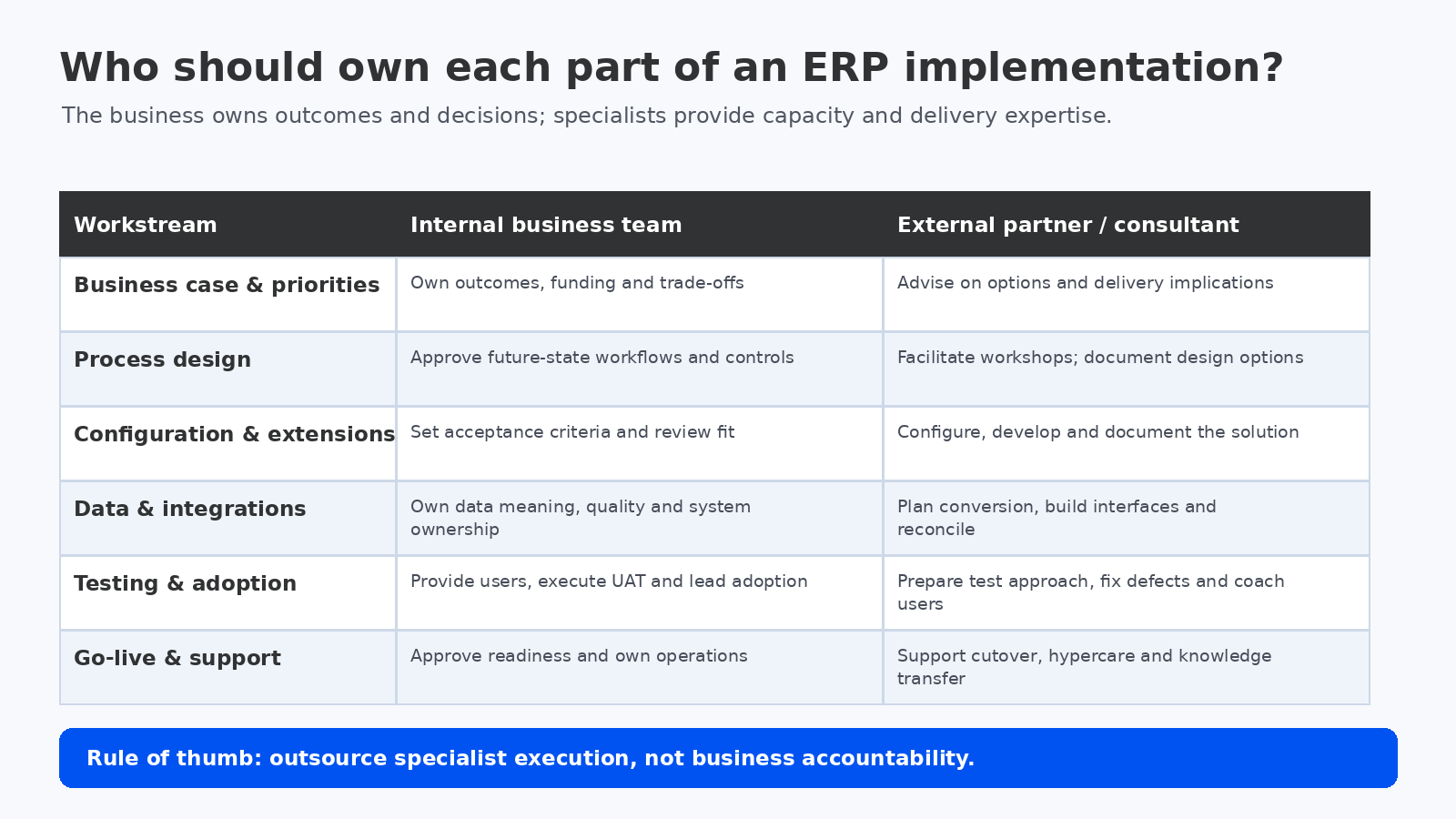
Some activities can be supported by consultants, but accountability should remain with the organisation. The business must own the outcomes it is paying to achieve.
- Business case and priorities: executives approve the investment, define the expected outcomes and resolve trade-offs between departments.
- Process ownership: business leaders approve future-state workflows, policy choices, controls and acceptable exceptions.
- Data accountability: data owners define what a customer, supplier, item, employee or financial record means and approve cleansing and reconciliation rules.
- Decision-making: designated owners approve requirements, design choices, scope changes and residual risks within agreed authority.
- User acceptance and adoption: employees test whether the system supports real work; managers reinforce new processes and training.
- Operational ownership: the organisation decides who administers the platform, manages releases, supports users and governs future enhancements.
A partner can facilitate workshops, recommend controls and execute migration tasks. It cannot independently decide how the business should recognize revenue, approve purchasing, manage inventory ownership or assign accountability for customer records. Those decisions need internal authority.
What can be outsourced effectively?
External support is most valuable when it fills a defined capability or capacity gap. Common candidates include:
- ERP solution architecture and product-specific configuration.
- Specialist finance, manufacturing, supply chain or project-accounting design.
- Integration development, API management and middleware configuration.
- Data extraction, transformation, loading and technical reconciliation support.
- Custom extensions, reports, workflows and development.
- Test strategy, performance testing and technical defect resolution.
- Cutover planning, deployment support and short-term hypercare.
- Independent quality assurance or programme assurance where the project needs an objective review.
Outsourcing execution does not remove the need for an internal owner. For example, the partner can build an interface, but the organisation should approve which system owns each data field, who monitors failed messages and how business users resolve exceptions.
Three delivery models to consider
1. Fully in-house implementation
This model is most plausible when the organisation already has experienced ERP professionals, a stable internal project team, strong platform knowledge and sufficient time to deliver without compromising daily operations. It can make sense for a well-understood system extension, a controlled rollout to another site or a platform where the organisation has an established centre of excellence.
Watch for: hidden opportunity cost, reliance on a few key employees, limited exposure to implementation patterns and a lack of independent challenge. Internal familiarity can also make teams less likely to question legacy processes that should be redesigned.
2. Partner-led implementation
A partner-led model gives the external firm primary responsibility for project delivery, usually under a defined statement of work. It may suit a first-time ERP implementation, a complex migration, a major platform change or a business without enough specialist resources.
Watch for: business decisions being delegated to consultants, excessive customization, undocumented design choices and weak knowledge transfer. A partner-led project still needs a capable customer-side sponsor, project owner and process leads.
3. Hybrid implementation
In a hybrid model, internal employees own the business case, process decisions, data meaning, acceptance and operational model. The partner supplies product expertise, architecture, configuration, development and specialist delivery capacity. The project manager may be internal, external or shared, but decision rights must be unambiguous.
For many mid-market and enterprise buyers, this is the most practical starting point. It preserves business ownership while giving the project access to skills that may be expensive or unnecessary to retain permanently.
How to decide what to keep in-house
Assess each workstream against four questions:
- Is the capability strategically important after go-live? Keep ownership of capabilities that will remain central to ongoing operations, product direction or competitive differentiation.
- Do internal people have proven experience? Distinguish general IT experience from hands-on delivery of the selected ERP platform, integrations and business processes.
- Can the team commit the required time? Confirm actual availability, decision turnaround and backfill needs—not just names on an organisation chart.
- Is the skill needed continuously or temporarily? Specialist migration, architecture or performance skills may be more economical to contract for a defined period than to hire permanently.
Use the answers to build a workstream-by-workstream sourcing plan. Avoid deciding that the whole project must be internal or external before understanding the capability gaps.
Calculate the real cost of each model
An internal team is not free simply because salaries already exist. Include the time employees spend on workshops, data preparation, testing, training, governance and project management. If they are removed from day-to-day roles, estimate backfill, overtime, temporary staff or delayed operational work.
For external delivery, include consulting fees, travel, expenses, subcontractors, change requests, third-party tools, post-go-live support and the cost of extending the engagement if internal decisions are delayed. Confirm which deliverables and test cycles are included in the statement of work.
Then include the cost of transition to business-as-usual: training internal administrators, documenting integrations, transferring configuration knowledge, establishing support procedures and resolving issues after hypercare. The cheapest implementation quote may not be the lowest-cost operating model.
For a broader cost model, see ERP implementation partner cost, fees and total cost of ownership.
Governance controls for a hybrid team
Most disputes between a customer and an implementation partner are easier to prevent when governance is explicit. Establish these controls before configuration begins:
- Decision-rights matrix: name who recommends, approves, executes and is consulted for each major decision.
- Single integrated plan: combine customer and partner tasks, dependencies, milestones, resource commitments and decision deadlines.
- Design authority: record design decisions, alternatives considered, impacts and approvers.
- Scope and change control: assess changes for cost, schedule, integration, data, testing and adoption impact before work starts.
- Deliverable acceptance: define evidence required for design, configuration, migration, testing, training and handover.
- Knowledge transfer: require documentation, walkthroughs, administrator training and practical handover before partner exit.
ERP Research’s project-team guidance and SAP’s implementation-team guidance both emphasize cross-functional business participation and clear project roles. TechTarget’s 2026 overview also outlines the responsibilities that commonly sit with sponsors, project leaders, IT, subject-matter experts, consultants and implementation partners. Use these as role-design references, then adapt the structure to your organisation’s size and risk.
Useful reference material: SAP’s ERP implementation team structure guide, TechTarget’s ERP implementation team roles and ERP Research’s project team guide.
Questions to ask before signing an implementation contract
- Which roles will the partner provide, and who is named for each critical workstream?
- What time commitment is expected from our executive sponsor, project manager and process owners?
- Which deliverables are included, and what evidence is required for acceptance?
- Who owns requirements, design decisions, data quality and user acceptance?
- How will partner team changes, subcontractors and resource availability be managed?
- What documentation, training and knowledge transfer are included before exit?
- What support is available after go-live, and how are additional services priced?
Final recommendation
Do not frame the decision as “in-house or consultant” until you have mapped the work and the skills required. Keep business accountability, process ownership, data decisions and acceptance inside the organisation. Use external specialists where they provide demonstrable platform expertise, delivery capacity or independent assurance that the business does not need to maintain full-time.
A strong hybrid model has one integrated plan, named owners on both sides, documented decision rights and a deliberate handover to internal operations. That structure helps control project cost without creating long-term dependence on the implementation partner.
Frequently asked questions
Can a company implement ERP without an external consultant?
Yes, if it has sufficient platform expertise, project leadership, functional capacity and time to manage design, configuration, migration, testing and deployment. The decision should be based on proven capability and delivery risk, not only a preference to avoid consulting fees.
Who should own an ERP implementation: IT or the business?
ERP implementation requires both. IT typically manages architecture, security and technical integration, while business process owners define workflows, controls and acceptance. Executive sponsorship and cross-functional governance connect the two.
Is a hybrid ERP implementation model cheaper?
Not automatically. It can reduce permanent hiring and improve internal capability, but it still requires committed customer resources and external services. Compare the full cost of delivery, backfill, partner fees, support and future administration.
What should be included in an ERP implementation partner handover?
At minimum, include approved design documents, configuration records, integration specifications, migration mappings, test evidence, known issues, operating procedures, administrator training, support contacts and access to required environments.
