
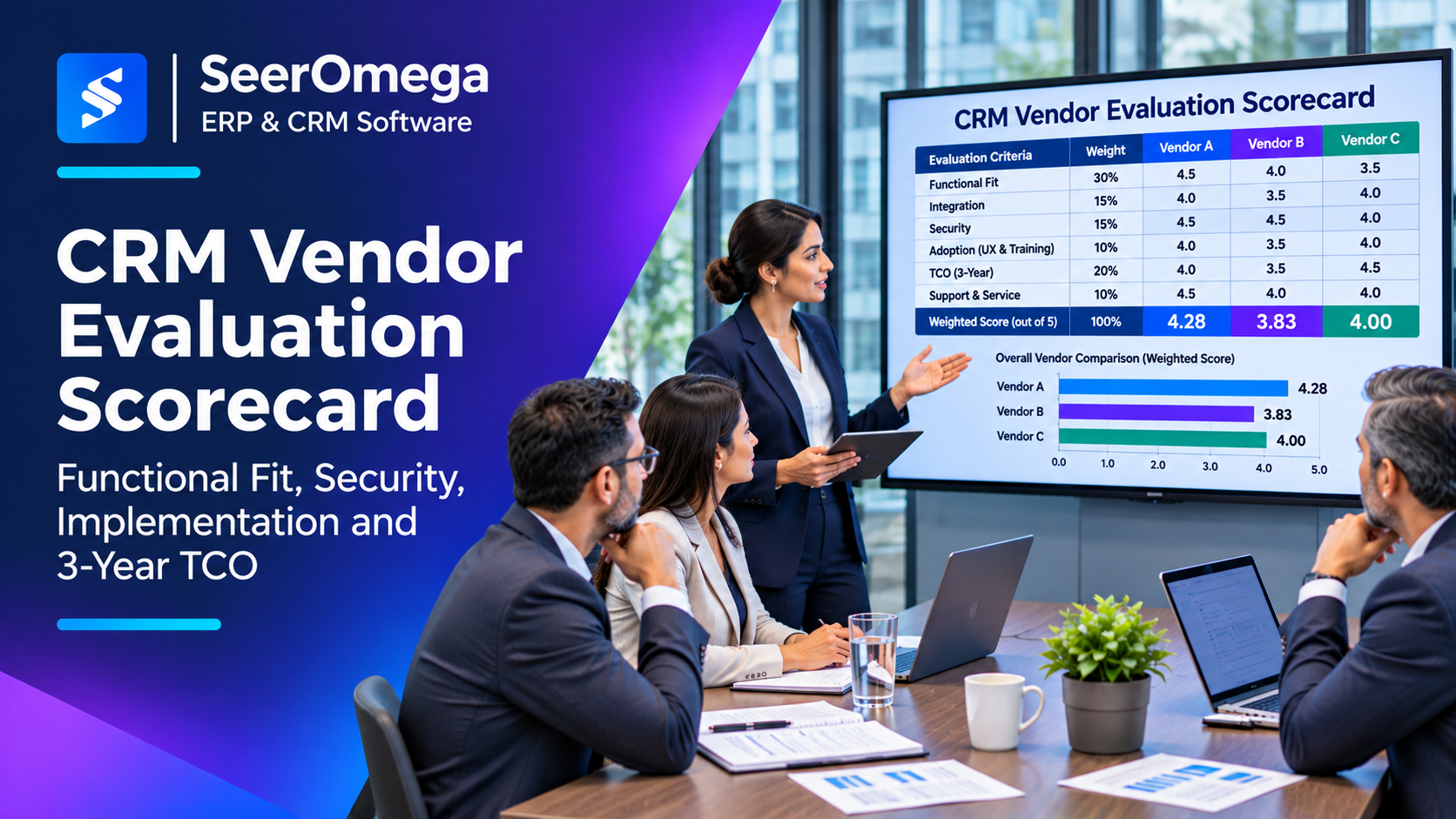
A CRM vendor evaluation scorecard helps a buying team compare platforms against the same business requirements and evidence. Without a shared method, stakeholders can end up comparing different demonstrations, feature lists and pricing assumptions rather than deciding which system best fits the organisation.
A useful scorecard does more than rank features. It tests whether the platform supports real workflows, fits the existing technology environment, meets security expectations, can be adopted by users and remains affordable over the contract period.
Before scoring: define the evaluation rules
Start with an approved requirements set and a shortlist. For most organisations, a small group of credible finalists is easier to evaluate thoroughly than a long list of vendors. Confirm the same test scenarios, data assumptions, user roles and evaluation period for every vendor.
Separate mandatory pass/fail conditions from weighted preferences. For example, a vendor that cannot meet a required data residency or identity control should not win simply because it scores highly on interface design. Agree these gates before demonstrations begin.
Recommended CRM evaluation categories and weights
The following is an illustrative starting model, not a universal benchmark. Adjust weights to reflect the business case. A regulated organisation may give security and auditability more weight; a distributed sales team may place greater emphasis on usability and mobile workflows.
| Category | Illustrative weight | Evidence to request |
|---|---|---|
| Functional and process fit | 25% | Live scenario demonstration against prioritised requirements |
| Usability and adoption | 15% | Role-based task tests with representative users |
| Integration and data architecture | 15% | Architecture, connector scope, API limits and error handling |
| Security and governance | 15% | Security documentation, identity controls, audit and data terms |
| Implementation and migration | 10% | Delivery plan, roles, assumptions, migration approach and references |
| Three-year TCO | 15% | Written quote, add-ons, services, support and renewal assumptions |
| Support and vendor fit | 5% | Support model, escalation, roadmap and relevant references |
Weights total 100%. Do not adjust them after seeing which vendor is leading; that undermines the comparison.
1. Functional and process fit
Evaluate the workflows the organisation actually needs: lead capture and qualification, account and contact management, opportunity stages, forecasting, customer service, renewals, approvals and reporting. Ask vendors to demonstrate the same scenarios using representative or anonymised business data.
Score not only whether a feature exists but how well it supports the process. Record whether the workflow is available out of the box, requires configuration, depends on an add-on or needs custom development. Capture manual workarounds and any limitations that would affect daily operations.
2. Usability and adoption
A powerful CRM can underperform if users avoid it. Test common tasks with the people who will perform them: create a lead, find an account, update an opportunity, record an interaction, complete a hand-off and use the mobile application where relevant.
Observe task completion, navigation effort, error rates and the amount of training required. Check whether users can access the information they need without excessive clicks or switching between screens. Do not rely only on executive impressions of the demonstration.
3. Integration and data architecture
List every system the CRM must exchange data with, including ERP, email, calendar, marketing automation, customer support, identity and analytics platforms. For each connection, identify the direction of data flow, ownership of records, sync frequency, expected volume, latency and failure process.
Ask for the precise API limits and connector entitlements for the quoted plan. Confirm whether middleware, premium connectors, additional environments or specialist implementation services are required. Validate how duplicate records, conflicts, deleted records and failed messages are handled.
Where ERP integration is material, review the SeerOmega guide to CRM–ERP data ownership and synchronisation before finalising architecture assumptions.
4. Security, privacy and governance
Evaluate identity and access management, role and field-level permissions, single sign-on, multi-factor authentication, audit logging, encryption, data location, retention, backup and incident response. Ask which controls are included in the exact subscription tier being quoted and which require an upgrade.
Request current documentation and involve security, privacy and legal reviewers where appropriate. Do not treat a logo or verbal assurance as evidence that the proposed configuration meets the organisation’s requirements. Confirm how administrators can review access and investigate changes to sensitive records.
5. Implementation, migration and partner capability
Review the proposed delivery plan, project governance, discovery method, data migration approach, integration testing, user acceptance, training and post-launch support. Ask who will perform each activity and which responsibilities remain with the customer.
Check assumptions about data cleansing, historical records, customisation, third-party systems, environments and business-user availability. A low implementation quote may exclude important work that later appears as change requests.
Request references from organisations with a similar size, operating model and integration landscape. Ask what changed from the original scope, what caused delays and how support worked after go-live.
6. Three-year total cost of ownership
Subscription price is only one part of CRM cost. Model the expected cost over a consistent period, using the same user counts, growth assumptions, required features and service levels for every vendor.
| Cost component | Questions to include |
|---|---|
| Licensing | Which user types and tiers are required? How does pricing change as seats grow? |
| Add-ons | Are advanced reporting, automation, storage, AI, sandbox or SSO separately charged? |
| Implementation | What discovery, configuration, migration, integration and testing are included? |
| Data and integration | Are middleware, API usage, connectors, storage or data enrichment charged separately? |
| Training and change | What initial and ongoing enablement is needed? |
| Administration | How much internal capacity is required for configuration, data quality and releases? |
| Support | What support tier, response target and premium services are needed? |
| Renewal and exit | What are renewal uplifts, notice periods, export services and termination obligations? |
Use a transparent formula:
Three-year TCO = subscriptions + required add-ons + implementation + integration + migration + training + internal administration + support + other operating costs.
Model at least a base case and a growth case. Include expected user growth, storage, transaction or API consumption and any tier changes. Separate one-time costs from recurring costs, and show assumptions rather than presenting a single unexplained total.
How to score each criterion
Use a consistent five-point scale and require evidence for every score.
| Score | Definition |
|---|---|
| 1 – Does not meet | Requirement is unsupported or a material gap exists. |
| 2 – Partially meets | Significant workaround, custom work or limitation is required. |
| 3 – Meets | Requirement is supported with acceptable configuration and effort. |
| 4 – Exceeds | Strong fit with limited complexity and clear evidence. |
| 5 – Strongly exceeds | Excellent fit demonstrated under realistic conditions. |
Calculate the weighted score by multiplying each criterion score by its weight, then summing the weighted results. For example, if functional fit carries 25% and a vendor scores 4 out of 5, its contribution is 1.00 points to the overall five-point score.
Illustrative scorecard example
The following fictional example demonstrates the calculation only; it is not a rating of real CRM products or vendors.
| Category | Weight | Vendor A | Vendor B | Vendor C |
|---|---|---|---|---|
| Functional fit | 25% | 4.5 | 4.0 | 3.5 |
| Usability and adoption | 15% | 4.0 | 3.5 | 4.0 |
| Integration | 15% | 4.0 | 3.5 | 4.0 |
| Security | 15% | 4.5 | 4.5 | 4.0 |
| Implementation | 10% | 4.0 | 3.5 | 4.0 |
| Three-year TCO | 15% | 4.0 | 3.5 | 4.5 |
| Support and vendor fit | 5% | 4.5 | 4.0 | 4.0 |
| Weighted total | 100% | 4.23 | 3.78 | 3.93 |
Vendor A leads in this example, but the result is not an automatic purchase decision. The team should review mandatory gates, evidence quality, delivery risk and any low score in a critical category. A vendor that fails a non-negotiable security requirement should not proceed because of a strong weighted average.
Run comparable demonstrations and proof-of-concept tests
Send each finalist the same scenario brief and ask them to demonstrate the workflow end to end. Use a fixed timebox and record evidence, assumptions, limitations and follow-up actions. Do not allow one vendor to show a polished standard process while another is tested against complex exceptions.
Where technical uncertainty is high, run a limited proof of concept. Define the question the POC must answer, the data and environment required, success criteria, duration, customer effort and exit decision. A POC should reduce a specific risk, not become an unpaid implementation project.
Reference checks and contract diligence
Speak with customers whose size, complexity and use cases resemble yours. Ask about implementation effort, support responsiveness, adoption, unexpected costs, upgrade impact and the practical process for exporting data. Seek evidence beyond references selected solely by the sales team where possible.
Before signature, reconcile the scorecard with the proposal and contract. Confirm quoted user tiers, add-ons, service scope, implementation assumptions, support levels, renewal terms, data processing terms, export format and exit assistance. Any material vendor promise should be reflected in written commitments.
CRM vendor evaluation checklist
- Business requirements and mandatory gates are approved.
- Every vendor is evaluated against the same scenarios.
- Standard functionality is distinguished from configuration and custom work.
- Representative users have tested common workflows.
- Integration and data ownership assumptions are documented.
- Security controls are verified for the quoted plan.
- Implementation responsibilities and exclusions are clear.
- Three-year TCO uses comparable assumptions.
- Weighted scores include evidence and evaluator notes.
- References, contract terms and exit rights are reviewed.
Frequently asked questions
How many CRM vendors should we evaluate?
Shortlist a manageable number that meet the initial requirements, then conduct consistent deeper evaluations with the strongest candidates. The right number depends on procurement complexity and internal capacity.
Should price have the highest score weight?
Not necessarily. Price matters, but a low subscription cost can be offset by implementation, integration, administration or adoption costs. Weight TCO according to the business case and treat critical controls as pass/fail gates.
Can a vendor with the highest weighted score still be rejected?
Yes. A scorecard supports judgement; it does not replace it. Mandatory requirements, unacceptable delivery risks, weak evidence or contract concerns can disqualify a leading vendor.
When should the scorecard be completed?
Score each vendor immediately after its demonstration or test, while evidence is fresh. Then hold a moderated review to resolve differences and document final assumptions.
Conclusion
A strong CRM vendor evaluation scorecard creates a defensible decision based on process fit, user experience, integration, security, delivery capability and three-year cost. Use the same requirements and scenarios for every finalist, demand evidence, and keep non-negotiable requirements separate from weighted preferences. This gives buyers a clearer view of implementation risk and gives vendors a fairer basis for demonstrating value.
Further reading: HubSpot’s CRM RFP and scoring criteria guide and HubSpot’s CRM vendor comparison guide.
