
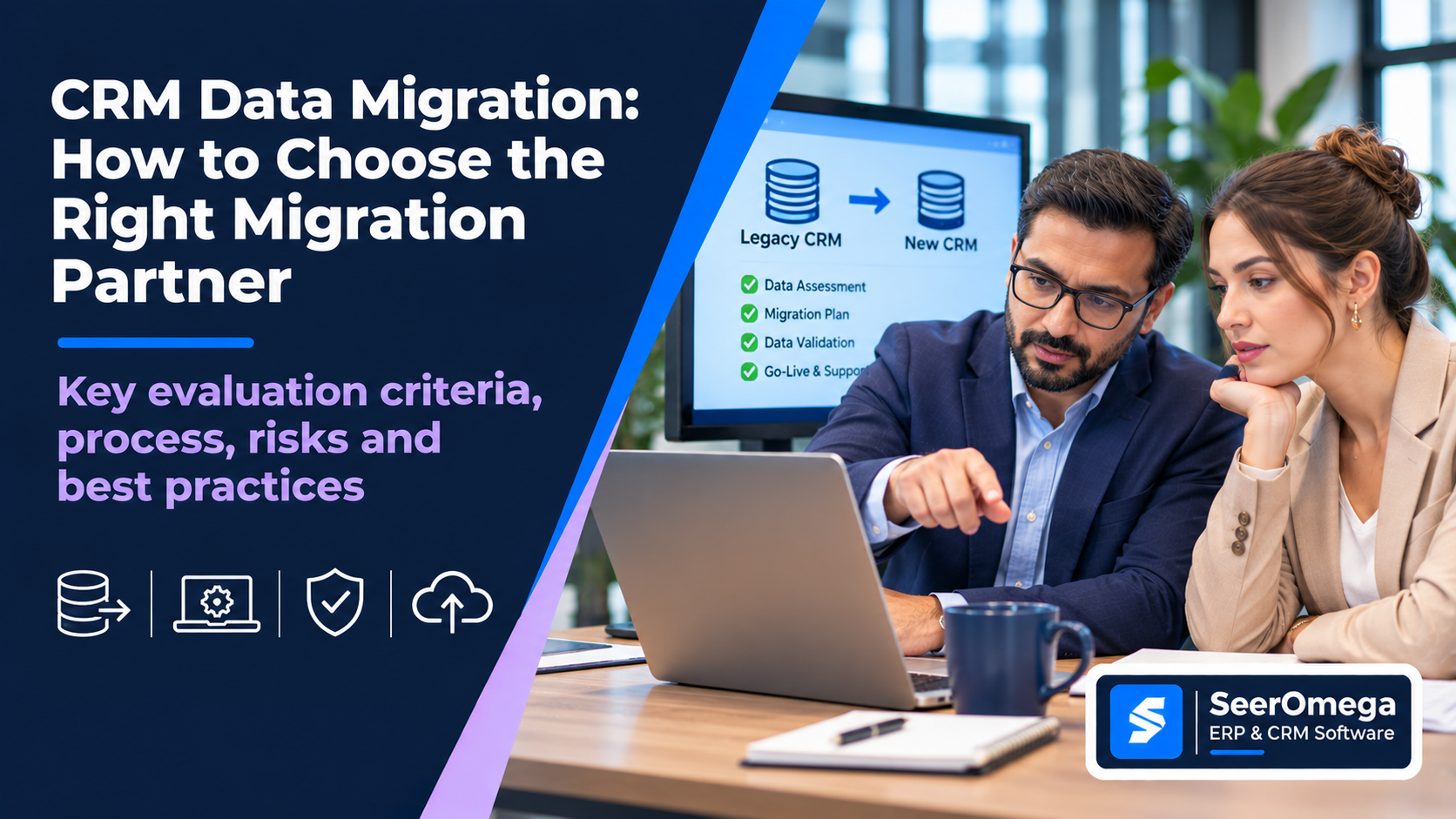
Moving customer records from a legacy CRM to a new platform is a business data project, not simply a file import. The work can involve accounts, contacts, leads, opportunities, activities, cases, consent records, relationships, attachments and historical transactions. Poorly planned migration can leave sales teams with duplicate records, broken ownership, missing activity history or unreliable reports after go-live.
A CRM data migration partner should therefore bring more than technical extraction skills. The provider needs to understand the source and target data models, business rules, data quality, security, validation and cutover requirements. This guide explains how to assess that capability, compare migration proposals and agree the controls needed to protect customer information and business continuity.
What does a CRM data migration partner do?
A migration specialist plans and executes the movement of data between CRM platforms or from other systems into a CRM. The engagement may include:
- Source-system assessment and data profiling.
- Inventory of objects, entities, fields, relationships and historical records.
- Data cleansing, deduplication, standardisation and enrichment rules.
- Source-to-target mapping and transformation logic.
- Migration tooling, scripts, APIs and import configuration.
- Trial migrations, reconciliation and exception handling.
- Security controls, access management and audit evidence.
- Cutover planning, production migration and post-go-live support.
Some CRM implementation partners provide migration as part of a wider implementation. Others specialise in data engineering or migration tooling. The right choice depends on the complexity of the source environment, target CRM, data volume and the level of business risk.
When should you hire a specialist migration provider?
A specialist may be appropriate when data is spread across multiple CRMs, legacy databases or spreadsheets; when the migration includes complex relationships and activity history; when data quality is poor; or when the business needs a controlled cutover with detailed reconciliation. Specialist support is also useful when the migration must preserve auditability, consent information or access restrictions.
For a small, clean dataset with a supported import path, the CRM implementation partner may be able to complete the work without a separate migration firm. Avoid adding another supplier unless the specialist capability or independent assurance justifies the additional coordination and cost.
How to evaluate CRM data migration companies
1. Relevant source and target platform experience
Ask which source and destination platforms the proposed team has migrated between, and whether the examples included the same data objects and relationships as your project. Experience moving contacts and accounts is not automatically evidence of expertise with opportunities, cases, activities, custom objects, attachments or complex ownership rules.
Request the names and roles of the people who will lead the migration. Establish whether the team understands the target CRM’s import mechanisms, APIs, object model, validation rules, limits and security model. Ask how the approach changes when the source system has custom fields, undocumented workflows or inconsistent identifiers.
2. Data discovery and profiling methodology
Before estimating the migration, a capable provider should inspect the source data. Ask how it will identify duplicates, missing values, inconsistent formats, invalid references, inactive records and conflicting ownership. The output should be a data assessment that explains quality issues, volumes, dependencies and remediation decisions.
Do not accept a fixed migration estimate based only on the number of rows. The number of objects, relationships, transformation rules, attachments, historical records and exceptions can matter as much as volume.
3. Source-to-target mapping and transformation
Every migrated field should have an agreed destination or a documented decision to exclude it. Ask for mapping specifications that identify source fields, target fields, transformation rules, default values, lookup resolution and handling of unsupported data. Business owners should approve important mappings because a technically valid transformation may still change the meaning of a sales or service record.
Pay particular attention to record ownership, account-contact relationships, parent-child structures, currencies, dates, statuses, picklists, consent preferences and links between activities and customer records.
4. Data cleansing and deduplication controls
Clarify which cleansing activities are included and who approves the rules. For example, the provider may identify possible duplicates, but the business may need to decide whether two customer records should be merged. Define how the team will handle incomplete records, invalid email addresses, inconsistent country or industry values and obsolete data.
Keep a record of rejected, merged, transformed and excluded records. This makes it possible to explain differences between the source and target totals and to resolve disputes about missing information.
5. Migration tooling and technical approach
Ask whether the provider will use supported platform tools, APIs, ETL processes, specialist migration software or custom scripts. The proposal should explain why the approach fits the data model, volume, security requirements and cutover window. Tools alone do not guarantee quality: mapping, validation, exception management and reconciliation remain essential.
For Microsoft Dataverse and Power Platform workloads, Microsoft’s data migration guidance describes migration considerations and approaches. Salesforce also publishes data migration best practices. Use the documentation relevant to the target platform to validate the proposed method and its constraints.
6. Security, privacy and access controls
CRM data may contain personal information, commercial history and sensitive customer communications. Confirm how the provider will access source and target systems, protect credentials, encrypt data transfers, restrict copies, manage temporary files and remove data after the engagement. Clarify the provider’s role in relation to your organisation’s privacy obligations and contractual requirements; do not assume that a migration vendor’s standard terms automatically satisfy them.
Ask whether production data will be used in non-production environments and, if so, what masking or access controls apply. Ensure that access is time-limited, logged and removed when no longer required.
7. Testing, reconciliation and exception handling
A successful import message is not proof that the migration is correct. The provider should plan test loads and validate record counts, field values, relationships, ownership, attachments and business-critical calculations. Agree sample-based and automated checks, plus full reconciliation for critical data sets where appropriate.
Ask how exceptions will be logged, assigned, corrected and retested. Define who approves each migration cycle and what evidence is required before the production cutover.
8. Cutover and post-migration support
The cutover plan should define data freeze or delta migration, final extraction, migration sequence, reconciliation, user access, go/no-go decision, rollback or recovery approach and communications. Clarify how new or changed records created during the cutover window will be captured and transferred.
After go-live, users may identify missing relationships, unexpected field values or process issues. Agree a hypercare period, severity definitions, response times, ownership and the process for resolving migration defects.
Questions to ask shortlisted CRM migration partners
- Which source and target CRM platforms have you migrated, and what data complexity did those projects involve?
- Will you profile the source data before providing a final estimate?
- How will we approve source-to-target mappings and transformation rules?
- Which records, history, activities, attachments and relationships are included or excluded?
- How will duplicate records and unresolved data-quality issues be handled?
- Which tools, APIs or migration methods do you propose, and why?
- How will sensitive data, credentials and temporary extracts be protected?
- What reconciliation reports and acceptance evidence will we receive?
- How many trial migrations and test cycles are included?
- What is the cutover, rollback and post-go-live support plan?
- Who owns the migration scripts, mapping documents and final data sign-off?
What should the migration statement of work include?
Make the migration scope measurable. The statement of work should identify source and target systems, data objects, estimated volumes, historical scope, attachments, mapping deliverables, cleansing responsibilities, trial loads, test cycles, reconciliation criteria, cutover activities and support period. It should also specify security controls, access dependencies, customer responsibilities, assumptions, exclusions, change control and acceptance criteria.
Define business ownership clearly. The provider can execute technical profiling and transformation, but business stakeholders usually need to approve data definitions, merge decisions, retention rules and the accuracy of critical records. Without that involvement, the migration may be technically complete but operationally unreliable.
Compare CRM data migration costs
Migration pricing depends on source-system count, data volume, complexity, data quality, relationships, history, tooling, security requirements and cutover constraints. Compare providers using the same inventory and assumptions.
| Cost area | What to clarify |
|---|---|
| Discovery and profiling | Source assessment, volume analysis, data quality report and risk findings |
| Mapping and transformation | Number of objects, fields, relationships and business-approved rules |
| Cleansing and deduplication | Rules, manual review, exception volumes and business-owner effort |
| Migration execution | Tools, scripts, trial loads, full loads and delta migration |
| Testing and reconciliation | Test cycles, reports, acceptance evidence and defect remediation |
| Cutover and support | Production window, rollback planning, hypercare and response commitments |
Ask providers to separate fixed deliverables from work that depends on findings during profiling. A discovery phase followed by a refined migration estimate can be more credible than a low fixed quote made before the source data is understood. Include internal data-owner time and any migration-tool or platform charges in the total budget.
Warning signs when selecting a CRM migration partner
- The provider estimates the work from record count alone without profiling the data.
- It cannot explain how relationships, ownership, activities or attachments will be preserved.
- There is no mapping approval, reconciliation or exception-management process.
- Security, temporary data storage and credential handling are not documented.
- The migration plan has no trial loads, cutover controls or recovery approach.
- Business data owners are not included in the plan.
- The proposal excludes post-go-live defect support without making the impact clear.
CRM migration partner vs CRM implementation partner
A CRM implementation partner may be the best choice when migration is a defined part of a broader, well-understood deployment and the team has the necessary data engineering skills. A specialist migration company can add value when the source environment is complex, multiple systems must be consolidated, data quality is poor or independent migration assurance is needed.
If two providers are involved, define who owns the target data model, mapping approval, migration execution, testing, cutover and defect resolution. Avoid split accountability where the implementation partner blames the migration specialist for target configuration issues and the migration specialist blames the CRM team for data model changes.
Related CRM migration resources
Use SeerOmega’s CRM data migration checklist for the operational steps involved in planning, mapping, testing and moving records. This partner-selection guide complements that checklist by focusing on how to assess the provider responsible for the work. You can also review the SeerOmega ERP/CRM directory when building a shortlist of CRM implementation and migration providers.
Bottom line: select a CRM data migration partner based on its ability to understand your source and target data, document mappings, protect sensitive information, validate results and manage cutover. A defensible proposal makes responsibilities and acceptance criteria explicit and accounts for the work required after the data is loaded.
