


Shop operators are constantly looking for ways to increase your CTR (CTR) in order to attract more relevant traffic. Recently, search results can now also in Germany known by. “Google Rich Snippets” are enriched with additional information such as product reviews and prices. With one implementation, shop operators gain a competitive advantage.
Rich snippets are generated by Google and by the way perhaps soon from other search engines if you equip your site with additional HTML markup. What the visitor to the Google search results page then sees are rich snippets, greatly enhanced search result snippets that show in the overview of the SERP (Search Engine Result Page) directly essential features of your offer. It may be product descriptions with prices and availability, events, people, product reviews, recipes and more.
Competitive advantage through the early implementation
It is obvious what can be achieved through these rich snippets likely: Compared to sites that have not implemented the additional markup, you are with your correspondingly enriched offer not only higher in the ranking, but also of the seeker perceived as relevant – and clicked. This mainly because essential snippets of information have to be awkward explored on your site do not, but are displayed directly in the search results list.
In all cases obtain at present through the use of fairly simple to use markup extensions a competitive advantage. One should, for this reason already begin to implement, the competitors are probably already doing. In a few months, the use of rich snippets is probably already part of everyday life and other strategies will be the classic SEO thoughts following, revolve around how the additional markup can be optimized so that it is superior to that of competitors. Currently, there is a window of time that is suitable to secure a certain advantage in terms of the attractiveness of your website in the search results.
Schema.org: An overarching standard for additional markup
As already mentioned, it is necessary to prepare the site for the production of rich snippets only a manageable expense. The additional markup to be incorporated into the existing HTML pages is relatively easy to implement and is on the launched for this purpose website Schema.org described in great detail. Who has applied to the HTML files of the Web appearance even hand, will have no difficulty to do the preparation for rich snippets themselves. But for systems such as TYPO3, Magento or WordPress implementations exist that allow the use.
Incidentally, one must not worry about the presentation of content in particular. The additional markup actually is for information only for crawlers made by Google. A display within the layout of your website does not occur. (Editor’s note: Google has updated its SEO Webmaster Guidelines content for rich snippets must, therefore, be visible to users..)
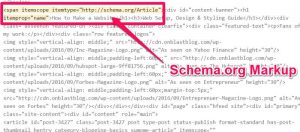 In the past, additional markup needed to be addressed on a specific Google URL. To allow the subject a universal distribution, one then swung over to the site Schema.org. Here a markup crawler_id independently defined, which can be currently interpreted by Google, Microsoft and Yahoo and the default is open. So more vendors can jump on the moving train. In the future, there could be special services that aggregate the data that can be retrieved through the additional markup in a way that goes far beyond a mere show of enriched search results.
Schema.org already supports more additional markup as Google for rich snippets currently used. You should therefore from the scope of possibilities not be killed, but clearly focused on the markup options required to generate rich snippets in the Google search. Currently, Google uses data snippet generation in the areas of people, events, reviews, products, recipes and side navigation. Let’s take below a closer look at the subject products and reviews.
Products with additional information in the SERP
An important piece of information you should keep in mind: you do not try with great perfection, to honor all the elements of the site schema.org compliant. Depending on the scope of the offer, this approach would inflate a giant project. Instead, go first so ago that you only extend some parts of your presence, so especially those who want to bring in the visitors focus. Classically it could be special offers of any kind act to special promotions or special products. In this way, you gain experience in the handling and also the impact of the additional markup without having to equip your entire website with rich snippets. You can expand the scope of award later still.
 Google will add the index to the then newly added information with every new search. Another advantage in this way: The crawler finds at every visit of change, the love search engines. Have you been offered products on your site, so this appeared in the HTML markup ultimately as plain text information. This is sufficient for the eye of the human visitor but looks pretty unstructured on search engines.
Google would, therefore, have to try out a jumble of first peer text information, the main algorithmic read to them presenting structured can. This works at least across multiple languages rather bad.
The standardized on Schema.org markup improved – as shown above – this situation dramatically. The relevant pieces of information such as ratings (stars), product images or quotations are individually provided with properties and can as the contents of a database structured to be read. Since the markup based on nearly natural English terms, but it is also for us humans quickly understandable and usable: One can easily imagine what the properties price, description or worst rating and best Rating they mean.
The technique: Rich Snippets and HTML markup
Technically be products while in a container (a so-called Div) written within which then with additional elements (so-called. Spans), the individual information is housed. Besides the fact that we have to work with Div and span in the HTML code, but it is ultimately the type of product description that (can and from there possibly automated in the Google Rich Snippets contribute) for example, we also find in catalogs. First, the product is called, and in the immediate vicinity as well as learn additional information about the description, the price or availability. A sample HTML may at first look a little awkward, quickly but you can see how easy rich snippets are constructed.
<div itemscope itemtype=“http://schema.org/Product“>
<span itemprop=“name“>ACME 17″ Mikrowelle</span>
<img src=“acme-microwave-17in.jpg“ alt=’ACME 17″ Microwave’/>
<div itemprop=“aggregateRating“ itemscope itemtype=“http://schema.org/AggregateRating“>
Rated <span itemprop = “ratingValue”> 3.5 </ span> / 5 based on <span itemprop = “review count”> 11 </ span> User Reviews </ div>
<div itemprop=“offers“ itemscope itemtype=“http://schema.org/Offer“>
<Span itemprop = “price”> € 55.00 </ span>
<link itemprop=“availability“ href=“http://schema.org/InStock“/>Auf Lager</div>
Product description:
<Span itemprop = “description”> eight cooking programs and a
Parental controls, make this microwave ideal for families. </
span></div>
In summary, one can say: The nesting of various div elements to an almost unmanageable complexity of a single product display can be achieved. Thus, the “data” are added in this way customer reviews or meta-information, and the aggregation of various values with corresponding averaging is provided. For example, the meaningful second snippet-line in the search result, indicating, for example, with a view of adjacently placed asterisks how well the product was evaluated and how many reviews of the graph is based arises. It is obvious that a potential customer is more likely to click on a link such enriched, as a lack of information is to be taken.
Working with the Google Testing Tool
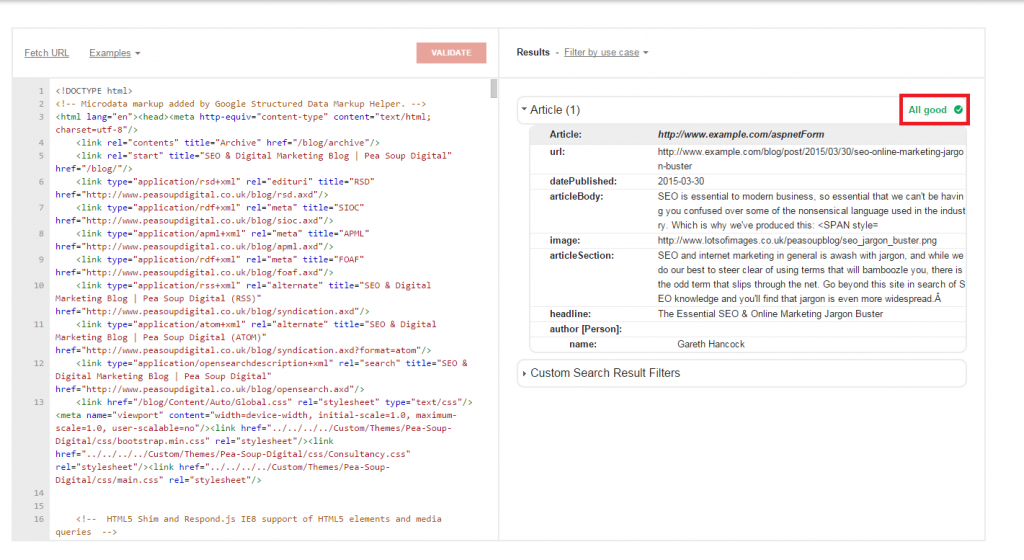
To make sure that no mistakes have been made in the integration of additional markup, you can use the Google Rich Snippets Testing Tools. This tool displays the information that Google can recognize from the markup. Note that it is indeed a WYSIWYG Preview acts, but not a true preview of the search result. It is, therefore, the rich snippet displayed as it would appear in the search results – if it were for display. But the latter is not guaranteed. Warnings and error indicate the tool striking also get a list of the extracted information.
