

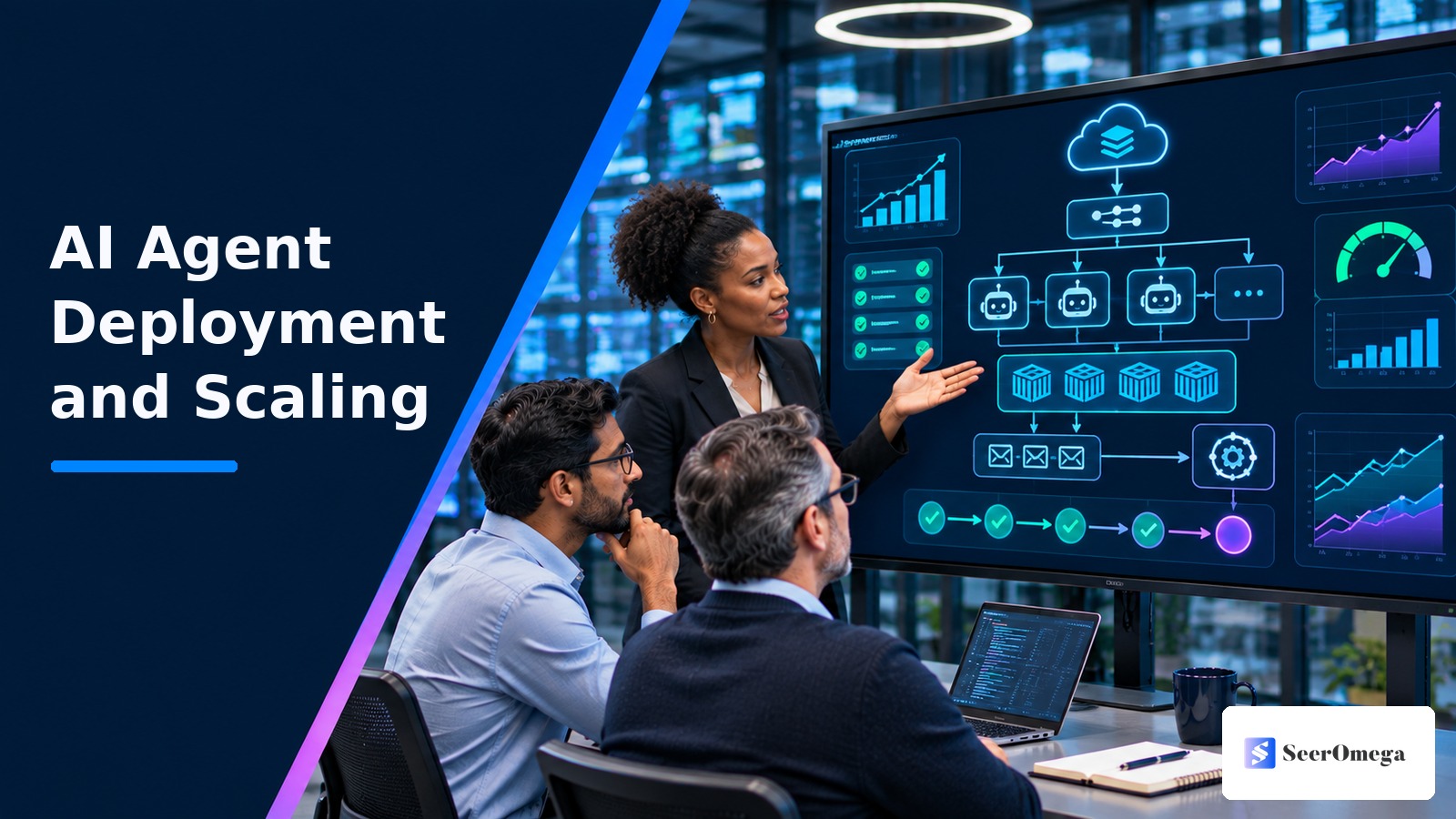
Moving an AI agent from a successful demo into production changes the engineering problem. The system must handle real users, real business data, variable demand, service interruptions, model changes and actions that can affect downstream systems. It also needs clear ownership, controlled releases, measurable service levels and a way to recover when a run fails halfway through a task.
Scaling is not simply adding more model capacity or running more agent instances. It means building a repeatable platform and operating model so teams can deploy multiple agents safely, keep their state and permissions isolated, manage dependencies, observe behavior and control cost as usage grows.
This guide explains how to design an enterprise deployment path for AI agents in 2027. It focuses on runtime architecture, environment separation, durable state, workload scaling, reliability, release engineering, operations and organizational readiness. It complements our guides to AI agent management platforms, agent observability, agent evaluation and testing, and enterprise agent governance.
What production deployment needs to solve
An agent prototype usually runs with a narrow set of users, a limited workload and a developer who understands its assumptions. Production introduces concurrent sessions, long-running tasks, changing context, retries, tool failures, data access requirements and business-critical expectations.
A production-ready deployment should provide:
- Repeatable delivery: versioned code, prompts, models, tools and configuration with tested release and rollback paths.
- Controlled runtime: isolated execution, bounded permissions, resource limits and approved network access.
- Durable workflow state: recoverable task state that survives process restarts and instance replacement.
- Elastic capacity: the ability to handle changing demand without uncontrolled concurrency or cost.
- Resilience: timeouts, retries, idempotency, queues, checkpoints and explicit failure handling.
- Operational visibility: traces, metrics, logs, alerts and service ownership across the full agent workflow.
- Security and governance: identity, least privilege, data boundaries, approvals and lifecycle review.
- Business accountability: defined service expectations, user support, outcome measures and a retirement process.
AWS’s Agentic AI Lens organizes architecture guidance around infrastructure, agent runtime, orchestration, memory, security and operations. Google’s production architecture guidance similarly emphasizes reliability, horizontal scaling and separating state from runtime. These are useful architectural references, but the exact service choices should follow an organization’s workload, cloud strategy and risk requirements. See the AWS Well-Architected Agentic AI Lens and Google Cloud’s single-agent architecture guidance.
1. Choose a deployment pattern that matches the workload
Not every agent needs the same runtime. A synchronous assistant that answers a user in a few seconds has different requirements from a background agent that processes thousands of records or a workflow that waits for human approval over several days.
| Deployment pattern | Typical workload | Architecture considerations |
|---|---|---|
| Request-response service | Interactive assistant or bounded task initiated by a user | API gateway, authenticated session, short execution window, request limits and graceful timeout handling |
| Asynchronous job worker | Document processing, case triage or batch operations | Queue, durable job state, worker pool, retry policy, dead-letter handling and progress status |
| Long-running workflow | Multi-stage process with external dependencies or human approval | Durable orchestration, checkpoints, timers, resumable state and explicit cancellation |
| Event-driven agent | Responding to business events such as a ticket, order or system alert | Event filtering, deduplication, idempotency, backpressure and event replay controls |
| Multi-agent system | Several specialized agents collaborating on a larger task | Orchestration boundaries, delegated identity, shared context policy, bounded fan-out and trace correlation |
Choose the simplest pattern that meets the workflow’s latency, reliability and autonomy requirements. A multi-agent architecture adds coordination, state, failure and security complexity. Use it only when task decomposition or specialization provides a measurable benefit over a single agent or conventional workflow.
2. Separate environments and establish a deployment foundation
Use distinct development, test, staging and production environments. They should have separate credentials, data access, tool endpoints, network rules and resource quotas. Production data should not be copied into development without an approved protection process.
Establish a standard agent deployment package that records:
- Agent code, framework and dependency versions.
- Model provider, model identifier and relevant inference configuration.
- System instructions, prompt templates and policy versions.
- Tool definitions, API schemas, MCP servers and connector versions.
- Identity, permission scopes, secret references and network requirements.
- Evaluation results, release approvals and known limitations.
- Runtime resource limits, scaling configuration and operational owner.
Keep secrets outside source code and model context. Use a managed secrets service or workload identity where supported. Build artifacts through controlled pipelines, scan dependencies and retain a record of the exact versions deployed. An agent’s prompt and tool definitions are production configuration and should be versioned and reviewed like application code.
Microsoft’s agentic AI maturity guidance identifies consistent deployment, lifecycle management, operational telemetry and governance as characteristics of higher-maturity organizations. See Microsoft’s technology and data maturity guidance and its governance and security maturity guidance.
3. Design the runtime for isolation and bounded authority
Run each agent with an identity and permissions that match its approved purpose. Avoid shared credentials and broad service accounts that allow one compromised agent to access unrelated systems. Separate agent identity from the identity of the user who initiated a task, and preserve both in audit records when delegation is used.
Runtime boundaries should cover:
- Identity: distinct workload identity, secure authentication and short-lived credentials where supported.
- Authorization: least-privilege access to tools, records, APIs and data sources.
- Execution: sandboxing or container isolation for code execution and untrusted workloads.
- Network: controlled ingress and egress, approved destinations and restricted access to internal services.
- Resources: CPU, memory, execution duration, concurrency, token and tool-call limits.
- Human control: explicit approval for consequential, external or irreversible actions.
- Containment: a tested way to pause a workflow, revoke credentials and block tool access.
Place policy enforcement at trusted application, gateway and target-system boundaries. Do not rely on a model instruction to prevent unauthorized access. An agent should not be able to expand its own permissions, alter its deployment configuration or disable monitoring through ordinary tools.
For identity-specific design, see our guide to AI agent identity and access management. For protocol-level integration controls, see MCP security for enterprise teams.
4. Make workflow state durable and recoverable
Long-running agents should not depend on a single process or container to preserve their entire task state. Instances may restart, autoscaling may replace workers and external services may become unavailable. Store the state needed to resume work in a durable system outside the runtime process.
Separate different kinds of state:
| State type | Examples | Design requirement |
|---|---|---|
| Conversation context | Recent user messages, task context and relevant references | Access-controlled storage, retention rules and user or tenant isolation |
| Workflow state | Current step, completed actions, pending approvals and retry status | Durable checkpoints, versioned schema and recoverable transitions |
| Business data | Orders, tickets, customer records and transactions | Keep authoritative records in their source systems; use APIs and transactions |
| Long-term memory | Approved preferences or reusable knowledge | Explicit policy for scope, provenance, expiry, correction and deletion |
| Execution artifacts | Generated files, intermediate outputs and tool results | Controlled object storage, integrity checks and lifecycle cleanup |
Persist checkpoints at meaningful boundaries, such as after a validated tool result or before waiting for human approval. On recovery, verify that the saved state is still valid and that permissions have not changed. Do not blindly replay an action that may already have succeeded before a timeout.
Google Cloud’s reference architecture recommends decoupling agent state from runtime and using an external datastore so instances can restart or scale horizontally without losing context. See Google Cloud’s reliability and deployment recommendations.
5. Scale capacity without creating runaway workloads
Agent demand can vary with user activity, scheduled jobs, event volume and task complexity. A single request may trigger several model calls, retrieval operations or tool invocations. Scaling only on HTTP request count may therefore miss the actual workload placed on model providers, databases and downstream APIs.
Measure and manage several capacity signals:
- Incoming requests and queued jobs.
- Active agent runs and concurrent model calls.
- Queue depth, oldest job age and processing rate.
- Tool-call volume and downstream API rate limits.
- Model latency, token throughput and provider capacity responses.
- Runtime CPU, memory, session duration and worker saturation.
- Retries, timeouts, cancellations and failed task rates.
Use horizontal scaling for stateless or independently recoverable workers. Place a queue or admission-control layer in front of expensive or rate-limited operations. Set concurrency limits per tenant, agent, model deployment and downstream service. Apply backpressure when a dependency cannot safely accept more work rather than allowing queues and retries to grow without bound.
Autoscaling should consider both scale-out and scale-in behavior. Fast scale-out may protect latency during demand spikes, while conservative scale-in helps avoid terminating active long-running sessions. Use graceful shutdown, task draining and checkpointing so worker replacement does not abandon in-flight work.
Do not assume that more agent instances automatically improve throughput. Model-provider quotas, shared retrieval systems, database connections, external APIs and human approval queues can become bottlenecks before the agent runtime does.
6. Engineer reliability into every tool interaction
Agents depend on systems that can fail independently. A database may be available while a CRM API is rate-limited. A model call may time out after the downstream action has already completed. A tool may return partial data or an error that the agent misinterprets as success.
Use standard distributed-systems protections:
- Timeouts: set limits for model calls, tool calls, total runs and human approval waits.
- Bounded retries: retry transient failures with backoff and jitter, not permanent authorization or validation errors.
- Idempotency: use idempotency keys or deduplication for actions that create, send or update records.
- Checkpoints: persist progress before long waits and after completed side effects.
- Circuit breakers: stop repeated calls to a failing dependency and recover after a controlled interval.
- Fallbacks: route to a human, a simpler workflow or a safe read-only mode when the agent cannot proceed.
- Dead-letter handling: isolate jobs that repeatedly fail for investigation rather than retrying forever.
- Cancellation: allow users and operators to stop active runs and prevent queued actions from continuing.
Be especially careful with retries around non-idempotent actions. If a payment, email or record update may have succeeded before the connection failed, first check the target system for the result. Blind retries can create duplicate transactions or messages.
7. Release agents through a controlled delivery pipeline
Agent behavior can change when code, model versions, prompts, tools, retrieval sources, memory policies or orchestration logic change. Treat those components as a release unit and evaluate them together.
A production pipeline should include:
- Build: package code and dependencies, record model and tool versions, scan artifacts and generate deployment metadata.
- Test: run unit, integration, security and agent evaluation suites against representative and adversarial scenarios.
- Compare: check task success, tool accuracy, policy adherence, latency, cost and failure behavior against the current baseline.
- Approve: obtain required business, engineering, security and governance approvals based on risk tier.
- Deploy gradually: use a limited pilot, canary or percentage rollout where the architecture supports it.
- Observe: monitor errors, quality, cost and downstream effects during the rollout.
- Rollback or pause: revert the deployment or disable the affected capability when release criteria are not met.
Keep a known-good version available. A rollback should restore compatible prompts, tools, configuration and runtime behavior, not just the application binary. For changes to external models or hosted services that cannot be rolled back by the customer, maintain fallback options and re-run evaluations when the provider changes behavior or availability.
Our guide to AI agent evaluation and testing covers datasets, trace-level evaluation, safety testing and regression gates in more detail.
8. Operate with observability and service ownership
Production monitoring should make it possible to understand whether an agent is available, completing work correctly, respecting its permissions and using resources within expected limits. A single success-rate metric is not enough.
| Signal | Operational question |
|---|---|
| Availability and latency | Can users start and complete tasks within the expected service window? |
| Task outcomes | Are completed tasks accepted, correct and within the approved workflow? |
| Tool behavior | Which tools fail, time out, return unexpected data or trigger policy denials? |
| Queue and runtime health | Are workers saturated, jobs delayed or sessions stuck? |
| Security events | Are there unusual access attempts, permission changes or unexpected destinations? |
| Cost and efficiency | What is the cost per accepted task, and are retries or long-running sessions increasing? |
| Human intervention | How often are tasks escalated, rejected, corrected or cancelled? |
Use distributed traces to connect the user request, agent run, model calls, tool calls, child agents and downstream operations. Keep logs useful for diagnosis while applying data minimization and access controls. Define a named service owner, support route, incident severity model and on-call or escalation arrangement appropriate to the business impact.
AWS’s AgentOps guidance describes governance and security, build and operations, evaluation, and observability as connected operational pillars. Its enterprise agent architecture also places identity and policy at the gateway, with trust controls across the runtime and tool layers. See AWS AgentOps guidance and AWS’s enterprise agent architecture.
9. Manage multi-agent orchestration deliberately
Multiple agents can divide complex work into specialized tasks, but each additional agent introduces another identity, runtime, model call, state boundary and possible failure. Coordination can increase latency and cost, and parallel work can create conflicting updates or duplicate actions.
Before introducing multi-agent orchestration, establish:
- A clear reason why the workflow needs multiple agents rather than one agent or deterministic orchestration.
- Defined responsibilities and boundaries for each agent.
- Explicit parent-child relationships and delegated permissions.
- Shared correlation IDs and trace visibility across handoffs.
- Limits on delegation depth, fan-out, concurrency and total execution time.
- Conflict handling and a clear owner for final decisions.
- Validation of outputs before they trigger downstream actions.
Prefer deterministic workflow steps for operations that require exact sequencing, transaction handling or guaranteed policy enforcement. Use an agent where interpretation, adaptation or unstructured reasoning adds value. A hybrid design is often easier to test and operate than a system in which every step is delegated to another agent.
AWS’s enterprise scaling guidance highlights the challenge of operating across multiple frameworks, models, providers and teams, and recommends reusable platform patterns that preserve flexibility. See Scaling agentic AI: enterprise patterns without vendor lock-in.
10. Control cost and capacity as adoption grows
Scaling increases the importance of cost attribution and workload economics. Measure spend by agent, product, team and environment where provider and platform telemetry allow it. Include model inference, tool calls, runtime, storage, retrieval, observability and shared infrastructure.
Use budgets and runtime limits together. Financial alerts may arrive after usage has occurred, while per-run limits can stop an agent from making excessive calls during a single task. Set thresholds for maximum steps, retries, tool calls, execution duration and token consumption. Provide safe degradation or human escalation when a limit is reached.
Track cost per accepted outcome alongside latency and quality. A lower token bill is not an improvement if it creates more failures, retries or manual corrections. Reforecast when adoption, model mix, workflow complexity or provider pricing changes. For a detailed cost framework, see AI agent cost management and FinOps.
11. Create a reusable enterprise platform without forcing every team into one design
At scale, every product team building its own gateway, identity model, evaluation pipeline and monitoring stack creates duplicated work and inconsistent controls. A shared agent platform can provide reusable capabilities while allowing domain teams to own their workflows.
Common platform services may include:
- Approved model access, routing and quota management.
- Agent templates, runtime environments and deployment pipelines.
- Identity, secrets, tool registry and policy enforcement.
- Shared retrieval, memory and durable workflow services.
- Evaluation datasets, test runners and release gates.
- Tracing, metrics, logging, cost attribution and alerting.
- Agent inventory, ownership records and lifecycle workflows.
Standardize the controls that need consistency, such as identity, audit, data handling and production release evidence. Allow teams to choose frameworks and models when they meet the enterprise requirements. This reduces lock-in and makes it easier to evolve individual workloads without rebuilding the entire platform.
BCG’s 2026 analysis of scaling agentic AI describes a common enterprise backbone, graduation pathways from experimentation to production and adaptation of IT service management for the agent development lifecycle. Treat this as strategic industry analysis rather than a universal architecture prescription. See BCG’s enterprise scaling analysis.
12. Use a staged path from pilot to enterprise scale
Do not move directly from a successful demonstration to broad deployment. Use explicit stages with evidence and exit criteria.
| Stage | Primary objective | Evidence to advance |
|---|---|---|
| Prototype | Validate the use case and technical feasibility | Clear business problem, representative scenarios and initial evaluation results |
| Controlled pilot | Test with a limited user group and bounded permissions | Named owner, isolated environment, user feedback, risk review and support process |
| Production release | Operate a defined workload for real users | Release approval, service expectations, monitoring, incident plan, rollback and cost baseline |
| Scaled operation | Increase users, workload or business coverage | Capacity evidence, reliable state recovery, cost attribution, access reviews and operational ownership |
| Enterprise platform | Enable repeatable deployment across teams | Reusable platform controls, lifecycle governance, shared telemetry and consistent release standards |
Advancement should depend on evidence, not elapsed time or executive enthusiasm. A pilot that cannot explain its failures, costs or permissions is not ready for a larger user population.
A 90-day deployment and scaling roadmap
| Period | Priority work | Deliverable |
|---|---|---|
| Days 1 to 30 | Select one bounded workflow, document architecture and dependencies, define owners, separate environments and establish identity, evaluation and monitoring baselines | Production architecture, deployment package and release criteria |
| Days 31 to 60 | Implement durable state, queues or orchestration as needed, runtime limits, retries, idempotency, trace correlation and staged deployment | Controlled production pilot with recovery and incident procedures |
| Days 61 to 90 | Test load and failure scenarios, tune scaling and budgets, review operational results and standardize reusable platform capabilities | Scale-readiness assessment, service ownership and prioritized platform backlog |
This is an illustrative starting plan. Regulated workloads, complex integrations, safety-critical processes and high-impact actions require additional validation and may need a longer path.
Common deployment and scaling mistakes
- Scaling before proving reliability: more traffic magnifies unresolved errors, permission gaps and poor recovery behavior.
- Keeping state only in memory: instance replacement or restart can lose progress and create duplicate work.
- Autoscaling without admission control: agent instances can overwhelm model quotas, databases and downstream APIs.
- Retrying every failure: repeated non-idempotent actions can create duplicate transactions or external messages.
- Deploying prompts outside change control: prompt and tool changes can alter production behavior even when application code is unchanged.
- Using one identity across agents: shared credentials weaken isolation, attribution and revocation.
- Adding agents without a reason: unnecessary delegation increases cost, latency and operational complexity.
- Monitoring infrastructure but not outcomes: healthy containers do not prove that business tasks are completed correctly.
- Leaving ownership unclear: every production agent needs a business owner and an operational support path.
Frequently asked questions
What is AI agent deployment?
AI agent deployment is the process of moving an agent from development or testing into a controlled environment where it performs real tasks for users or business systems. It includes runtime infrastructure, identity, data access, release controls, monitoring, support and lifecycle ownership.
How do you scale AI agents in an enterprise?
Use a reusable deployment foundation, durable workflow state, horizontal worker scaling where appropriate, queues and admission control, scoped identities, observability, evaluation gates and cost limits. Scale based on workload and dependency capacity, not only request volume.
Should every agent run in a separate container?
Not necessarily. Isolation should match the trust boundary and risk. Some platforms can safely host multiple workloads with strong process and identity isolation, while untrusted code execution or high-impact agents may justify dedicated containers, sandboxes or separate environments.
How should long-running agents recover from failures?
Persist workflow state outside the runtime, checkpoint after meaningful steps, use bounded retries and idempotency for side effects, and provide cancellation and human escalation. Before replaying an action after a timeout, check whether the target system already completed it.
When should an organization use multiple agents?
Use multiple agents when specialization or task decomposition provides a measurable advantage. Keep deterministic sequencing, authorization and transaction controls in conventional services where possible, and bound delegation, concurrency and total execution time.
Scale the operating model, not just the runtime
Enterprise AI agent deployment succeeds when the runtime, data, identity, release process and operating model are designed together. Durable state and failure handling protect work from interruptions. Queues and controlled concurrency protect downstream systems. Evaluation and staged releases reduce the risk of behavior changes. Observability, ownership and cost attribution make the service manageable after launch.
Start with one bounded production workflow and prove that it can recover from failures, respect access boundaries and deliver an accepted outcome under realistic load. Then turn the successful controls into reusable platform capabilities. That is a more sustainable path to scale than multiplying prototypes and hoping each team will solve production operations independently.
