
NetSuite and Acumatica are both cloud ERP options often evaluated by growing mid-market companies, but their commercial models and product fit differ. The decision should start with operating complexity: entities, transaction volumes, inventory, manufacturing, ecommerce, reporting, international requirements and the number of people who need system access.
This comparison separates vendor-published product positioning from the buyer questions that still require a demonstration, quote and reference check. It is not a universal ranking: the stronger fit depends on your business model and implementation scope.
Quick comparison
| Area | Oracle NetSuite | Acumatica |
|---|---|---|
| Core positioning | Cloud business management suite spanning ERP, financials, CRM and commerce capabilities | Cloud ERP platform with editions and industry-focused capabilities |
| Commercial model | Subscription pricing influenced by edition, modules, users and contract terms; obtain a scoped quote | Consumption-oriented licensing model with pricing influenced by resource usage and selected edition; validate current terms |
| Multi-entity | OneWorld supports multi-subsidiary, multi-currency and consolidation scenarios | Supports multi-company structures; validate intercompany and consolidation needs in the proposed configuration |
| Industry fit | Broad ecosystem and SuiteApps; confirm specific process coverage | Industry editions and partner solutions for distribution, manufacturing, construction and other sectors |
| Extensibility | SuiteCloud, SuiteScript, SuiteApps and integration options | Customization, APIs and partner-built applications |
Financial management and multi-entity operations
Compare general ledger, accounts payable and receivable, revenue recognition, fixed assets, budgeting, cash management, tax, intercompany, currency handling and consolidation. For groups, test intercompany order flows and eliminations, local statutory reporting and the time needed to close books across subsidiaries.
NetSuite OneWorld is designed for organisations operating across subsidiaries, currencies and countries. Acumatica can also support multi-company operations, but buyers should test the exact entity, consolidation and intercompany requirements in their proposed edition and configuration. Do not assume “multi-company” means every consolidation workflow is included out of the box.
Inventory, distribution and manufacturing
For distributors, demonstrate replenishment, warehouse locations, bins, lot and serial tracking, landed cost, pricing, order allocation, returns and EDI. For manufacturers, add bills of material, routings, production orders, subcontracting, quality, traceability and planning. Ask each vendor to show exception handling—not just the happy path.
Acumatica publishes a direct comparison with NetSuite, but that is vendor-authored material. Use it to identify questions, not as independent proof of superiority. Ask both vendors to demonstrate the same scripts using your data and operating scenarios.
Pricing and licensing: what buyers should compare
Do not compare a single subscription figure. NetSuite quotes can depend on modules, user counts, edition, subsidiaries and contract terms. Acumatica’s consumption-based model is structured differently; understand the relevant resource metric, included capacity, thresholds and any costs for additional environments or services. Pricing and packaging change, so obtain current written quotes.
| Cost component | NetSuite questions | Acumatica questions |
|---|---|---|
| Subscription | Which edition, modules, users and subsidiaries are priced? | What usage metric and capacity are included in the quote? |
| Implementation | Which workflows, data and integrations are included? | Which edition, configuration and partner services are included? |
| Extensions | Which SuiteApps or SuiteScript work requires separate fees? | Which marketplace apps or customizations add recurring costs? |
| Support | What support tier and partner services are included? | Who provides first-line support and what are the response commitments? |
| Growth | How do new subsidiaries, users and modules affect price? | How do increased transaction volumes and resource use affect price? |
Implementation and ecosystem
Partner capability can materially change project risk. Evaluate the named functional and technical team, industry experience, migration method, integrations, testing, cutover, training and post-go-live support. For NetSuite, clarify whether the provider is a Solution Provider or Alliance Partner and who owns licensing. For Acumatica, distinguish VARs, services partners, ISVs and other ecosystem roles.
Which system may fit?
- Consider NetSuite when global financial management, multi-subsidiary operations, a broad SuiteCloud ecosystem or an integrated ERP/CRM/commerce suite is central to the requirement.
- Consider Acumatica when the business values its resource-based licensing approach, wants a flexible cloud ERP platform and finds a strong fit in its distribution, manufacturing, construction or service capabilities.
- Shortlist both when your processes are in the mid-market overlap and the final decision will turn on partner capability, total cost, user adoption and implementation risk.
Buyer checklist
- Model the user population, subsidiaries, currencies, sites and transaction volumes.
- Document must-have finance, inventory, manufacturing and reporting workflows.
- Demonstrate three to five end-to-end scenarios using realistic exceptions.
- Get a written breakdown of subscription, implementation, integrations and support.
- Speak to customers with similar size and operating complexity.
- Compare three-to-five-year TCO and exit/data-export provisions.
Conclusion
NetSuite and Acumatica can both serve growing businesses, but their licensing structures, ecosystem choices and strengths should be evaluated against your specific requirements. Make the decision with a scripted proof of fit and a normalized commercial model, not a vendor-led feature checklist.
See also our NetSuite alternatives guide, wholesale distribution ERP comparison and ERP cost guide.
Where the commercial models change the decision
The licensing difference is important, but it should not be reduced to “named users versus usage.” NetSuite’s subscription is negotiated around the selected edition, modules, user access and contract structure. Acumatica’s resource-based approach changes how usage and capacity should be forecast. In either case, buyers need a written definition of what is included, what triggers additional charges and how growth affects the contract.
For NetSuite OneWorld, Oracle documents a hierarchical subsidiary structure with subsidiary-specific base currencies and consolidated reporting. Its documentation also describes intercompany accounting and elimination capabilities. These details matter when a business has multiple legal entities, tax jurisdictions or currencies. Review Oracle’s OneWorld overview and subsidiary guidance, then verify limits and licensed scope in your order form.
For Acumatica, ask the vendor and reseller to explain the current usage metric, included resource allowance, monitoring method, overage treatment and whether a seasonal peak changes the subscription tier. Do not assume that every user or transaction is unlimited in every practical sense. Confirm the exact current commercial terms in writing; pricing structures can change and partner quotes may bundle services differently.
Test the workflows that expose real product fit
Generic demos make most mid-market ERP products look similar. Use scenarios that reflect the exceptions your finance and operations teams manage every week.
- Distribution: receive a partial shipment, allocate stock across warehouses, manage lot or serial traceability, apply customer-specific pricing and process a return.
- Manufacturing: revise a bill of material, handle a substitute component, record scrap, subcontract an operation and reconcile actual production cost.
- Multi-entity finance: post a transaction in a subsidiary currency, process an intercompany sale, complete consolidation and explain the audit trail.
- Ecommerce: synchronize item availability, customer pricing, orders, tax, fulfilment and refunds without creating duplicate records.
- Project or service operations: estimate work, track project costs, invoice milestones and report margin by customer and project.
Ask the partner to identify whether each step is native, configured, customized or delivered through an integrated application. That classification is often more useful than a yes/no feature response.
Industry fit: do not rely on edition names alone
Acumatica’s industry editions and partner applications can be relevant to distribution, manufacturing, construction and service businesses. NetSuite’s broader suite and SuiteApp ecosystem may be relevant where a business wants financials, CRM, commerce and operations within a connected platform. Neither statement proves that a specific workflow is covered in your proposed configuration.
For distribution, focus on inventory valuation, replenishment, warehouse execution, landed cost, order allocation and supplier lead times. For manufacturing, test production planning, routings, work centres, material availability, quality and subcontracting. For construction, test project accounting, commitments, change orders, retainage and cost-to-complete. Confirm which capabilities are standard, licensed separately or dependent on a partner solution.
Implementation cost and delivery risk
Request an estimate that separates discovery, solution design, configuration, data migration, integrations, reporting, testing, training, cutover and hypercare. The estimate should state the number of legal entities, locations, warehouses, integrations, historical years, data objects and reports assumed. Ask for a change-control rate card and a list of exclusions.
Data migration deserves a separate workstream. Identify the authoritative source for customers, suppliers, items, open orders, inventory, fixed assets, open receivables/payables and historical transactions. Agree reconciliation totals and business sign-off before the final cutover. A migration that merely imports records without proving balances and operational continuity is incomplete.
Normalize a three-to-five-year TCO model
| Cost line | What to request |
|---|---|
| Subscription | Edition, modules, user roles, capacity metric, included resources and renewal uplift |
| Partner services | Role-based rates, estimated days, deliverables, assumptions and exclusions |
| Applications | ISVs, SuiteApps, marketplace products, connector and support fees |
| Integration | Middleware, API development, monitoring and error resolution |
| Internal effort | Project team, process owners, data cleansing and training time |
| Run costs | Administration, support, release testing, enhancements and backup/continuity |
| Exit and change | Data export, contract termination, archive access and transition assistance |
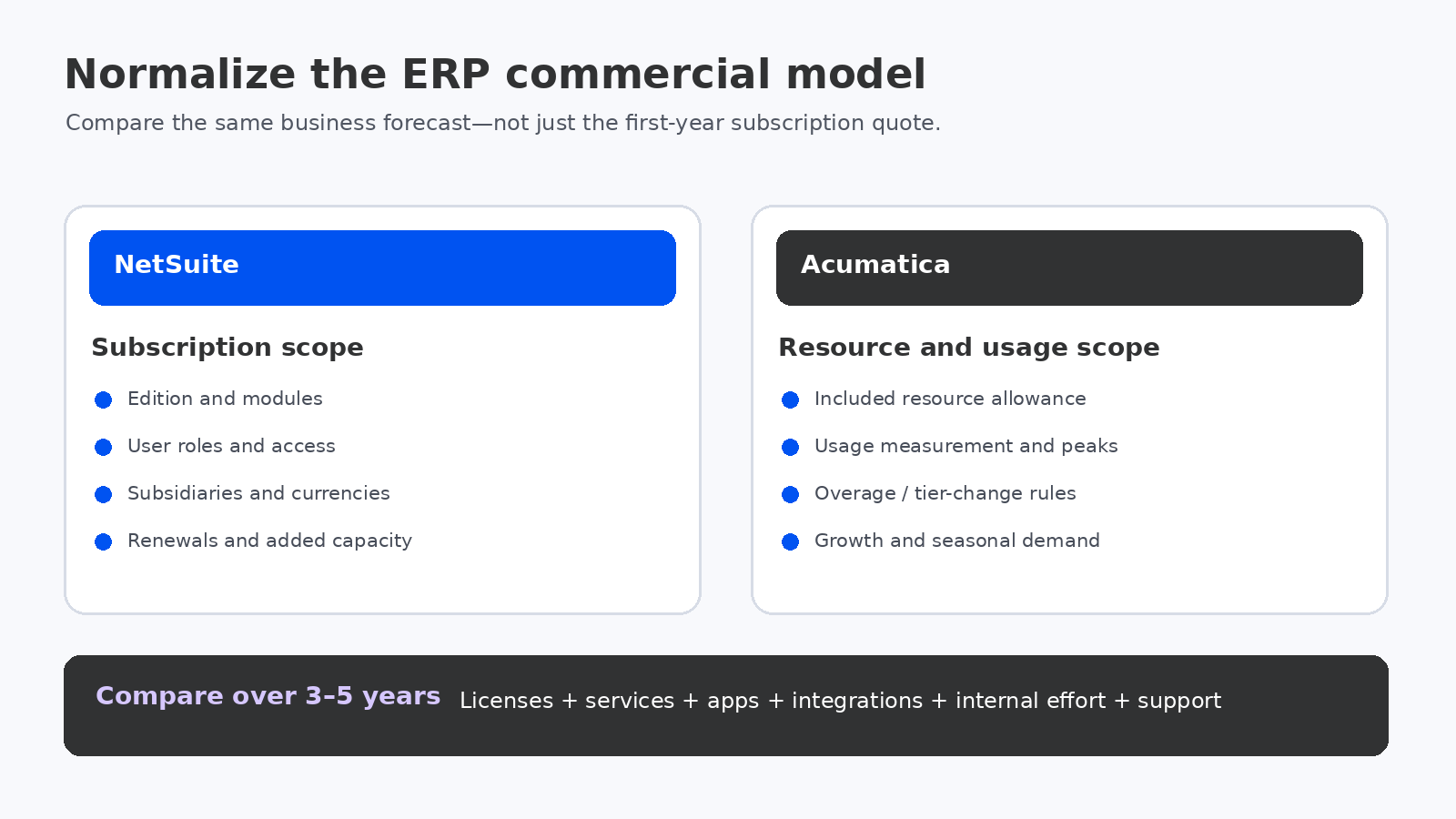
Use the same business growth assumptions for both vendors: forecast users, entities, transaction volumes, warehouses, product lines and geographic expansion. Include a downside case where growth is slower and a stress case where acquisitions or seasonal demand increase the load.
When to rule a platform out
- Rule out a proposal that cannot demonstrate a critical legal, tax or operational requirement without an uncosted workaround.
- Challenge a partner that cannot provide named resources or relevant customer references.
- Rework the business case if the price depends on a usage assumption that the company cannot measure or control.
- Do not proceed if data ownership, migration reconciliation or post-go-live support remains undefined.
Suggested shortlist scorecard
| Criterion | Weight |
|---|---|
| Critical process fit | 25% |
| Five-year cost and commercial clarity | 20% |
| Implementation partner and delivery plan | 20% |
| Integration and data architecture | 15% |
| Industry capability and references | 10% |
| Usability and administration | 10% |
Adjust these weights to match your risk profile. If multi-entity consolidation or manufacturing execution is business-critical, make it a pass/fail gate rather than allowing a high score elsewhere to compensate.
Decision rule: choose the platform that meets critical requirements with the clearest commercial model and lowest credible delivery risk. A lower subscription price is not a saving if it requires expensive extensions, duplicated systems or ongoing manual reconciliation.
