
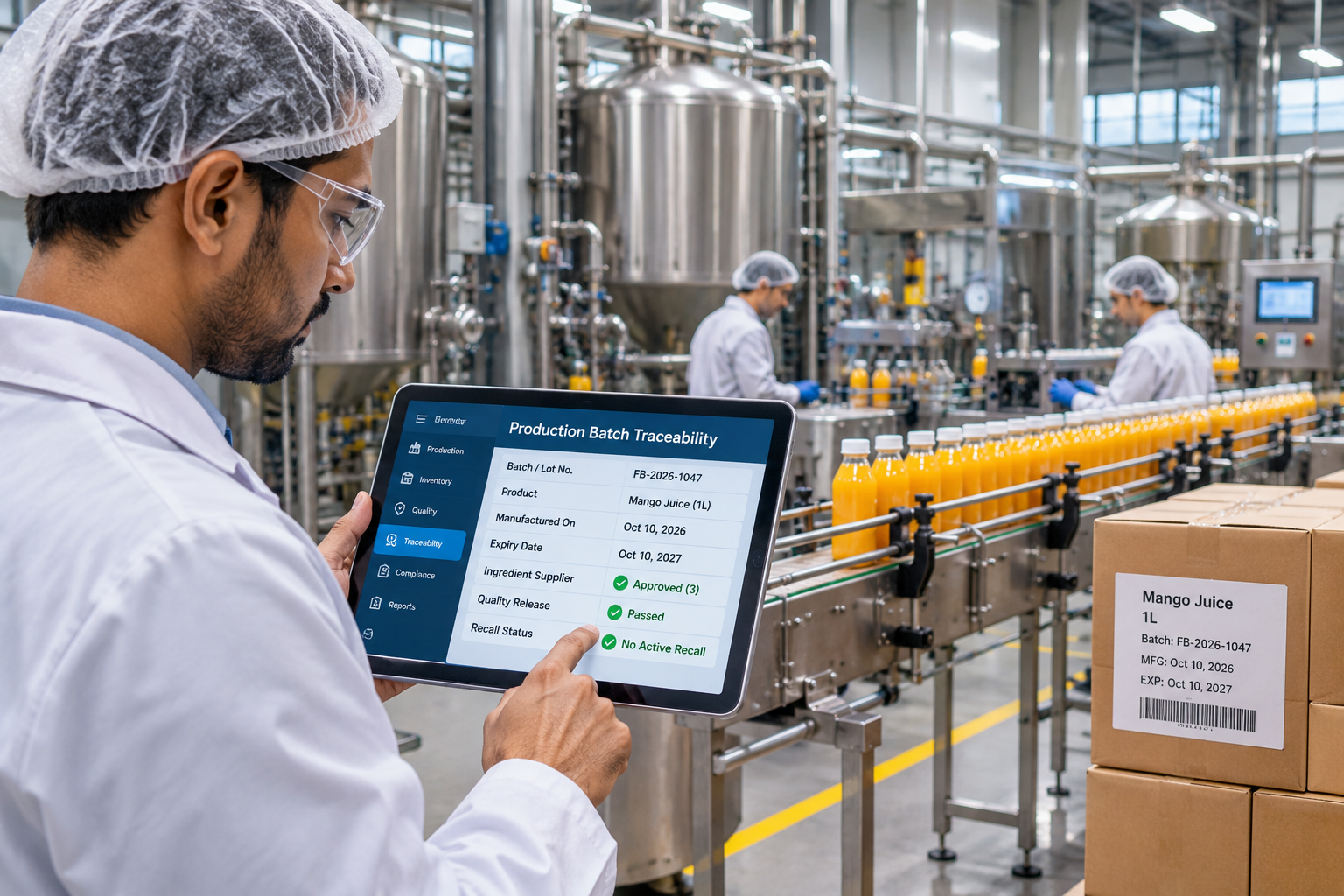
For a food or beverage manufacturer, inventory accuracy is not only a question of how many cases are available. The business also needs to know which supplier lot went into a finished batch, where that batch was packed, which quality checks were completed, when the product expires and which customers received it.
That makes batch and lot traceability a core operational requirement—not an optional reporting feature. A suitable ERP should connect purchasing, production, quality, warehouse execution, shipping and customer records so that a business can trace material forward and backward without reconstructing the history from spreadsheets.
This article focuses on the traceability and control requirements buyers should evaluate. It complements our broader food and beverage ERP systems guide rather than repeating a general software shortlist.
1. Understand batch and lot traceability
A batch or lot identifies a quantity of material or finished product that is managed together for production, quality or inventory purposes. The identifier may be assigned by a supplier, created during receiving or generated when a manufacturer transforms ingredients into a finished product.
Traceability requires more than storing a lot number in an item record. The system should retain the relationships between incoming ingredients, production orders, consumed quantities, outputs, quality results, packaging events, warehouse movements and customer shipments.
Two views matter:
- Backward trace: start with a finished product or customer shipment and identify the ingredient lots, suppliers, production runs and quality records associated with it.
- Forward trace: start with a supplier lot or ingredient batch and identify every production batch, finished product, warehouse location and customer shipment that may have used it.
Ask vendors to demonstrate both directions using a realistic production example. A screen that displays a lot number without showing the relationships behind it is not sufficient evidence of end-to-end traceability.
2. Core ERP capabilities for food and beverage operations
Lot and batch control
Evaluate how lots are created, received, consumed, split, merged, transferred and shipped. The system should preserve the relationship between source lots and resulting production lots. Confirm how it handles partial consumption, rework, co-products, repacking and changes to packaging or product identity.
Shelf-life and expiry management
Food businesses may need to manage manufacture dates, expiry dates, best-before dates, shelf-life periods and customer-specific remaining shelf-life requirements. Test whether the ERP calculates dates from configured rules, supports minimum remaining shelf life at dispatch and prevents or warns against the use of expired or unsuitable inventory.
Microsoft’s Dynamics 365 documentation, for example, describes batch attributes and product shelf-life settings that can support batch selection and expiry-related controls. These are product-specific capabilities; buyers should confirm the exact edition, configuration and process fit in their proposed solution. See batch attributes and shelf-life settings.
Quality management and holds
Quality processes may include incoming inspection, in-process checks, finished-goods release, supplier non-conformance, certificates of analysis and corrective actions. The ERP should make the status of stock visible to purchasing, production and warehouse users. A quality hold must prevent unauthorised allocation or shipment, not simply add a note to the record.
Ingredient and production genealogy
Manufacturers need to connect formula or bill-of-material requirements to actual ingredient lots consumed. The record should reflect substitutions, yield variance, scrap, rework and production deviations. If the recipe says one quantity was planned but a different lot or quantity was actually consumed, traceability must follow the production record rather than the planned recipe alone.
Warehouse execution and shipping
Test receiving, put-away, picking, replenishment, transfers, FEFO (first-expired, first-out) allocation where appropriate, packing and dispatch. Confirm how barcode scanning, handheld devices and warehouse management workflows capture lot information at each required step.
3. What an effective recall workflow should demonstrate
A recall or withdrawal investigation is a practical test of the entire data model. Ask the vendor to start with a supplier ingredient lot and identify all affected production runs, finished goods, warehouse locations and customer shipments. Then reverse the scenario: start with a customer complaint or finished-product lot and trace back to the supplier ingredients and quality checks.
The demonstration should show:
- Search by supplier lot, internal lot, finished-product lot or shipment reference.
- All receipts, transformations, production orders and inventory movements linked to that lot.
- Quality results, certificates, holds and release decisions.
- Quantities produced, consumed, scrapped, reworked, remaining and shipped.
- Customer, distributor and delivery details for affected shipments.
- A controlled report or export that can be reviewed by quality and compliance teams.
Do not judge recall readiness only by how quickly a dashboard loads. Check whether the underlying records are complete, retained, searchable and exportable, and whether the process is usable by staff who may not work in the ERP every day.
4. Regulatory traceability: avoid treating ERP as automatic compliance
Food safety and recordkeeping requirements vary by jurisdiction, product category, activity and exemption. ERP software can support record capture and retrieval, but buying a particular platform does not by itself make a manufacturer compliant. The business remains responsible for determining which rules apply and ensuring its operating procedures and records meet them.
For US operations, the FDA Food Traceability Rule applies additional recordkeeping requirements to persons who manufacture, process, pack or hold foods on the Food Traceability List, subject to the rule’s scope and exemptions. It links Key Data Elements to specified Critical Tracking Events and includes traceability-lot-code requirements for covered activities. As of November 2026, FDA states that it intends not to enforce the rule before July 20, 2028, following the 2026 congressional direction; businesses should monitor official updates and obtain advice on their own coverage rather than relying on an ERP vendor’s generic compliance claim.
See the current FDA Food Traceability Rule page and its official FAQ. The requirements are specific to covered foods and activities; they should not be generalised to every food manufacturer or every market.
5. Food and beverage ERP demo checklist
| Scenario | What to verify |
|---|---|
| Ingredient receiving | Supplier lot, receipt date, quantity, certificate and inspection status |
| Quality hold | Held stock is blocked from unauthorised allocation and shipment |
| Production consumption | Actual ingredient lots and quantities are recorded against the production run |
| Finished batch | New lot is linked to inputs, process records and quality release |
| Shelf-life control | Manufacture and expiry dates, remaining shelf life and allocation rules work as required |
| Warehouse picking | Lot selection and FEFO rules operate across bins and locations |
| Recall investigation | Forward and backward trace reports identify affected stock and customers |
| Audit and export | Records are searchable, retained and available in a usable export format |
6. ERP architecture and integration considerations
Food manufacturers often connect ERP with laboratory information systems, production equipment, weighing and labelling systems, warehouse management, supplier portals, EDI and retailer platforms. Decide which system captures each event and how the information reaches the ERP without creating duplicate or contradictory records.
For example, a production system may capture actual consumption and output at the line, while the ERP owns inventory valuation and financial posting. The integration must preserve lot identity, quantities, timestamps and error handling across both systems. A barcode scan that is not successfully posted should be visible as an exception rather than silently disappearing.
Our guide to ERP integration strategy explains how to choose API, event-driven and batch patterns and define data ownership.
7. Costs and implementation risks
Traceability requirements can affect implementation cost through item and lot master-data design, barcode hardware, label formats, quality workflows, production integrations, warehouse processes, data migration and user training. Include the cost of supplier onboarding and customer-specific requirements where those affect the process.
Key risks include:
- Lot identifiers captured at receiving but not retained through production or shipment.
- Manual workarounds for rework, repacking, split lots or ingredient substitutions.
- Quality holds that are not enforced across all inventory and sales channels.
- Inconsistent units of measure or quantity conversions.
- Label and barcode data that do not match the ERP transaction record.
- Incomplete integration monitoring and no documented exception process.
Include these scenarios in scope and budget discussions. For a wider view of cost categories, see ERP implementation cost and TCO.
Questions to ask a food and beverage ERP vendor
- Can you demonstrate a full forward and backward trace using a real production genealogy?
- How are supplier lots linked to internal lots and finished-goods lots?
- How are expiry dates, shelf-life rules and customer-specific dispatch requirements enforced?
- Can a quality hold block inventory across warehouse, production and sales processes?
- How are substitutions, rework, co-products and repacking recorded?
- Which integrations capture production, weighing, labelling and warehouse events?
- Which regulatory records are supported natively, and which require configuration or external systems?
- What evidence can the system produce during a mock recall?
Conclusion
Food and beverage ERP selection should test the integrity of the product’s history from supplier receipt through production, quality release, warehouse movement and customer delivery. Prioritise complete lot genealogy, expiry controls, enforceable quality holds and practical recall reporting. Then verify the required integrations and regulatory recordkeeping for the markets in which the business operates. A convincing demo should prove the traceability workflow with real scenarios—not just show a batch-number field.
