
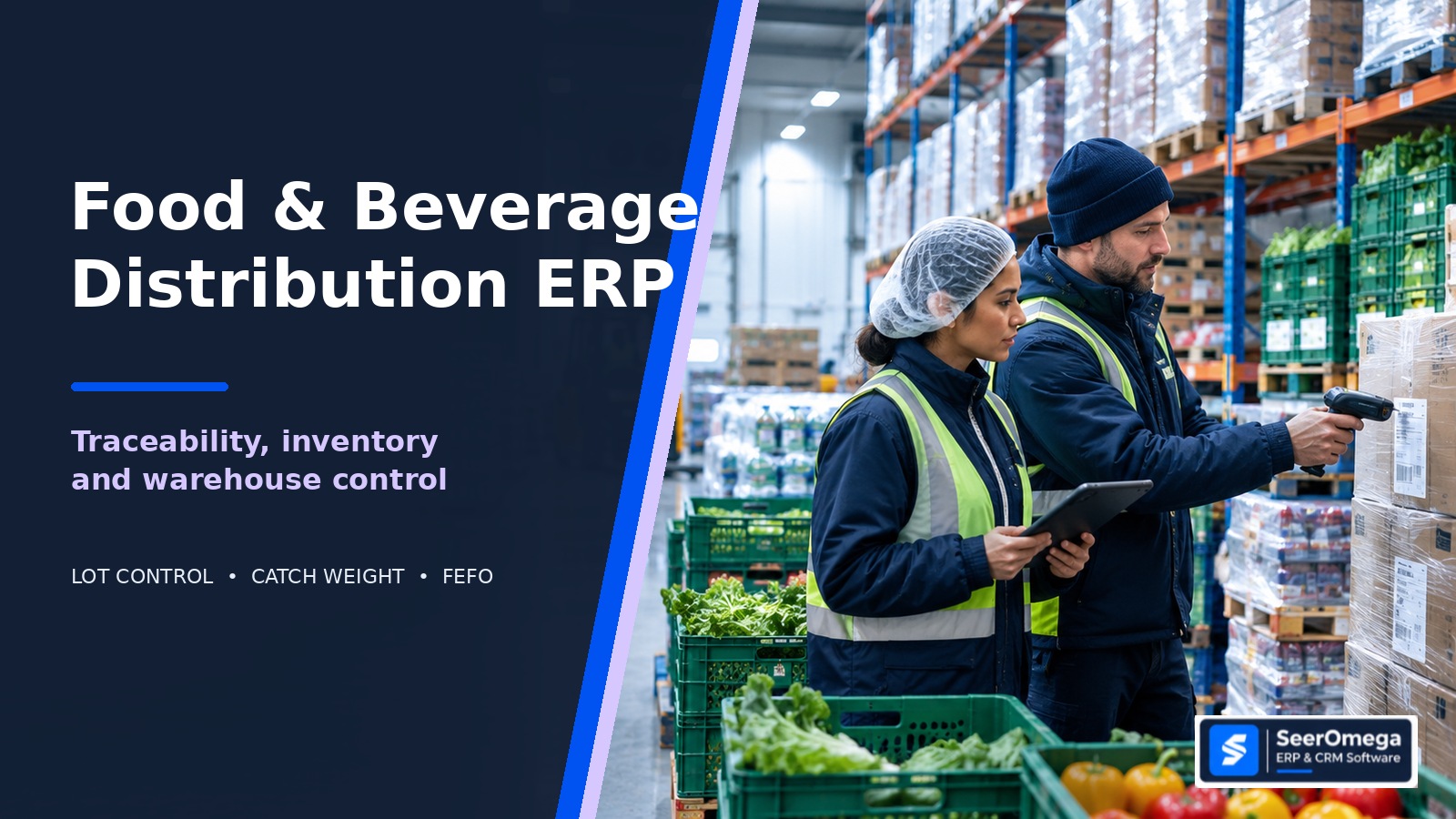
Food distribution is not simply wholesale distribution with a different product catalogue. A distributor handling chilled dairy, frozen foods, fresh produce, meat, seafood or beverages has to manage expiry dates, lot allocation, variable weights, temperature-sensitive deliveries, customer-specific order patterns and fast-moving stock—often while operating several warehouses or delivery routes.
An ERP system that reports inventory only in units or cases may leave critical questions unanswered: which lot is available, how much usable weight remains, which customer received a particular batch, whether a short-dated item should be picked first, and what the real margin was after freight, handling and credits. The right platform must connect purchasing, warehouse execution, sales, transport and finance around the realities of food distribution.
This guide compares seven ERP options for food and beverage distributors. It separates specialist food-distribution platforms from broader ERP systems that may need industry extensions or additional configuration. It is an editorial shortlist, not a paid ranking; suitability depends on product mix, distribution model, operating geography and the workflows demonstrated in a buyer’s own scenarios.
What food and beverage distributors need from ERP software
Before comparing products, map the operational requirements that have the greatest impact on service, waste, margin and recall readiness.
- Lot and expiry control: Record supplier, lot, receipt date, expiry or best-before date, quality status and customer shipment history. Test forward and backward traceability using a realistic recall scenario.
- FEFO and inventory rotation: Support first-expired, first-out allocation where appropriate, while allowing controlled exceptions for customer specifications, shelf-life commitments or quality holds.
- Catch weight and variable units: Handle products sold by both case and actual weight, such as meat, seafood and produce. Check how the system reconciles ordered, picked, invoiced and received quantities.
- Warehouse execution: Cover receiving, put-away, bin management, replenishment, directed picking, case breaking, cross-docking, packing, shipping and cycle counting. Confirm whether mobile scanning and scales are native or supplied through add-ons.
- Customer-specific order management: Support order guides, standing orders, substitutions, promotions, contract pricing, credit limits, backorders and customer-specific product requirements.
- Route and delivery operations: Connect orders to routes, multi-stop delivery plans, proof of delivery, returns and delivery costs. Beverage distributors may also need deposit and returnable-container handling.
- Supplier and landed-cost visibility: Reconcile purchase costs, freight, duties, handling, rebates and other charges so that margin reporting reflects the actual cost of supply.
- Food safety and quality processes: Record inspection results, holds, allergen or product attributes, temperature-related data and the evidence required by the company’s applicable food-safety programme and local regulations.
7 ERP platforms food and beverage distributors should evaluate
The systems below do not all serve the same operating model. Some are purpose-built for food distribution; others provide broader ERP or distribution foundations. Validate the exact product edition, modules, regional availability, partner extensions and implementation scope before treating a capability as included.
1. NECS entrée V5
Potential fit: Foodservice and specialist food distributors that want distribution workflows in a dedicated platform.
NECS positions entrée V5 as an ERP platform built specifically for food distributors. Its published feature set covers sales and order entry, customer-specific pricing and order guides, purchasing, inventory, warehouse operations, accounting, dashboards and reporting. The product information also describes catch weight, case breaking, lot control and traceability support, picking documents, returns, cycle counts and optional customer-facing ordering or EDI extensions.
For a food distributor, the value of a specialist system is the fit between everyday workflows and the product model—not just the presence of an accounting ledger. During evaluation, test how entrée handles variable-weight items from purchase receipt through pick, invoice and customer credit. Confirm which online ordering, proof-of-delivery and EDI functions are included in the proposed licence and which require extensions.
Official product information: NECS entrée V5
2. inecta Food ERP
Potential fit: Food and foodservice distributors looking for a food-specific solution built on Microsoft Dynamics 365 Business Central.
inecta describes its Food ERP as a cloud platform built on Business Central, connecting warehouse management, transportation, sales automation and compliance. Its published distribution capabilities include RF/RFID and smart-scanner workflows, bin management, cross-docking, license plating, scale integration for catch weight, lot traceability, route planning, returns and customer order guides. The vendor also describes FEFO rotation and multi-stop delivery processes for foodservice operations.
The underlying Business Central platform and the inecta food-specific solution should be evaluated as one proposed architecture, but buyers should still identify which functions come from standard Business Central, which are provided by inecta, and which depend on other applications or integrations. Ask for an end-to-end demonstration from receipt of a variable-weight lot to warehouse pick, route assignment, proof of delivery and margin reporting.
Official product information: inecta Food Distribution ERP
3. Aptean Food & Beverage ERP – Enterprise Edition
Potential fit: Larger food and beverage businesses combining trading or distribution with complex supply-chain, quality or processing requirements.
Aptean’s Enterprise Edition is built on Microsoft Dynamics 365 Finance and Supply Chain Management. Its product datasheet describes support for food producers and traders/distributors across areas such as product attributes, supplier specifications, EDI, sales-order processing, proof of delivery, transportation planning, temperature and packaging requirements, quality control and end-to-end traceability. It also describes detailed lot profitability, including costs such as haulage, labour, machine costs, duty and rework.
This breadth may be relevant to businesses that buy, process, trade and distribute products across complex supply chains. It may be more extensive than a pure wholesaler needs. Ask Aptean to map each requirement to the Enterprise Edition, the Microsoft platform, configuration and any separate services. Do not assume that every capability in a product datasheet is included in every commercial package.
Official vendor information: Aptean (request the current Food & Beverage ERP Enterprise Edition specification for your region)
4. Aptean Food & Beverage ERP – JustFood Edition
Potential fit: Food businesses where manufacturing, quality and distribution processes overlap.
JustFood is positioned around food and beverage operations, with published material describing quality, food safety, warehouse and inventory, manufacturing, reporting, finance, sales and purchasing capabilities. That makes it relevant to distributors that also perform processing, packing, kitting or other value-added activities. It should not automatically be treated as equivalent to a specialist broadline foodservice distribution system.
Buyers should establish the current product architecture and deployment model, then test the specific distribution workflows that matter: catch weight, customer order guides, route delivery, FEFO allocation, lot traceability and proof of delivery. If the business is primarily a wholesaler, compare these workflows directly with NECS and inecta rather than selecting on manufacturing functionality alone.
Official vendor information: Aptean
5. Sage X3
Potential fit: Mid-sized and larger product businesses with food operations, distribution and multi-site or international requirements.
Sage positions X3 for manufacturing, distribution and food and beverage businesses. Its current product information describes financial and supply-chain management, inventory and supplier controls, multiple countries and currencies, and food-sector capabilities such as lot and batch traceability, quality, recall support and allergen reporting. Sage also describes distribution capabilities across warehouse operations, inventory visibility and fulfilment.
Sage X3 is a broad product ERP rather than a foodservice distribution-only platform. A buyer should therefore test food-distribution details instead of assuming they are native to every deployment. Ask how the proposed solution handles catch weight, case conversion, FEFO picking, route planning, customer order guides, EDI and proof of delivery. Identify any partner solution or customization needed to close gaps.
Official product information: Sage X3 for Food & Beverage · Sage X3 for Distribution
6. Acumatica Distribution Edition
Potential fit: Growing distributors that need a configurable cloud ERP for inventory, purchasing, sales orders, warehouse work and financial management.
Acumatica Distribution Edition describes capabilities including advanced inventory, sales and purchase orders, warehouse management, distribution requirements planning, mobile warehouse workflows, lot and serial tracking, inventory transfers and replenishment. These are useful foundations for a food distributor managing multiple sites and fulfilment processes.
However, a general distribution platform is not automatically a complete food ERP. Validate catch weight, expiry and shelf-life controls, FEFO allocation, allergen attributes, quality holds, food-specific traceability, temperature-controlled delivery and route execution. Some requirements may need configuration, an industry extension or an integration. The demo should use the distributor’s actual product and order data.
Official product information: Acumatica Distribution
7. Oracle NetSuite
Potential fit: Growing or multi-entity distributors that want a broad cloud ERP and can validate the food-specific layer separately.
NetSuite provides a broad ERP foundation for finance, purchasing, sales and inventory. Oracle’s documentation describes lot-numbered items that can record lot quantities, costs and expiration dates. Its Lot and Serial Number Trace SuiteApp can report supplier, customer, procurement, delivery and internal-transfer history for tracked items. Oracle’s documentation also makes clear that this trace SuiteApp is a reporting tool; it does not itself perform inventory transactions.
That distinction matters. NetSuite’s core capabilities and installed SuiteApps should be assessed separately from the specialist food-distribution functions a business may need. Test catch weight, case conversion, FEFO, warehouse scanning, route delivery, customer order guides, EDI and recall reporting in the exact configuration being proposed. Confirm the additional modules, partner applications and integration costs.
Oracle documentation: Lot Numbered Items · Oracle documentation: Lot and Serial Number Trace
Quick comparison by distribution model
| Distribution model | Platforms to evaluate first | Critical validation points |
|---|---|---|
| Broadline foodservice distributor | NECS entrée V5; inecta Food ERP | Order guides, catch weight, lot allocation, route planning, proof of delivery and returns |
| Specialist produce, meat or seafood distributor | inecta; NECS; Aptean Enterprise Edition | Variable weight, lot attributes, shelf life, landed cost, quality holds and traceability |
| Food trader with processing or packing | Aptean Enterprise Edition; JustFood; Sage X3 | Production or packing requirements, quality, lot genealogy, costing and distribution handoff |
| Growing multi-site distributor | Acumatica Distribution; Sage X3; NetSuite | Warehouse execution, multi-entity reporting, replenishment, integrations and food-specific extensions |
| Microsoft-oriented distributor | inecta Food ERP on Business Central | Business Central versus inecta functionality, licensing, upgrade path and partner support |
Questions to ask during a food distribution ERP demo
- Can the system trace a specific lot from supplier receipt through warehouse movements to every customer shipment?
- Can it allocate stock using FEFO rules while respecting customer shelf-life requirements and quality holds?
- How does catch weight work across purchase orders, receiving, inventory, picking, invoicing and credit notes?
- Can warehouse staff scan cases, split cases, weigh products and record substitutions without duplicate data entry?
- Can the system manage customer-specific order guides, prices, promotions, rebates and contract terms?
- Can sales orders flow into route planning, multi-stop delivery, proof of delivery, returns and freight-cost allocation?
- How are temperature records, quality checks, allergen attributes and supplier documentation captured and retrieved?
- Which EDI transactions, e-commerce portals, scales, scanners, transport systems and accounting integrations are included?
- Can the vendor demonstrate a mock recall and produce a complete, time-stamped traceability report?
- What are the total costs for licences, industry modules, WMS, integrations, devices, implementation, training and support?
Implementation risks that food distributors should plan for
Food distribution projects often fail at the boundaries between systems and teams. Product masters may contain inconsistent pack sizes or units of measure. Suppliers may label lots differently. Warehouse teams may use informal case-break practices that are not represented in the system. Sales teams may promise a shelf life that purchasing and warehouse staff cannot consistently verify. These are data and process design problems as much as software problems.
Before implementation, standardize product, supplier, customer, unit-of-measure and lot data. Define how expiry dates, quality status, catch weight, substitutions and returns will be recorded. Agree which system owns route planning, proof of delivery, customer ordering and EDI. Reconcile opening inventory by item, warehouse, bin, lot and status—not only by total value.
Use representative test cases: a short-dated product, a variable-weight item, a customer-specific order guide, a supplier substitution, a cross-warehouse transfer, a partial delivery and a recall. Run the scenarios with warehouse, sales, purchasing, transport and finance users before cutover. Calculate total cost of ownership over a realistic period, including the applications and devices needed to complete the workflow.
How to choose the right food and beverage distribution ERP
Start with the distribution model. A broadline foodservice wholesaler may place the greatest weight on order guides, catch weight, warehouse picking and route delivery. A produce or seafood distributor may prioritize lot attributes, variable weights, shelf life and supplier traceability. A business that also manufactures or packs products may need deeper quality, production and lot-cost controls. A multi-entity group may require stronger consolidation, intercompany and international capabilities.
Shortlist three systems, give each vendor the same sample products and order scenarios, and score the demonstrated workflow—not the length of the feature list. Record what is standard, configured, provided by an extension or dependent on a third-party integration. Compare implementation scope and three-to-five-year total cost alongside functional fit.
For a deeper look at food-sector traceability, see SeerOmega’s guide to batch traceability, shelf life and recall readiness. You can also explore the ERP and CRM software directory to identify software providers and implementation partners for your shortlist.
Editorial note: Product descriptions are based on publicly available vendor documentation. Product editions, licensing, regional availability, implementation scope and integrations can change. A feature described by a vendor may require a separate module, partner application or configuration. Confirm requirements through a current, scenario-based demonstration and contract review.
