
Choosing between Microsoft Dynamics 365 and SAP S/4HANA is an enterprise architecture decision, not a feature-count exercise. Both portfolios can support complex finance and operations, but the right fit depends on process standardisation, industry depth, deployment preferences, existing technology investments, internal capability and the cost of operating the platform over time.
This guide compares the platforms at a portfolio level. Dynamics 365 is a family of applications, including Finance and Supply Chain Management, while SAP S/4HANA is SAP’s ERP suite with public-cloud and private-cloud deployment options. A fair evaluation must compare the specific products and deployment models in scope—not a broad Microsoft brand against a single SAP product.
At a glance
| Decision area | Dynamics 365 | SAP S/4HANA |
|---|---|---|
| Product model | Composable business applications; Finance and Supply Chain Management can be scoped as separate applications | Integrated ERP suite with public-cloud and private-cloud options |
| Deployment | Cloud-first SaaS for core Finance and Supply Chain Management workloads, with product-specific options and constraints | Public cloud, private cloud and other SAP deployment choices depending on edition and contract |
| Extensibility | Microsoft ecosystem, Dataverse and Power Platform integrations; application-specific extension patterns | SAP extensibility and integration services, with clean-core principles important for cloud adoption |
| Industry fit | Broad capabilities; validate the exact industry processes and partner solutions required | Broad enterprise industry footprint; validate scope, edition and required industry capabilities |
| Commercial model | Application subscriptions, user types, attach licenses and capacity components | Contract and deployment-specific licensing/subscription metrics; consult current SAP commercial documentation |
1. Finance and enterprise control
Compare general ledger, multi-entity accounting, intercompany, consolidation, budgeting, fixed assets, tax, cash management, close automation and audit controls. The critical test is not whether a feature exists, but whether it supports your chart of accounts, legal-entity structure, approval model and reporting deadlines without extensive workarounds.
Dynamics 365 Finance may be attractive where the organisation wants to connect finance processes with Microsoft’s analytics, identity and productivity ecosystem. SAP S/4HANA may be a strong fit where the organisation has standardised on SAP processes or requires continuity with an established SAP landscape. These are starting hypotheses; prove them through process scenarios and references.
2. Supply chain and manufacturing
Map the actual operational model: discrete or process manufacturing, make-to-stock or engineer-to-order, advanced planning, warehouse execution, quality, maintenance, procurement, transportation and supplier collaboration. Ask each vendor to demonstrate a complete scenario from demand signal to production, shipment, invoicing and financial posting.
For global manufacturers, test plant-level variation, intercompany flows, traceability, product configuration, local compliance and planning data. Do not accept a generic demo that skips exceptions and operational constraints.
3. Integration and extensibility
Inventory the systems that must connect: CRM, ecommerce, MES, WMS, PLM, payroll, tax, banking, EDI, data platforms and specialist applications. For each interface, document the system of record, data owner, frequency, error handling, security and support owner.
Microsoft’s licensing documentation describes application subscriptions and base/attach licensing. SAP publishes separate licensing guidance for its public-cloud offerings; private-cloud and other commercial models need separate review. Treat the current vendor documentation and negotiated order forms as authoritative, not third-party price tables.
4. Implementation and operating model
Implementation effort is driven by process complexity, number of entities and sites, data quality, integrations, customisations, reporting, controls and change management. Compare delivery plans by phase and named roles. Ask how each partner handles fit-to-standard workshops, data migration, testing, cutover, training, hypercare and upgrades.
For Dynamics 365, confirm which applications, environments, Power Platform components and integrations are in scope. For SAP, confirm the exact S/4HANA edition and deployment model, clean-core approach, extensibility boundaries and upgrade responsibilities.
5. Total cost of ownership
Build a five-year model covering subscriptions, implementation services, internal project labour, infrastructure where applicable, integration platforms, extensions, data migration, training, support, release testing and future enhancements. Model realistic user types and peak usage rather than multiplying a headline licence price by employee count.
| Cost category | Questions to resolve |
|---|---|
| Software | Which applications, user types, capacity and environments are required? |
| Implementation | What is included in discovery, design, configuration, testing and cutover? |
| Integration | Which interfaces need middleware, custom APIs or ongoing monitoring? |
| Data | How much history moves, who cleans it and how is reconciliation signed off? |
| Operations | Who owns administration, release testing, security and support? |
How to run a defensible selection
- Define the business outcomes and non-negotiable process requirements.
- Choose the exact product editions and deployment models to compare.
- Provide both vendors the same scenarios, data volumes and integration inventory.
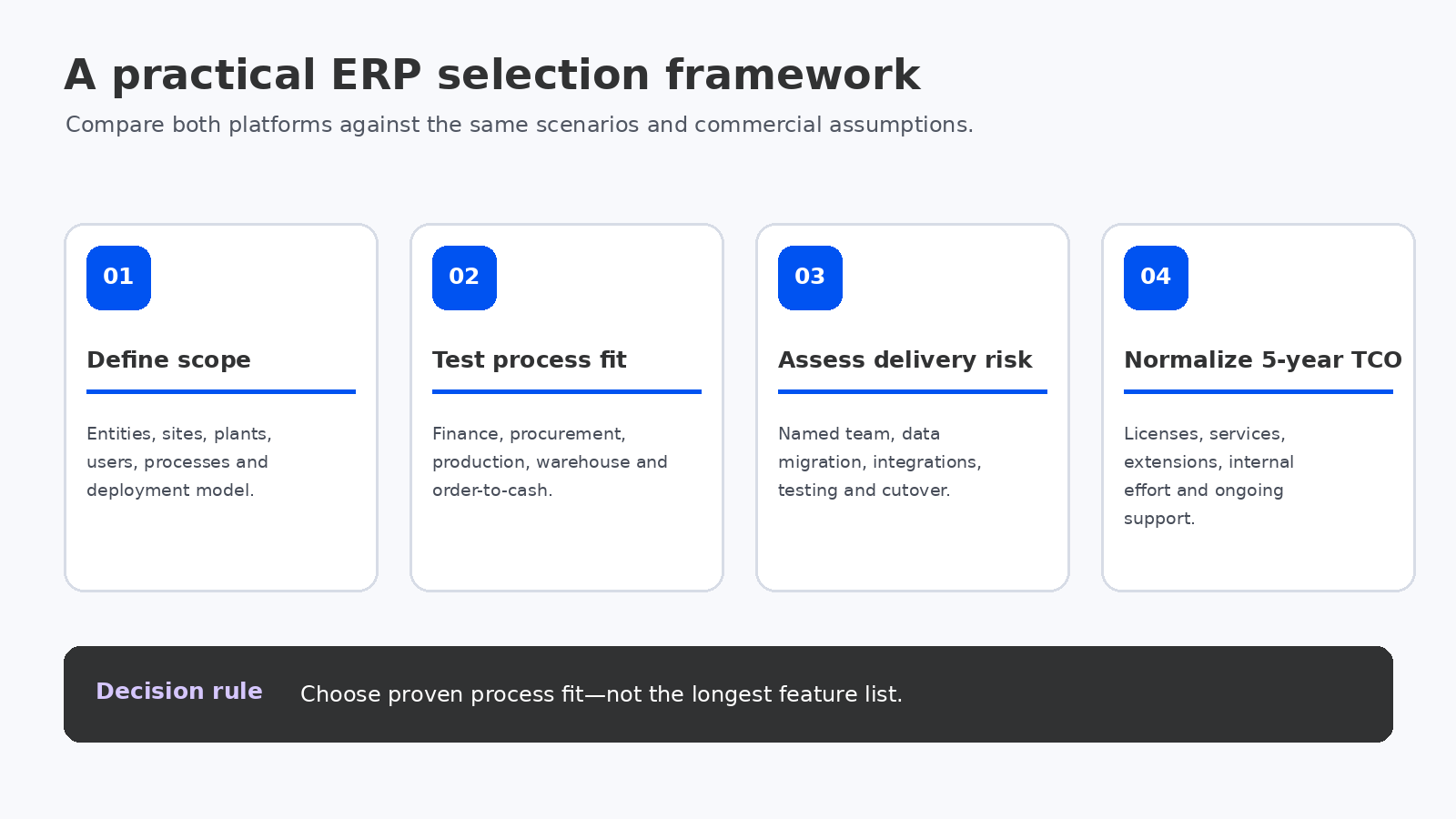
- Score fit, implementation risk, partner capability, usability and TCO separately.
- Validate the proposed team through customer references and a detailed statement of work.
Product scope matters more than the brand comparison
One common selection mistake is comparing Dynamics 365 Finance and Supply Chain Management with every capability in SAP S/4HANA without agreeing on scope. Create a product map before inviting vendors to demonstrate. List the legal entities, plants, warehouses, countries, business units, finance processes and operational systems that are included in phase one. Then mark what remains in adjacent applications.
For Dynamics 365, Microsoft describes Supply Chain Management capabilities across planning, procurement, shop-floor management, order management, warehouse management and asset management. The buyer still needs to establish which capabilities are included in the proposed application and license mix, and whether specialist manufacturing or warehouse systems remain necessary. Review the current Microsoft Supply Chain Management capability and pricing information alongside the applicable licensing guide.
For SAP, distinguish S/4HANA Cloud Public Edition from Private Edition and any other deployment arrangement in the proposal. SAP’s public-cloud licensing guide explicitly has a different scope from private-cloud licensing. Do not carry a public-cloud entitlement assumption into a private-cloud commercial model. Start with the current SAP public-cloud licensing guide and obtain the binding contract documents for the edition being evaluated.
Run the same proof-of-fit scenarios
A fair ERP demonstration uses identical business scenarios, sample data and acceptance criteria. A useful shortlist usually includes at least these workflows:
- Record-to-report: post transactions across two legal entities, run intercompany entries, close a period and produce consolidated management reporting.
- Procure-to-pay: create a requisition, source a supplier, receive goods, match an invoice and route an exception for approval.
- Plan-to-produce: convert demand into planned orders, manage material shortages, report production progress and calculate actual production cost.
- Order-to-cash: promise inventory, fulfil a partial order, invoice the customer and process a return or credit.
- Asset and maintenance: schedule planned maintenance, record downtime and show the financial and operational impact.
Ask vendors to show standard functionality first, then identify the configuration, extension or third-party product needed for each gap. Record the implementation owner and recurring cost of every non-standard component. A demonstration that relies on slides or a pre-recorded workflow is not sufficient evidence.
Hidden trade-offs buyers should make explicit
Standardisation versus local variation. A global template can reduce support and upgrade complexity, but local tax, statutory reporting, language, industry and plant requirements may demand controlled variation. Ask how each platform governs local configuration and prevents uncontrolled divergence.
Composable architecture versus suite consolidation. A modular application strategy can allow phased replacement and specialist tools. It can also increase integration ownership and data reconciliation. A more consolidated suite can simplify some flows but may not eliminate the need for specialist applications. Map the end-to-end process, not just the ERP boundary.
Customisation versus upgrade discipline. Every extension should have a business owner, documented reason, test coverage and retirement path. Ask the implementation partner to classify requirements as standard, configuration, extension, integration or process change. This makes future maintenance costs visible before contract signature.
Partner selection and delivery assurance
Do not evaluate the software separately from the team expected to implement it. Request named programme leadership, solution architecture, finance and supply-chain leads, data migration ownership, integration capability, testing leadership and change-management resources. Ask for two references with comparable complexity and speak to the customer sponsor as well as the IT lead.
Make the statement of work measurable. It should define deliverables, assumptions, exclusions, environments, data volumes, integration counts, acceptance criteria, defect severity, cutover rehearsal, training, hypercare and change-control rates. A low initial estimate that excludes data cleansing, reporting, integration testing or business change is not a lower-cost proposal.
Decision matrix: suggested evaluation weights
| Evaluation area | Suggested weight | Evidence to score |
|---|---|---|
| Business process fit | 25% | Scenario results and gaps against critical requirements |
| Implementation and delivery risk | 20% | Named team, plan, references, assumptions and acceptance approach |
| Five-year TCO | 20% | Normalized subscription, services, integration and operating costs |
| Architecture and integration | 15% | Data ownership, APIs, extension approach and support model |
| Usability and adoption | 10% | Role-based user testing and change plan |
| Vendor and partner roadmap fit | 10% | Product direction, local capability and support commitments |
These weights are a starting template, not a market benchmark. Change them before scoring if a factor such as regulated manufacturing, global consolidation or a fixed deployment requirement is a genuine pass/fail condition.
Questions to resolve before a final decision
- Which exact Dynamics 365 applications or S/4HANA edition are being proposed?
- Which critical requirements need a third-party application, custom extension or manual workaround?
- What is the migration strategy for historical transactions, open balances, master data and attachments?
- Who owns integration monitoring and production support after go-live?
- What is excluded from the fixed-fee implementation estimate?
- How will future releases be tested and regression issues resolved?
Bottom line: shortlist the product and the delivery partner together. The strongest proposal is the one that proves the required processes with the least avoidable customization and a credible operating cost—not necessarily the one with the longest feature list.
Final recommendation
Dynamics 365 may fit organisations seeking composable applications and close alignment with Microsoft’s business and productivity stack. SAP S/4HANA may fit organisations whose operating model and enterprise architecture are already strongly SAP-oriented or require the particular processes and deployment choices SAP offers. Neither conclusion should be made from brand preference alone. Run scenario-based demonstrations and compare five-year cost, process fit and delivery risk.
For related comparisons, see our guides to Business Central vs NetSuite, NetSuite alternatives and ERP implementation cost.
Frequently asked questions
Is Dynamics 365 the same product as Business Central?
No. Dynamics 365 is a portfolio. Business Central targets small and midsize organisations, while Finance and Supply Chain Management address more complex enterprise requirements.
Is SAP S/4HANA only available in the cloud?
No. SAP offers public-cloud and private-cloud deployment options, with commercial and functional differences. Confirm the exact edition and contract scope.
Which platform costs less?
There is no universal answer. Licensing, implementation scope, internal skills, integrations, customisation and operating model can change the five-year cost materially.
