
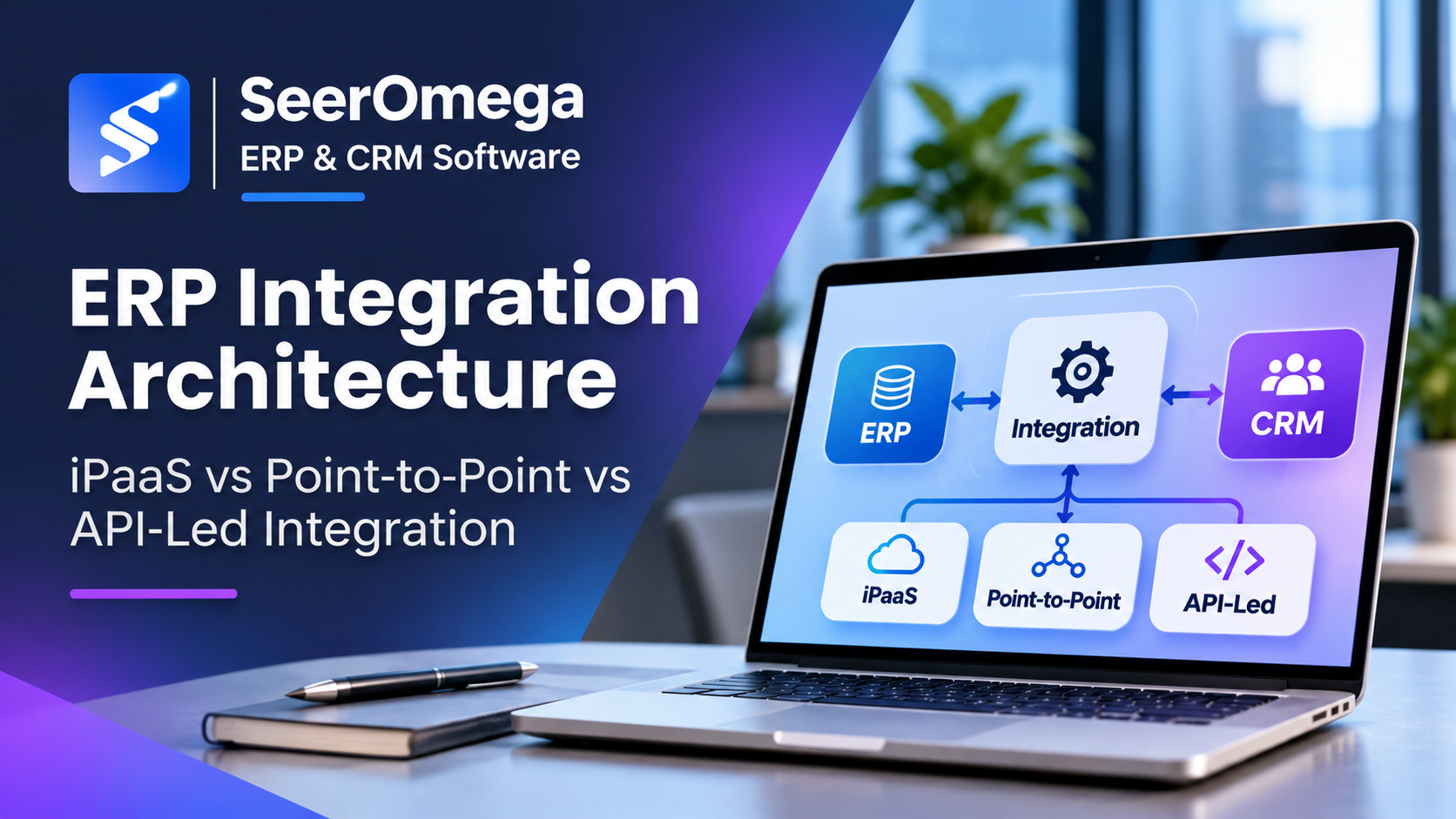
ERP integration architecture determines how reliably finance, sales, inventory, ecommerce, warehouse, service and analytics systems exchange business-critical data—and how expensive those connections become to maintain as the application estate grows. Three patterns appear frequently: point-to-point connections, integration-platform-as-a-service (iPaaS), and API-led integration. They are not mutually exclusive; a well-designed environment may use all three with consistent ownership, contracts and monitoring.
Start with the business requirements
Map the events and data that must move: a confirmed order creating an ERP sales order, a shipment updating CRM, a product change reaching ecommerce, or an approved invoice flowing to reporting. For each flow, document source of truth, direction, latency, volume, sensitivity, dependency on the receiving system and the required failure response. “Real time” should be a measured requirement, not a default. A nightly reconciliation may be more reliable and less expensive than continuous synchronisation.
1. Point-to-point integration
Point-to-point connects one application directly to another through an API, file exchange, database interface or native connector. It is often the quickest option for a small number of stable interfaces with limited transformation requirements.
Good fit: a small application estate, a narrow low-volume flow, a temporary migration bridge, or a vendor-supported connector that already handles the required logic. Risk: as systems multiply, direct connections create a mesh of dependencies. A change to an identifier, API version or order status may require updates in several places. Monitoring, credentials, retries and transformations become scattered. The low initial cost can turn into high support and change-management cost.
Point-to-point is not inherently poor architecture. It becomes a problem when interfaces are duplicated, undocumented or ownerless.
2. iPaaS: a managed integration platform
An iPaaS provides a shared environment for connecting applications, orchestrating workflows, mapping data and monitoring runs. It can reduce the need to build and operate every connection independently.
- Reusable connectors and common transformation patterns.
- Central workflow visibility, error handling and operational alerts.
- Faster delivery for common SaaS-to-ERP and CRM-to-marketing flows.
- Shared governance when environments, roles and deployment controls are configured correctly.
Trade-offs include platform subscription, transaction, connector and execution costs. Complex workflows can become difficult to test when business rules are embedded in visual flows without version control or documentation. A connector does not remove the need to understand API limits, data ownership or source-system behaviour. Evaluate supported endpoints, throughput, concurrency, error replay, deployment controls, audit history, data residency and the skills needed to operate the platform.
3. API-led integration
API-led integration organises interfaces into reusable layers, separating systems of record, shared business capabilities and experience-specific endpoints. The objective is to expose stable, governed capabilities rather than letting every consumer connect to internal application details.
For example, an order service can provide a controlled business interface while the underlying ERP, ecommerce and warehouse systems evolve. API management can apply authentication, authorisation, throttling, validation, versioning and usage analytics at the boundary. This pattern supports reuse when multiple applications need the same customer, product, pricing or order capabilities. It also requires disciplined API ownership, lifecycle management, developer experience and operational support. Introducing layers for a small, stable estate may add unnecessary complexity.
Compare the patterns
| Dimension | Point-to-point | iPaaS | API-led |
|---|---|---|---|
| Initial delivery | Fast for a few links | Fast when connectors fit | More design effort |
| Reuse | Usually limited | Reusable workflows | Reusable business APIs |
| Governance | Distributed unless standardised | Central platform controls | Explicit API ownership |
| Operational burden | Grows with each connection | Platform plus flow operations | API lifecycle and service operations |
| Best fit | Small bounded scope | Mixed application estate | Many consumers and shared capabilities |
Choose by complexity, not product category
Use point-to-point where the connection is few, stable and easy to monitor. Consider iPaaS when the organisation has many SaaS applications, repeatable workflows and a need for central operational visibility. Invest in API-led architecture when business capabilities must be reused across channels, products or teams and the organisation can support API governance. Hybrid is common: an iPaaS can orchestrate workflows while API management secures shared services.
Controls every integration needs
- System of record: Name the authoritative owner for each entity and attribute. Avoid uncontrolled bidirectional writes.
- Contracts: Define schemas, identifiers, required fields, validation, versioning and compatibility rules.
- Resilience: Use bounded retries, backoff, dead-letter handling, idempotency and replay procedures. Do not retry permanent validation failures indefinitely.
- Observability: Track success rate, latency, queue depth, rejected records, retry count and reconciliation variance.
- Security: Use scoped identities, secret management, encrypted transport and auditable access.
- Change management: Test interface changes with producer and consumer teams before deployment.
Microsoft’s integration architecture guidance distinguishes direct API calls from asynchronous messaging and event-based communication. Synchronous calls suit immediate responses; queues and events can decouple systems and absorb temporary outages.
Calculate total cost of ownership
Compare more than licence price. Include implementation, connector development, platform consumption, API gateway capacity, monitoring, support, upgrades, incident response, testing and the cost of business disruption. Estimate cost over three years using expected transaction growth and the number of interfaces likely to change. A delayed dashboard refresh may be tolerable; a duplicated order, incorrect inventory commitment or missed invoice posting may have direct financial consequences. Investment should be proportional to business criticality.
Implementation sequence
- Inventory applications, interfaces, data entities and owners.
- Classify flows by criticality, latency, volume and sensitivity.
- Choose a pattern for each integration domain, not one tool for every problem.
- Define standards for identity, logging, retries, versioning and error queues.
- Prove the design with one high-value, bounded use case.
- Load-test, reconcile records and rehearse recovery before production rollout.
- Review cost, failure rates and interface sprawl quarterly.
Related reading
See our ERP integration testing checklist, CRM–ERP integration guide and SaaS integration platform comparison.
Bottom line
There is no universally best integration architecture. Point-to-point minimises overhead for a small number of stable connections; iPaaS standardises workflow delivery across a broad application estate; API-led integration creates reusable, governed business capabilities. Select the least complex pattern that meets reliability, security, scale and change requirements—and make ownership and operations part of the design from day one.
