
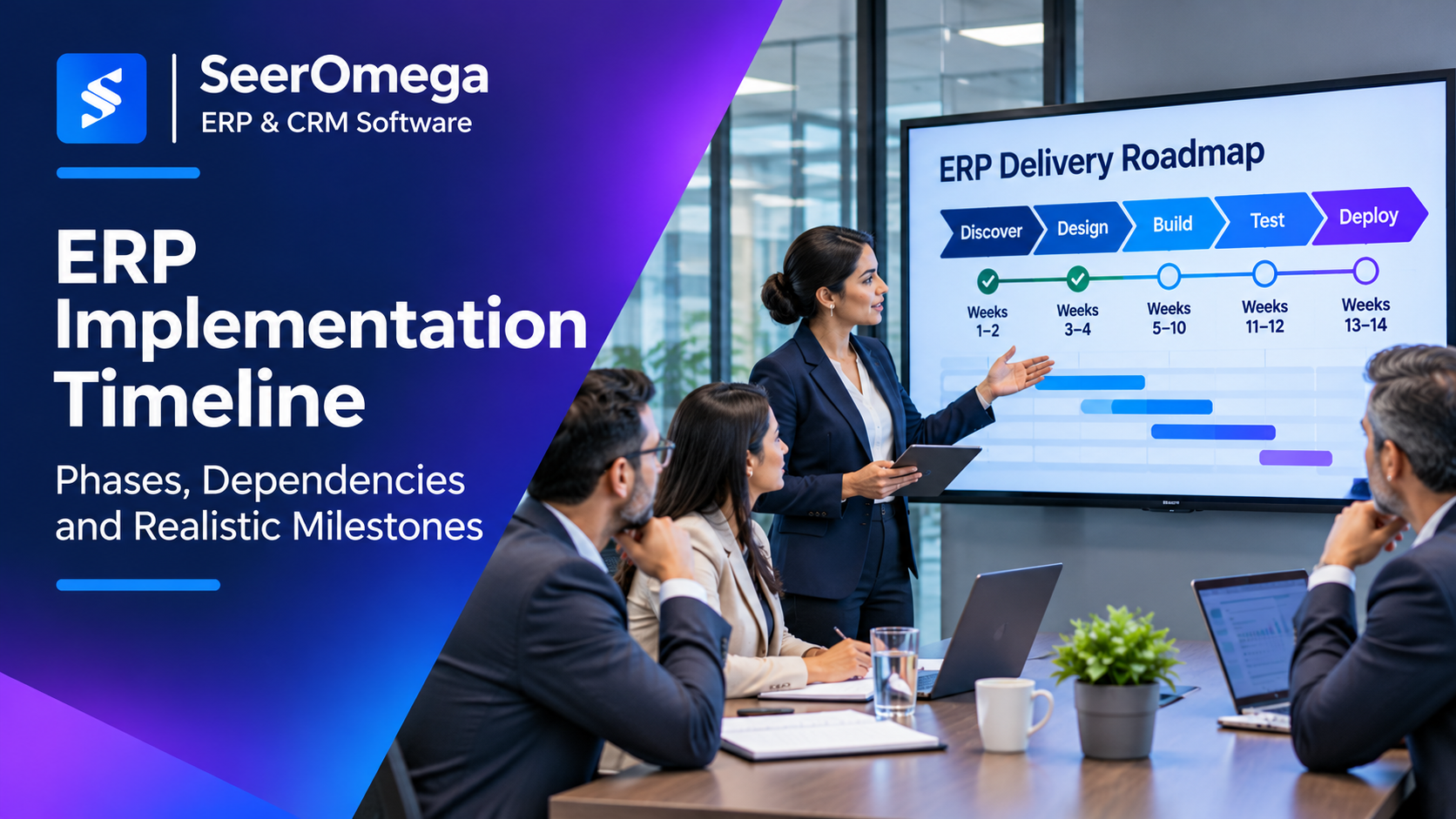
There is no reliable single number for how long an ERP implementation should take. A focused deployment with standard processes, clean data and a small number of integrations can move much faster than a multi-entity transformation involving complex manufacturing, finance, warehouses and legacy systems. The useful question is not “How many weeks does ERP take?” but “What scope, decisions, resources and evidence are required to reach a safe go-live?”
An ERP implementation timeline should be built from deliverables and dependencies, not copied from a vendor proposal. It needs to show what the business must complete, what the implementation partner will deliver, when decisions are due and which activities determine the critical path.
ERP implementation phases and typical outputs
ERP delivery methods use different phase names, and some workstreams run in parallel. A practical lifecycle usually includes the following stages:
| Phase | Core activities | Exit evidence |
|---|---|---|
| 1. Discovery and mobilisation | Business objectives, scope, stakeholders, current processes, risks, project governance and plan | Approved scope, business case, project team and baseline plan |
| 2. Process and solution design | Future-state workflows, fit-gap analysis, architecture, data and integration design | Signed-off solution blueprint and prioritised gap decisions |
| 3. Configuration and development | Core setup, workflows, reports, roles, integrations and approved extensions | Configured solution ready for structured testing |
| 4. Data preparation and migration | Data profiling, cleansing, mapping, trial loads and reconciliation | Validated migration results and approved cutover approach |
| 5. Testing and business validation | Unit, system integration, user acceptance, security and performance testing | Business sign-off, acceptable defect position and tested processes |
| 6. Training and operational readiness | Role-based training, support preparation, cutover rehearsal and communications | Trained users, support ownership and go-live readiness approval |
| 7. Cutover and go-live | Final migration, transaction freeze, reconciliation, production switch and validation | Production system operating with active support coverage |
| 8. Hypercare and optimisation | Issue resolution, adoption monitoring, stabilisation and improvement backlog | Support transition and agreed exit criteria |
Microsoft’s process-focused implementation lifecycle uses business processes to connect scope, design, build, testing, cutover and ongoing operations. This is useful because it prevents the project plan from becoming a disconnected list of technical tasks.
What determines the length of an ERP project?
Timeline estimates are driven by the amount of work and the organisation’s ability to complete it. The largest variables are:
- Scope and operating model: number of entities, countries, sites, modules, business processes and deployment waves.
- Process complexity: specialised manufacturing, pricing, compliance, intercompany, approvals and exception handling.
- Data readiness: source-system quality, duplicate records, historical data requirements, ownership and reconciliation needs.
- Integrations: number of connected applications, interface complexity, API availability and third-party coordination.
- Customisation: extensions, custom reports and workflows that require design, build, testing and future maintenance.
- Decision speed: availability of business owners and the time needed to resolve design, scope and policy questions.
- Resource capacity: whether subject-matter experts can contribute alongside their normal operational responsibilities.
- Change and training: number of user groups, locations, languages and process changes that require adoption support.
Published timeline ranges can help with early planning, but they are not commitments. Rand Group’s ERP implementation timeline analysis illustrates how scope and delivery approach can create very different schedule ranges. Treat any benchmark as a starting hypothesis, then validate it against your own work breakdown and dependencies.
Build the schedule from workstreams and dependencies
Use an integrated plan with accountable owners for business process design, application configuration, integrations, data, reporting, security, testing, change management and cutover. Each workstream should define deliverables, predecessor tasks, effort estimates, decision dates and acceptance evidence.
Not all activities can happen in parallel. For example:
- Migration mapping depends on agreed data ownership and target design.
- End-to-end testing depends on stable integrations and representative test data.
- User acceptance depends on working business processes, trained testers and agreed scenarios.
- Cutover rehearsal depends on migration scripts, task ownership, downtime assumptions and recovery steps.
- Go-live approval depends on test outcomes, defect disposition, support readiness and business sign-off.
Show these relationships in the project schedule. A milestone date without its predecessor conditions is only a target, not a forecast.
Use milestone gates instead of calendar-only progress
Milestones should confirm that a deliverable is complete and accepted. Examples include scope baseline approved, solution design signed off, first integrated process demonstrated, migration rehearsal reconciled, UAT accepted, cutover rehearsed and operational support ready.
For each milestone, specify the evidence required, approver, planned date, forecast date and consequence if it slips. A design milestone should not be marked complete because workshops have ended; it should require documented decisions and process-owner approval. Similarly, a testing milestone should reflect passed scenarios and resolved or accepted defects, not simply the number of test scripts executed.
Plan for the critical path and decision latency
The critical path is the chain of dependent activities that determines the earliest possible completion date. It may include a third-party integration, a regulatory decision, a data conversion, a specialised extension or a business sign-off. Identify these items early and review them more frequently than low-risk tasks.
Decision latency is a common hidden schedule risk. If process owners take several weeks to resolve an approval rule or data definition, downstream configuration and testing may stall. Create a decision log with a responsible decision-maker, due date, required input and escalation route. This is one reason project governance and delivery planning must operate together.
Include time for data migration and testing
Data migration is not a single weekend task. It includes source profiling, cleansing, mapping, transformation rules, trial conversions, validation, reconciliation and sign-off. The number of trial cycles depends on source quality, data volume and business risk. Schedule time for business users to review converted data rather than assuming technical completion equals data acceptance.
Testing also needs realistic duration. Include unit testing, integration testing, end-to-end process testing, user acceptance, security testing and performance testing where relevant. Allow time to fix defects and repeat affected scenarios. If the plan contains only one testing pass, it probably understates the work.
Use a phased rollout when it reduces risk
A phased rollout can separate entities, locations, modules or business capabilities into controlled releases. It may reduce the scale of each cutover and allow lessons from an early deployment to improve later waves. However, it can also increase the duration of coexistence, integration complexity, reporting effort and temporary operating costs.
Choose a phased approach when there is a clear business or risk reason, such as different readiness levels or a need to validate a common template. Avoid splitting the programme solely to make the initial date appear shorter.
Build contingency into the forecast
Do not add an arbitrary percentage to every task and call the schedule realistic. Identify specific uncertainties: incomplete data, delayed decisions, vendor dependencies, resource availability, custom development, testing defects and business blackout periods. Estimate the likely impact and create explicit contingency around high-risk activities.
Maintain a baseline schedule and a current forecast. Report variance honestly, explain the cause, identify the recovery action and show whether the action changes scope, cost, resources or risk. Do not compress testing or training automatically to recover a missed date; that may transfer schedule pressure into production disruption.
Questions to ask an ERP implementation partner
- What assumptions underpin the proposed duration and what is explicitly excluded?
- Which customer roles must be available, and at what level of effort?
- What are the critical-path dependencies and how are they managed?
- How many data migration rehearsals and testing cycles are included?
- What evidence is required to pass each milestone or stage gate?
- How are change requests assessed for schedule and cost impact?
- What happens when a customer decision or third-party dependency is late?
- How much time is planned for training, cutover rehearsal and hypercare?
Compare the proposed schedule with the scope, deliverables and acceptance conditions in the implementation statement of work. Our guide to ERP implementation challenges covers common delivery risks that can affect the plan.
ERP implementation timeline checklist
- Scope, entities, sites, modules and rollout approach are defined.
- Business and technical workstreams have named owners.
- Dependencies and critical-path activities are visible.
- Data migration and testing include multiple planned cycles where needed.
- Milestones have evidence-based entry and exit criteria.
- Business decision dates and escalation routes are documented.
- Training, cutover rehearsal, support transition and hypercare are scheduled.
- Contingency reflects specific risks rather than arbitrary padding.
- Baseline and forecast dates are reported separately.
Final consideration
A credible ERP timeline is a delivery model, not a sales promise. It connects scope to resources, dependencies, decisions and acceptance evidence. Buyers should challenge schedules that omit data, testing, business participation or operational readiness. A realistic plan may take longer to approve, but it gives executives a more dependable basis for cost, resource and go-live decisions.
