

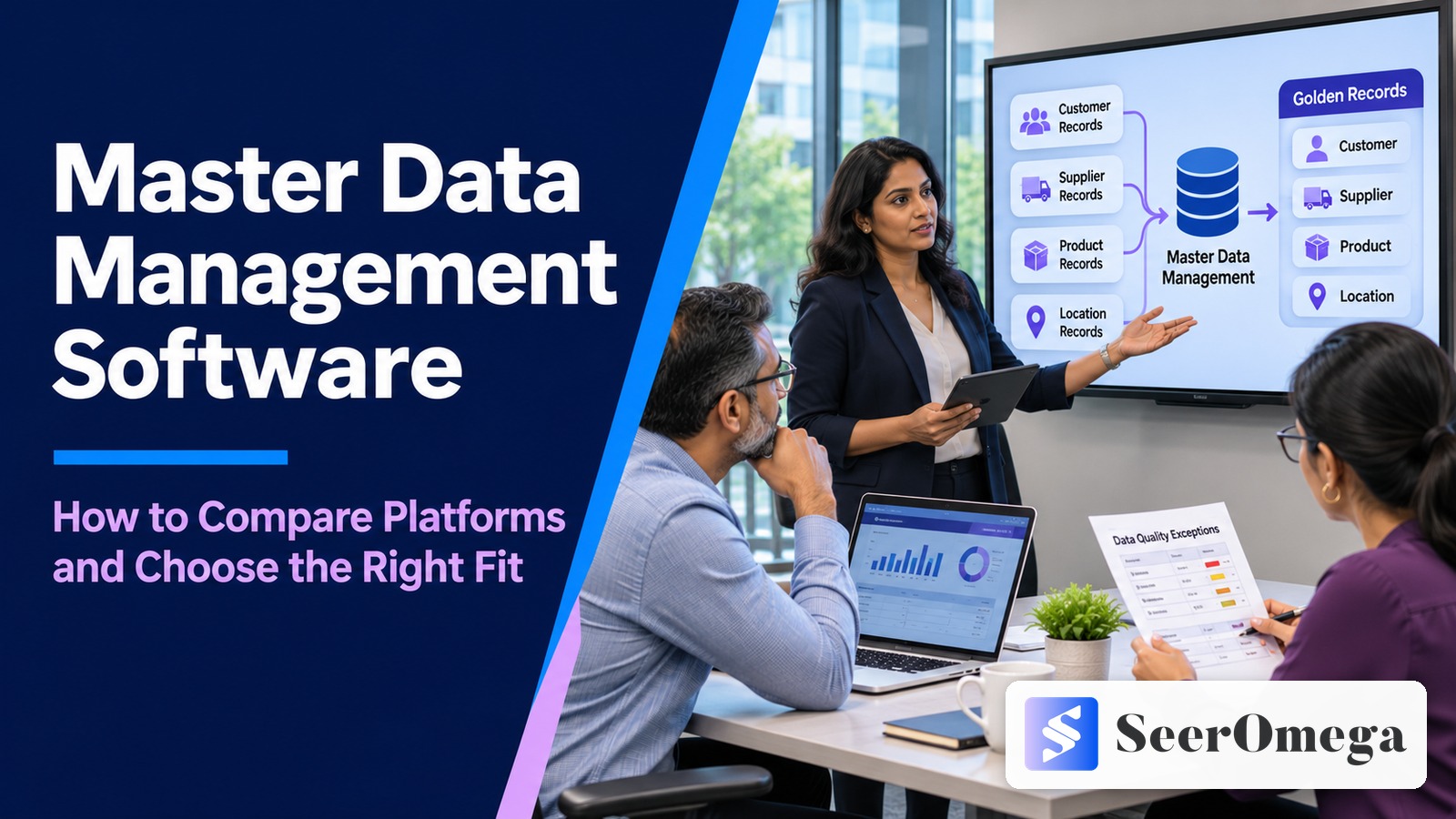
Customer, supplier and product records rarely live in one system. An ERP may hold supplier details, a CRM may contain customer accounts, ecommerce platforms maintain product attributes, and analytics teams create their own reconciled versions. When these records disagree, the consequences reach beyond reporting. Teams can onboard the wrong supplier, contact duplicate customers, publish inconsistent product information or make decisions using conflicting definitions.
Master data management (MDM) software helps organisations identify, govern and distribute trusted records for the entities shared across business processes. The right platform does more than find duplicates. It defines who owns each data domain, how records are matched and approved, where the authoritative version lives, and how approved changes reach the systems that depend on it.
This guide compares 15 MDM platforms and explains how to choose between them. It is written for data leaders, enterprise architects and IT decision-makers planning a new MDM programme or replacing an existing hub. The shortlist is not a ranking, and not every product is a direct substitute for every other product. Product descriptions reflect public vendor documentation reviewed in November 2026. Confirm current packaging, availability and licensing with vendors before procurement.
What should master data management software do?
MDM software creates and maintains governed records for core business entities such as customers, suppliers, products, locations, assets, employees and financial structures. It connects records from multiple systems, resolves duplicates and conflicting values, applies business rules, supports data stewardship and makes trusted records available to authorised users and applications.
A golden record is the governed representation of an entity created from one or more source records. It is not automatically the only copy of that entity, nor does it mean every connected application must surrender ownership of all fields. The MDM design must define the authoritative value for each attribute and the way changes are distributed.
Gartner’s description of the MDM solutions market highlights several core capabilities: data quality and cleansing, stewardship and governance, integration and synchronisation, golden-record creation, multidomain support and operational or analytical use cases. Those capabilities make a useful starting checklist, but the priority and implementation depth depend on your business requirements. See Gartner Peer Insights’ MDM market overview.
15 master data management platforms to evaluate
The following platforms represent different approaches to MDM. Some are broad multidomain hubs. Others are closely aligned with a particular enterprise ecosystem, product-data workflow or entity-resolution problem. The order is for navigation only, not a quality ranking.
| Platform | Potential fit | What to validate |
|---|---|---|
| Informatica MDM | Large multidomain programmes | Domain applications, modules, consumption and Salesforce alignment |
| Reltio | Cloud-first, connected entity data | SAP ownership, integration design and standalone commercial terms |
| Semarchy Data Platform | Multidomain data products | Deployment, certification workflows and data-product operations |
| Profisee | Microsoft-oriented data estates | Fabric architecture, deployment and product release status |
| Ataccama ONE MDM | Data-quality-led MDM | Data model, quality engine and governance responsibilities |
| Stibo Systems STEP | Product-heavy organisations | Product hierarchies, supplier onboarding and channel publishing |
| SAP Master Data Governance | SAP-centric operations | Exact S/4HANA edition, governance mode and release |
| IBM Master Data Management | Complex enterprise data estates | Deployment, matching, APIs and licensing entitlements |
| Oracle Cloud EDM | Financial and enterprise structures | Viewpoints, workflow, subscriptions and record limits by offer |
| Boomi Data Hub | Boomi-connected application landscapes | Domain scope, integration dependencies and stewardship model |
| Syndigo MDM | Product and commerce ecosystems | Product, supplier and location domains plus syndication |
| Tamr | Complex entity resolution | Matching outcomes and downstream governance capabilities |
| ON EBX | Model-driven multidomain governance | Data modelling, workflows, hierarchies and current ownership |
| Precisely EnterWorks | Multidomain and product information | Domain coverage, data quality and channel distribution |
| CluedIn | Microsoft-aligned data fabric and MDM | Azure architecture, graph model and stewardship controls |
1. Informatica MDM
Informatica MDM is suited to enterprises that need customer, product, supplier, finance or reference data managed across complex application estates. Its portfolio includes domain-focused 360 applications built on the wider Informatica data management platform. Evaluate how the required MDM capabilities fit with data integration, quality, governance and privacy services.
Informatica became part of Salesforce when the acquisition closed on 18 November 2025. Buyers should assess the current product roadmap, contractual entity, licensing and integration direction rather than relying on older ownership references.
2. Reltio
Reltio provides cloud-native multidomain MDM for connected views of customers, suppliers, products, locations and other entities. Its approach is relevant when matching and relationship context must support operational applications as well as analytics. Test how records are matched, how attribute survivorship is decided and how quickly trusted data is made available to downstream systems.
SAP completed its acquisition of Reltio on 7 May 2026. Reltio’s ownership and SAP’s broader data strategy are material procurement considerations, especially for organisations that also use SAP Business Data Cloud.
3. Semarchy Data Platform
Semarchy Data Platform combines MDM with data quality, stewardship and governed data-product delivery. Its published capabilities include semantic modelling, entity resolution, certification pipelines and interfaces for consuming trusted records. Semarchy documents SaaS and self-hosted deployment options, with cloud and container deployment choices. Confirm the current platform edition, supported architecture and operational responsibilities for the environment you intend to run.
4. Profisee
Profisee focuses on multidomain MDM, entity resolution, data quality and stewardship, with a strong Microsoft ecosystem orientation. Its Microsoft Fabric integration is relevant to organisations building a data platform around Fabric and Purview. Profisee announced Profisee Anywhere for Microsoft Fabric on 18 November 2026 and said general availability was planned for December 2026. As of 26 November 2026, treat that specific offer as planned, not generally available. Evaluate the existing generally available Profisee platform separately from roadmap announcements.
5. Ataccama ONE MDM
Ataccama ONE MDM combines master data management with an integrated data quality engine. Its documentation describes metadata-driven processing, cleansing, standardisation, matching, merging, stewardship and online or batch data delivery. It is worth evaluating when data quality and MDM need to operate as connected disciplines. Confirm the modules, architecture and deployment pattern required for your use case.
6. Stibo Systems STEP
Stibo Systems STEP has a strong product information and product master data orientation, with capabilities for managing and repurposing product information for publication or syndication. Retailers, manufacturers and distributors should test its handling of product hierarchies, attribute completeness, supplier contribution, approvals and channel distribution. Do not assume that a product-centric implementation automatically covers every customer or financial data requirement.
7. SAP Master Data Governance
SAP Master Data Governance supports central governance, consolidation, matching, change-request workflows and audit trails for business-critical data. It is a natural candidate when SAP S/4HANA is central to the business process and the organisation wants governance close to its SAP data models and application controls.
Check the exact product and deployment. SAP’s S/4HANA-based MDG options are not interchangeable with every SAP cloud MDM offer. SAP has also stated that the BTP-based SAP Master Data Governance, cloud edition is being discontinued, with renewals unavailable. Confirm the current product path and contract eligibility with SAP before designing around it.
8. IBM Master Data Management
IBM Master Data Management provides multidomain matching, relationship discovery, stewardship, APIs and deployment choices that include cloud, on-premises and hybrid environments. It may suit enterprises with complex entity relationships or existing IBM data platform investments. IBM’s current product pages and documentation should be used to distinguish the current IBM MDM service from older InfoSphere or Match 360 references.
9. Oracle Cloud Enterprise Data Management
Oracle Fusion Cloud Enterprise Data Management manages and governs changes to master data, reference data and metadata across enterprise viewpoints. Its request-based workflows, subscriptions and hierarchy mapping are particularly relevant to financial and enterprise structures. It is not a direct substitute for every customer or product MDM hub. Confirm the exact Oracle service, subscription and record limits that apply to your intended scope.
10. Boomi Data Hub
Boomi Data Hub is a cloud-based master data synchronisation service that helps keep selected data domains consistent across SaaS, on-premises and hybrid systems. Its relationship with Boomi Integration is important: organisations already using Boomi may find the combined architecture relevant. Buyers should test data modelling, golden-record workflows, quarantine handling, stewardship and how updates are synchronised to consuming applications.
11. Syndigo MDM
Syndigo combines multidomain MDM with product experience management capabilities. Its current Synapse platform is described by the vendor as built on a multidomain MDM foundation and extends across product, supplier, location, compliance and performance data. It is relevant to consumer goods, retail and commerce organisations that need governed product content and trading-partner distribution. Validate which functions are included in the package being proposed.
12. Tamr
Tamr focuses on AI-assisted entity resolution and the creation of trusted records from fragmented datasets. It may be appropriate when identifying and linking entities across inconsistent source data is the primary challenge. Matching is only one part of an MDM operating model, so test how resolved entities are governed, corrected, assigned persistent identifiers and delivered to systems that need to use them.
13. ON EBX
ON EBX, part of Cloud Software Group, is a model-driven multidomain platform for managing master data, reference data, hierarchies, metadata and data products. It is worth evaluating when business structures are complex and the organisation needs configurable data models, workflows, version control and role-based governance. Confirm current product ownership, version, support terms and deployment requirements during due diligence.
14. Precisely EnterWorks
Precisely EnterWorks is a multidomain MDM and product information management platform. Precisely describes capabilities for centralising master data across product, customer, supplier and location domains, with data quality, workflows and syndication to channels and partners. It may suit organisations where product information and broader enterprise data need to be governed together. Ask for a demonstration using the actual domains and distribution targets in scope.
15. CluedIn
CluedIn’s MDM integration with Microsoft Purview is documented by Microsoft as an approach to data ingestion, preparation, matching, cleaning, governance and distribution. The architecture uses graph-based relationships and connects with Microsoft data services. It is relevant to Microsoft-oriented organisations that want MDM capabilities integrated with Purview and Azure services. Validate the supported architecture, stewardship experience, data residency and operational ownership for your deployment.
How to choose the right MDM platform
Start with the business problem and data domains, not a vendor feature checklist. A platform that excels at product information may be the wrong choice for customer identity resolution. A solution that fits an SAP-centred operating model may introduce unnecessary complexity in a Microsoft-first estate.
1. Define the data domains and system boundaries
List the entities to be mastered, the applications that create them, the teams that own them and the systems that consume them. Identify which attributes need to be governed centrally and which remain owned by source applications. Start with one domain if that is sufficient to prove value, but document dependencies on other domains.
2. Select the MDM implementation style
| Style | How it works | When it may fit |
|---|---|---|
| Registry | Links identities across source systems while source records remain in place | When systems cannot be changed and a unified index is needed |
| Consolidation | Collects source data into a central view for reporting or downstream use | When analytics and consistent reporting are the initial priority |
| Coexistence | Maintains a hub and synchronises approved changes with connected systems | When both central governance and operational updates are required |
| Centralised | Uses the hub as the primary point for creating and maintaining master records | When the organisation can change creation processes and source ownership |
Many organisations use a hybrid approach across domains. Decide whether the design needs to evolve over time and ask vendors to explain what changes when a domain moves from registry or consolidation toward coexistence or centralised governance.
3. Test matching, merging and survivorship with real records
Do not rely on a clean vendor demonstration dataset. Use representative records containing misspellings, incomplete addresses, changed company names, duplicate identifiers, shared locations and legitimate near-duplicates. Ask the vendor to show why two records matched, which attributes survived, how confidence thresholds work and how a steward can reverse an incorrect merge.
Check deterministic and probabilistic matching, hierarchy resolution, persistent identifiers, source trust, exception queues and audit history. A high match rate is not useful if false positives merge distinct entities or if stewards cannot explain the result.
4. Evaluate governance and stewardship as daily work
Identify the people who will own each domain and resolve data issues. Assess role-based permissions, approval workflows, change history, attribute-level ownership, policy enforcement, lineage and escalation. Measure how much work a steward must perform for a typical new record, duplicate review, correction and bulk change. Governance that exists only in a policy document will not keep the hub reliable.
5. Map integrations and data distribution
Document source and target systems, APIs, batch schedules, event streams, latency requirements, error handling and retry behaviour. Determine whether the platform publishes full records, changed attributes or references, and how it handles downstream failures. If application integration is a major part of the project, compare the design with your wider iPaaS architecture.
6. Confirm security, deployment and operating responsibilities
Compare SaaS, self-managed cloud, hybrid and on-premises options where available. Verify identity integration, role design, encryption, data residency, audit logging, backup, recovery, retention and segregation of duties. Establish who maintains connectors, data models, rules, environments, upgrades and production support. Check the vendor’s security documentation and contractual commitments for the exact edition being evaluated.
7. Calculate total cost of ownership
MDM pricing is often quote-based and may depend on domains, record volumes, environments, modules, connectors, API usage, deployment, support and consumption. Include implementation services, data remediation, migration, training and the ongoing cost of stewardship. Request a written bill of materials and a three-year cost model based on your expected data volumes, integrations and growth. Do not compare a subscription quote with another vendor’s estimate unless the scope is equivalent.
Questions to ask vendors during a proof of value
- Can you demonstrate our highest-priority data domain using representative records from our systems?
- How does the platform explain a match, merge and survivorship decision?
- Can a steward reverse a merge and see the original source values and audit history?
- Which domains and implementation styles are supported natively in the proposed edition?
- Which features require separate licences, add-ons, professional services or partner products?
- How are mastered records synchronised with ERP, CRM, ecommerce and analytics systems?
- What happens when a downstream application is unavailable or rejects a record?
- How are data ownership, attribute-level permissions and approval workflows configured?
- What deployment regions, data residency options and recovery commitments apply?
- What is the full three-year cost, including implementation and ongoing administration?
Agree acceptance criteria before the proof of value starts. Examples include match precision on a labelled test set, steward review effort, time to publish approved changes, data freshness and the proportion of records that pass agreed validation rules. These are project-specific measures, not universal vendor benchmarks.
Common MDM implementation mistakes
- Choosing software before defining ownership: unclear data owners create approval delays and unresolved conflicts.
- Starting with too many domains: a broad rollout can multiply modelling and integration dependencies before the operating model is proven.
- Ignoring source quality: poor identifiers and inconsistent standards can undermine matching and survivorship.
- Using a golden record as a substitute for governance: a trusted record needs ongoing ownership, policy and exception handling.
- Leaving downstream systems out of scope: the hub creates limited operational value if consuming applications do not use its data.
- Confusing MDM with adjacent categories: data quality, governance, PIM, CDP and integration can complement MDM, but they do not all solve the same problem.
- Assuming product names or packaging are static: confirm current ownership, product editions, release status and licensing before signing.
Frequently asked questions
What is master data management software?
Master data management software helps an organisation create, maintain, govern and distribute trusted records for shared business entities such as customers, suppliers, products, employees and locations. It commonly includes data modelling, matching, quality rules, stewardship workflows and integration with source and consuming systems.
What is the difference between MDM and data governance?
Data governance defines policies, decision rights, accountability and controls for data. MDM applies those rules to the creation, matching, maintenance and distribution of core business records. MDM is one operational capability within a broader data governance programme.
Is MDM the same as product information management?
No. Product information management (PIM) focuses on enriching and distributing product content for channels such as ecommerce, retail and catalogues. MDM has a broader remit that can include customers, suppliers, locations, employees and financial reference data. Some platforms combine PIM and MDM capabilities.
How much does MDM software cost?
Costs depend on data volumes, domains, modules, deployment, integrations, environments, support and implementation scope. Many enterprise vendors provide custom quotes. Request a scoped proposal and include data remediation, implementation and ongoing stewardship in the total cost calculation.
Can a company implement MDM without replacing its ERP or CRM?
Yes. MDM often operates as a separate hub or governance layer connected to existing ERP, CRM, ecommerce, data warehouse and operational systems. The architecture must define which system owns each attribute and how approved changes are synchronised.
How long does an MDM implementation take?
There is no universal timeline. A focused domain with prepared data and clear ownership may be delivered more quickly than a multi-country, multidomain programme involving legacy systems, complex matching and extensive governance. Scope a phased proof of value using representative data and explicit acceptance criteria.
Final recommendation
There is no universally best master data management platform. The right choice is the one that fits your data domains, matching requirements, stewardship model, integration architecture, security obligations and operating capacity. Informatica, Reltio, Semarchy, Profisee, Ataccama, Stibo Systems, SAP and IBM are candidates for broad enterprise requirements. Oracle Cloud EDM, Boomi, Syndigo, Tamr, ON EBX, Precisely EnterWorks and CluedIn address more specific architecture or domain needs that should be tested against the intended use case.
Shortlist platforms against the same requirements, then run a proof of value with real records, real exceptions and a defined distribution workflow. The quality of the operating model and the ability to maintain trusted data matter more than the length of a feature checklist.
For related context, see SeerOmega’s guides to data quality for AI, data warehouses and iPaaS platforms.
Editorial note: Product descriptions are based on official vendor documentation and public product materials reviewed in November 2026. Capabilities, ownership, packaging, availability and commercial terms can change. Confirm current details directly with each vendor before purchasing.
