
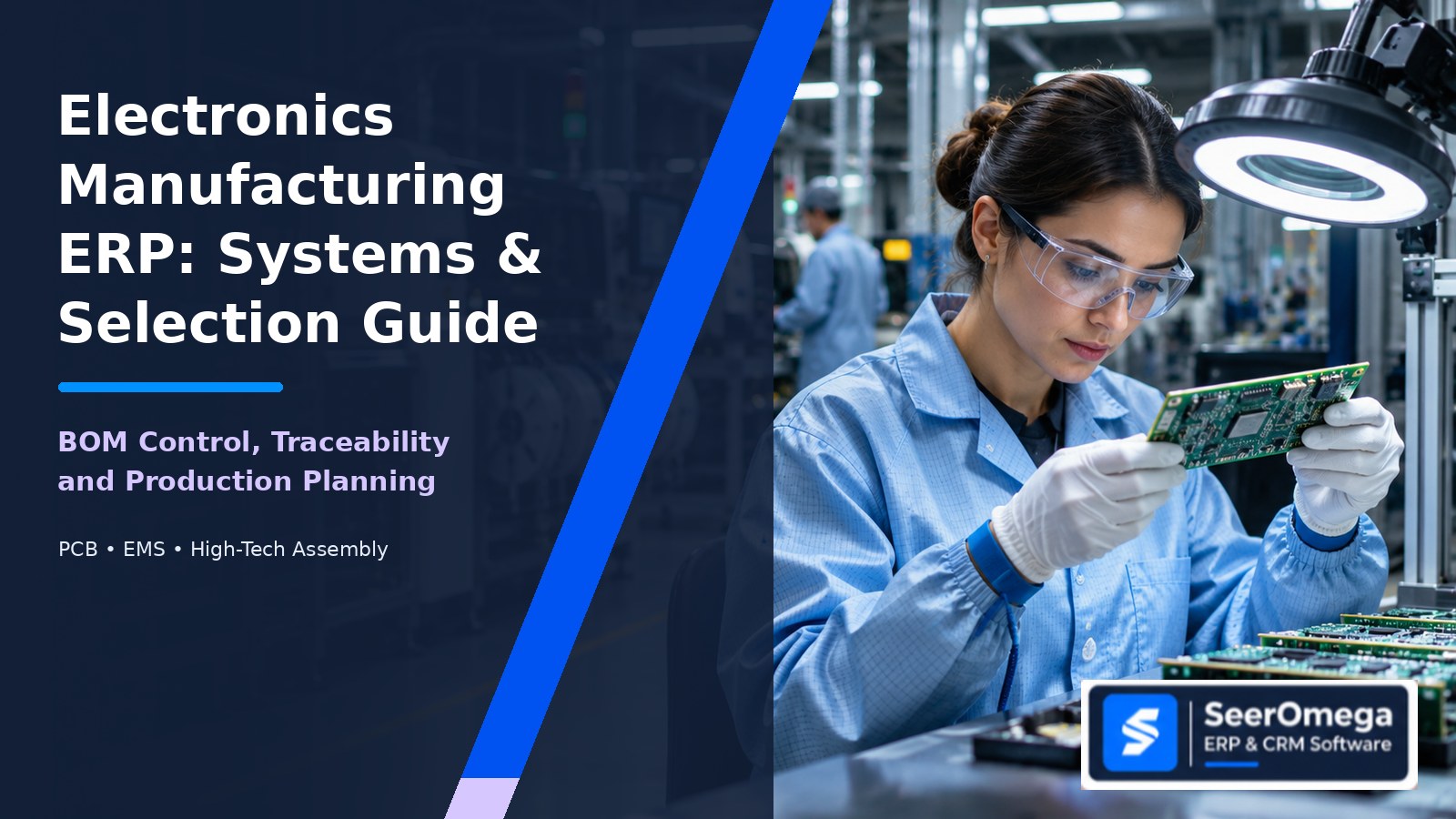
Electronics manufacturers can lose control of production long before a finished product reaches test. A component becomes obsolete, an approved alternate is substituted, an engineering change updates the bill of materials (BOM), or a supplier ships a different date code. If engineering, purchasing, stores and production are working from different revisions, the factory may build the wrong configuration—or struggle to prove which components went into a shipped unit.
Electronics manufacturing ERP must connect engineering data with procurement, component inventory, production execution, quality and finished-goods traceability. The requirements are especially demanding for PCB assembly, electronics manufacturing services (EMS), contract manufacturers, original equipment manufacturers (OEMs) and high-tech businesses with frequent product revisions or long-lead components.
In brief: shortlist systems by testing multi-level BOM and revision control, approved component alternates, reel/lot/date-code traceability, material planning, subcontract or customer-owned inventory, production and test records, returns and warranty workflows. A generic manufacturing ERP may cover some of these areas, but the buyer must verify the complete electronics workflow in the proposed product configuration.
Why electronics manufacturing needs a more specific ERP evaluation
Electronics operations combine product complexity with supply-chain volatility. A single assembly may contain hundreds or thousands of components, each with its own manufacturer part number, approved supplier, lead time, lifecycle status, lot or date code and storage requirements. A small component shortage can stop a production order even when the total inventory value appears healthy.
The operating model also varies. A PCB assembly business may run surface-mount technology (SMT), through-hole assembly, inspection and test. An EMS provider may build to customer-owned BOMs and hold consigned components. An electronics OEM may own the design, purchase components, outsource assembly and manage finished-product warranties. A distributor may need serial and lot traceability but not production planning.
These are not interchangeable requirements. Define whether the business is an EMS/contract manufacturer, an OEM, a component assembler, a high-tech equipment maker or a distributor before comparing products.
Eight ERP capabilities to test for electronics manufacturers
1. Multi-level BOMs, revisions and engineering change control
The BOM should represent the approved product structure, including assemblies, subassemblies, component quantities, alternates and relevant effectivity. Buyers should test how engineering change requests are reviewed, approved and released, how the effective date or work-order boundary is applied, and how production is prevented from using an obsolete revision.
Ask the vendor to demonstrate a change to a component on an active product. Which open work orders are affected? Can purchasing see the new requirement? Can the system identify finished units built before and after the change? Can a user retrieve the exact BOM revision used for a specific serial number?
Where CAD, ECAD, PLM or product data management software owns the engineering definition, clarify which system is authoritative and how approved BOMs and revisions are transferred to ERP. Avoid creating a manual re-entry process that makes purchasing and production dependent on email attachments.
2. Approved manufacturer lists and component alternates
Electronics procurement often needs more than a supplier field. The business may need to control manufacturer part numbers, approved manufacturer lists (AMLs), approved vendor lists, alternate components, qualification status and customer-specific restrictions.
Test how an alternate is approved and whether the approval is linked to the relevant product revision, customer or engineering change. The planning engine should not treat every technically similar part as an acceptable substitute. Buyers should be able to distinguish an approved alternate from an unapproved replacement suggested because the preferred component is unavailable.
3. Reel, lot, date-code and serial-level traceability
Component traceability is a core selection criterion. A buyer may need to know which reel or supplier lot was issued to a production order, which finished serial numbers consumed it, and which customer received each unit. The reverse query should also work: starting with a finished serial number, retrieve the component lots, work order, BOM revision and inspection/test history associated with the build.
Do not accept a demonstration that only records a lot number at goods receipt. Follow the material through receiving, inspection, storage, kitting, line issue, consumption, production completion, shipment and return. Include partial reels, split lots, unused material returned to stores, substitutions and rework.
4. Material planning for long-lead and constrained components
Traditional MRP calculations are only useful when item masters and supply assumptions are credible. Electronics manufacturers should test manufacturer and supplier lead times, minimum order quantities, order multiples, safety stock, allocation, open purchase orders, component lifecycle status and demand changes.
Ask the system to calculate shortages for a real production schedule. Can planners see which customer orders are affected, which components are constrained and whether an approved alternate exists? Can the business identify excess or obsolete inventory when a design revision reduces demand for a component?
Planning should also distinguish stock that is physically present from stock that is usable. Material on quality hold, allocated to another customer, expired under a relevant control, or held as customer-owned inventory should not be treated as freely available without the appropriate rules.
5. EMS, subcontracting and customer-owned material
Contract manufacturers may hold customer-owned components, consigned stock or materials supplied for a specific job. ERP should preserve ownership and accountability as materials move through receiving, storage, kitting, production, subcontract operations and finished-goods dispatch.
Demonstrate how the system records customer-supplied components separately from company-owned inventory, reconciles consumption and scrap, and reports unused balances. For outsourced processes, test the movement of material to a subcontractor, expected returns, processing charges, inspection and the cost roll-up to the finished assembly.
6. Production execution, work-in-progress and test records
ERP should connect production orders with routings, work centres, material issue, labour or machine reporting and completion. Depending on the plant, detailed execution may belong in a manufacturing execution system (MES) rather than ERP. The important point is to define the boundary and prove that the data needed for planning, costing, quality and traceability flows between systems.
For PCB and electronic assembly, test the required production stages: kitting, SMT or through-hole assembly, inspection, programming, functional test, rework, final assembly and pack-out. Determine whether automated test equipment, inspection systems or shop-floor devices can send results to MES or ERP, and whether the interface is standard, partner-delivered or custom development.
7. Quality, nonconformance, RMA and warranty
Evaluate incoming inspection, in-process checks, final test, nonconformance handling, supplier corrective action, rework and disposition. A rejected component should be placed under the appropriate control, and the record should show the decision and its impact on available material.
After shipment, serial-level records can support returns and warranty investigations. Test whether a returned unit can be linked to its original work order, component lots, test results, revision and customer. Ask how repair, replacement, failure analysis and supplier claims are handled. Do not assume that every ERP includes a full eQMS or service-management function.
8. Compliance documentation and product costing
Depending on product and customer requirements, manufacturers may need to retain supplier declarations, material compliance documents, inspection evidence, test records and controlled work instructions. Establish which system stores each document, who approves it, how revisions are controlled and how records are retrieved.
Costing should reflect the real manufacturing model: component purchase cost, landed cost, scrap, yield loss, labour, subcontracting, rework and overhead. For EMS providers, profitability may need to be analysed by customer, product, work order and conversion service—not only by finished-goods SKU.
Electronics manufacturing ERP platforms to evaluate
The following shortlist is based on publicly available product and industry documentation. It is not a ranked product test, and a vendor’s industry positioning is not proof that a particular module or integration is included in your quote. Confirm the proposed edition, licensing, implementation scope and current availability directly with the provider.
Epicor Kinetic
Epicor publishes a Kinetic brochure specifically for electronics and high-tech manufacturers. Its stated focus includes engineering change orders, demand planning, forecasting, advanced scheduling, manufacturing execution systems and multi-site capabilities.
Consider it when: you want to evaluate a manufacturing ERP with an explicit electronics/high-tech industry proposition and need to connect planning, engineering changes and production execution.
Validate: the exact electronics functions in the proposed release, component-level traceability, customer-owned or consigned material, test-system integration, RMA workflows and the scope of any industry-specific extensions. Epicor Kinetic for Electronics and High-Tech Manufacturers.
Infor CloudSuite Industrial and Infor XA
Infor’s electronics and electrical manufacturing materials describe support for different production modes, BOMs and routings, engineering change management, component/material management, lot and serial traceability, job costing, production scheduling and component alternates. Infor XA is positioned for discrete manufacturers and lists engineer-to-order, contract manufacturing, configure-to-order, make-to-order and make-to-stock environments.
Consider it when: the operation has complex discrete manufacturing, multiple production modes, engineering changes or high-volume assembly requirements.
Validate: which Infor product is proposed, the deployment and support model, how electronics-specific component and date-code controls are configured, and whether MES, PLM, quality or supplier functions are included or separately licensed. Infor: ERP for Electronics Manufacturing and Infor XA.
QAD Adaptive ERP
QAD positions Adaptive ERP for industrial manufacturing and describes a broader manufacturing and supply-chain portfolio that includes production planning, supplier performance, quality, inventory and traceability. Its industrial manufacturing proposition is relevant to manufacturers with evolving processes and complex supply chains, although buyers should verify the electronics-specific fit rather than infer it from general industrial coverage.
Consider it when: the business needs a configurable manufacturing and supply-chain platform and wants to evaluate QAD’s capabilities across planning, supplier management, production and quality.
Validate: electronics BOM revision handling, approved component alternates, reel/date-code traceability, EMS/customer-owned stock and test-data integration in the exact proposed solution. QAD: Industrial Manufacturing.
Visibility ERP
Visibility ERP publishes an electronics and high-tech industry solution. Its stated functionality includes multi-level BOMs, CAD/EPDM integration, available-to-promise, Kanban, serial and warranty tracking, and support for regulatory and industry standards. The product also lists engineering change control, part and BOM management, inventory, quality and shop-floor functions across its wider ERP suite.
Consider it when: you are evaluating a manufacturing-focused ERP with an explicit electronics/high-tech solution and need engineering, planning and shop-floor capabilities in the same evaluation.
Validate: the depth of component-level lot/date-code genealogy, approved alternates, customer-owned material, test data capture, integrations and the scope of the relevant modules. Visibility ERP: Electronics and High Tech.
Microsoft Dynamics 365 Supply Chain Management
Dynamics 365 Supply Chain Management is a broad enterprise option rather than an electronics-only product. Microsoft’s documentation describes engineering change management for versioned products, BOMs, routes and controlled change orders. The platform may be relevant to electronics manufacturers that need wider enterprise supply-chain, manufacturing and finance integration.
Consider it when: the business has broader enterprise requirements, an established Microsoft application estate or a need to connect engineering changes with manufacturing and supply-chain processes.
Validate: the specific product and module scope, the transaction-level version traceability needed, the integration with ECAD/PLM and MES, and the component-level tracking required for reels, lots and date codes. Microsoft’s documentation notes that tracking engineering versions in transactions has additional inventory and planning implications, so design this deliberately. Microsoft Learn: Manage Changes to Engineering Products and Engineering Change Management FAQ.
Comparison: where to focus your evaluation
| Platform | Published evaluation angle | Proof to request in a demo |
|---|---|---|
| Epicor Kinetic | Electronics/high-tech manufacturing proposition | Engineering changes, planning, MES and serial/lot traceability |
| Infor CloudSuite / XA | Electronics and discrete manufacturing across multiple production modes | BOM/routing control, alternates, genealogy, scheduling and job costing |
| QAD Adaptive ERP | Industrial manufacturing, supply chain, supplier and production processes | Electronics-specific component controls and integrations |
| Visibility ERP | Electronics/high-tech functionality and engineering/operations integration | Component-level traceability, ECAD/EPDM and shop-floor execution |
| Dynamics 365 Supply Chain Management | Enterprise supply chain and engineering change management | Version effectivity, BOM governance and integration architecture |
This is a shortlist for further evaluation, not a recommendation that all products provide equivalent electronics functionality. The winning system is the one that can demonstrate your actual process with the least operational risk and an acceptable total cost of ownership.
A practical electronics ERP demo scenario
Do not let vendors demonstrate only a clean production order with no exceptions. Prepare one realistic scenario and ask each shortlisted provider to run it in the proposed system configuration:
- Create or release a product revision. Show the approved multi-level BOM, manufacturer part numbers, alternates and effective date. Confirm how the prior revision is controlled.
- Receive a constrained component. Capture supplier, manufacturer part number, lot/date code or reel identity, inspection status and ownership. Show how nonconforming material is blocked.
- Plan a production order. Include a long-lead component shortage, a minimum order quantity and a permitted alternate. Show the planning exception and approval path.
- Issue material to production. Record which component lots or reels are consumed by the work order. Include a partial reel return and any scrap or rework.
- Record assembly and test. Demonstrate routing, work-in-progress, inspection and test results, including the source of any imported machine or test-station data.
- Complete and ship serialized units. Link each finished serial number to its BOM revision, consumed component lots and test records.
- Process a customer return. Retrieve the original build record, identify affected components and record the repair, replacement or warranty decision.
- Report cost and margin. Reconcile material, labour, scrap, subcontracting and rework against the order or customer programme.
Score each step on standard functionality, configuration effort, third-party dependencies, manual workarounds, evidence quality and user effort. Ask the implementation partner to identify every item that requires custom development or a separate application.
Questions to ask before selecting an electronics ERP partner
- Which electronics manufacturers or EMS businesses with a similar production model have you implemented for? What was your actual role?
- Can you demonstrate component-level genealogy from supplier reel or lot through finished serial number and customer shipment?
- How are engineering changes approved, made effective and communicated to purchasing and production?
- How are approved alternates and customer-specific component restrictions controlled?
- Can customer-owned and consigned components be separated from company-owned stock and reconciled by job?
- Which integrations are standard for ECAD/PLM, MES, AOI, ICT, functional test, barcode scanning and label printing?
- How are obsolete components, excess inventory, substitutions and supplier lead-time changes managed?
- What is included in implementation, data migration, integration, training, validation, support and future upgrades?
Common mistakes when selecting ERP for electronics
- Choosing a general manufacturing system without a traceability test: inventory by item is not the same as genealogy by reel, lot, date code and finished serial.
- Treating engineering changes as document storage: the released revision must govern purchasing, planning and production transactions.
- Assuming MRP understands component risk automatically: planners need accurate lead times, approved alternates, lifecycle data, allocations and supplier information.
- Ignoring customer-owned stock: EMS businesses can create serious reconciliation problems if ownership and consumption are not visible.
- Underestimating integrations: ECAD/PLM, MES, test equipment, quality and warehouse systems can materially affect cost and implementation risk.
- Comparing subscription prices only: include implementation, data cleansing, integrations, shop-floor hardware, extensions, support and internal project effort in the TCO model.
Final recommendation
Start with the production model and the evidence you need to retrieve—not with a generic list of ERP features. For PCB assembly and EMS, component genealogy, customer-owned inventory, production/test records and RMA workflows may be decisive. For an electronics OEM, engineering change control, supplier alternates, lifecycle planning and serial-level warranty history may carry more weight. For a high-tech equipment maker, project costing, configuration and after-sales service may also be central.
Epicor Kinetic, Infor, QAD, Visibility ERP and Microsoft Dynamics 365 Supply Chain Management are reasonable candidates to investigate based on their published manufacturing propositions. Their suitability depends on the exact product scope and implementation design. Require each vendor and partner to demonstrate the same component-to-customer scenario, document gaps and dependencies, and compare the three-to-five-year cost of operating the complete solution.
For broader manufacturing software context, see SeerOmega’s manufacturing ERP comparison. For related partner due diligence, use the ERP partner evaluation framework.
Editorial note: This guide is based on publicly available vendor documentation reviewed in November 2026. SeerOmega has not independently tested the listed products. Features, modules, deployment options and commercial terms can change; confirm current scope with vendors and implementation partners before making a purchase decision.
